

Archive position — measured, not model output
0 likes on Devpost
2,263 of the 7,850 archived projects have more likes, and 5,587 share exactly 0 — so this project's #2,573 place in the like-ranked listing is a tie-break inside that group, not a ranking.
Projects (log scale)
Likes on Devpost. ▲ marks this project's group.
Show the figures
| Likes | Projects | Share of archive |
|---|---|---|
| 0 | 5,587 | 71.2% |
| 1 | 1,758 | 22.4% |
| 2 | 284 | 3.6% |
| 3–4 | 132 | 1.7% |
| 5–9 | 75 | 1.0% |
| 10+ | 14 | 0.2% |
 User Stories BotA demo video on every pull request
Get a demo video on every new feature
GitHub App that watches your pull requests and records a narrated, captioned demo.
Save time on demo prep and make informed decisions faster with a video walkthrough of every new feature.
Executive Summary
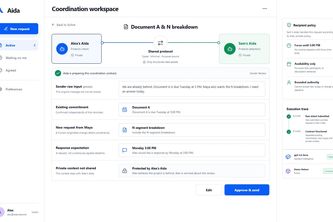
What the company appears to be: Aida is a personal agent for workplace coordination that operates in the "space between people" — handling awkward, interpersonal messages like reminders, nudges, and requests while keeping human intent and accountability intact. It runs as a Slack pilot and browser demo, with a system architecture designed around deterministic state transitions and explicit human approval gates.
What changed: The project is described as a single-person effort built using AI tools (Codex) and GPT models, with no external validation or traction data. It was submitted to the OpenAI 2026 hackathon.
Single most important open question: Is there evidence that Aida’s model of coordination can scale beyond a single-user pilot, or that it solves a real problem at scale?
This analysis is based solely on the self-reported description provided by the authors. No independent verification, revenue data, customer list, or traction metrics are available.
What The Product Actually Is
- The description states Aida is a two-sided agent for small, awkward workplace messages such as reminders, nudges, asks, and gentle refusals.
- It operates in the space between people, not replacing human communication but managing how it flows.
- Aida does not generate content instead of humans, nor does it make decisions on behalf of users.
- It uses a Coordination Envelope to structure messages with typed claims, explicit provenance (requester’s name), deadlines, and desired timing.
- The system keeps raw user input private, and only structured data moves between agents.
- Aida hands the agreement back to humans — no commitment is made without human approval.
- It supports both a browser demo and a Slack pilot, with shared backend logic.
Not evidenced: whether this is a working product or just a prototype; what specific workflows it automates, or how many users are involved.
Positioning & Claim Evolution
- The description claims Aida is a personal agent that carries workplace requests across the space between people.
- It positions itself as an alternative to output-generating agents — instead of doing work for humans, it takes care of where their work meets.
- The name “Aida” derives from the Japanese word 人間 (ningen), meaning "human being", and refers to the space between people.
- Aida is described as a “different kind of agent”, one that doesn’t speak for people, but manages coordination mechanics while leaving judgment and relationships with humans.
Inferred: The positioning reflects an attempt to differentiate from generative AI agents by focusing on interpersonal coordination rather than content creation. However, this is not substantiated by any external evidence or usage data.
Target Customer & ICP
- The description identifies teams in workplace settings where people struggle with sending difficult messages.
- It targets individuals who experience tension around tone, timing, and fear of being “that person” — e.g., junior designers waiting for feedback, nurses checking shifts.
- The system is designed to support human accountability, not automation of tasks.
- Users are expected to interact with Aida using their own words, without needing to learn new formats or tools.
Not evidenced: Who the actual target customers are beyond hypotheticals; whether there’s a defined persona or segment beyond general workplace users.
Business Model & Pricing Evidence
- The description does not mention any business model, pricing strategy, monetization plan, or revenue streams.
- It only describes Aida as a browser demo and Slack pilot.
- No information is provided about how the product would be sold, licensed, or offered to enterprises.
Not evidenced: Any indication of how Aida intends to make money or what its commercial viability looks like.
Technical & Delivery Signals
- Aida is built using:
- Codex CLI
- Express.js
- GPT-5.6 models (Luna, Sol, Terra)
- Node.js, React, TypeScript, Vite, Zod
- Slack Bolt, OpenAI Responses API
- The architecture is described as bounded and deterministic, with:
- Shared TypeScript domain service
- Zod schemas for envelopes, claims, approvals, audit logs
- State transitions validated by code
- It uses structured outputs from GPT models to interpret messages.
- The system fails closed on ambiguous or sensitive cases.
- A test suite written by Codex covers privacy boundaries, state transitions, and error handling.
Inferred: The technical design suggests a strong focus on safety, determinism, and auditability. However, no evidence of production deployment or scalability beyond the pilot.
Traction & Maturity Signals
- The project is described as a single-person effort (the team size is listed as 1).
- It was built for the OpenAI 2026 hackathon, suggesting it’s in early development.
- A browser demo and Slack pilot are mentioned, but no data on usage or adoption.
- No mention of customers, revenue, or user feedback.
Not evidenced: Any sign of traction, growth, or real-world usage beyond the author's own account.
Competitive Context
- The description does not reference any direct competitors.
- It contrasts Aida with agents that produce more output faster, rather than those focused on coordination.
- It implies a niche in interpersonal workplace communication, distinct from general-purpose AI assistants or task automation tools.
Not evidenced: No competitive landscape, market size, or comparison to existing tools in the space.
Open Questions & Risks
- The project is described as built by one person using AI tools (Codex), with no human code review.
- It relies heavily on natural language instructions, which may lead to misalignment between intent and execution.
- There is no evidence of real-world testing or feedback loops from users.
- The system is designed to fail closed — this could be a strength or a limitation depending on user expectations.
- The lack of any commercial or product traction raises questions about whether the idea has been validated.
Inferred: Risk of misalignment between human intent and AI interpretation due to reliance on natural language instructions. Also, risk that the concept may not scale beyond a prototype without further development or validation.
Questions the description leaves open
- What specific problems in workplace coordination does Aida solve, and how do you know?
- How many users are currently using the Slack pilot or browser demo?
- What is the mechanism for ensuring that human intent aligns with AI interpretation over time?
- Are there plans to expand beyond two-person coordination?
- How do you intend to monetize this product if it’s not just a hackathon project?
- What are the key assumptions about user behavior and trust in the system?
Overall Assessment
- The description presents Aida as an experimental, concept-driven project with strong technical design principles.
- It is not evidenced to have traction, revenue, or a clear path to market.
- The focus on human accountability and coordination mechanics may appeal to enterprise clients seeking better team communication tools.
- However, the lack of any commercial evidence, customer data, or scalability plan makes it difficult to assess its readiness for investment or partnership.
Not evidenced: Whether Aida has reached a point where it can be considered a viable product or business opportunity.
User Stories BotA demo video on every pull request
Get a demo video on every new feature
GitHub App that watches your pull requests and records a narrated, captioned demo.
Save time on demo prep and make informed decisions faster with a video walkthrough of every new feature.
Source
Submitted to the OpenAI 2026 hackathon on Devpost. Project home on Devpost. Back to the full gallery on Devpost.
This competitive analysis was produced by top-founders.com (opens in a new tab)
Generated by a language model from this project's public Devpost page — its tagline, the author's own write-up and any built-with tags listed there — as captured in August 2026. Short quotations are the author's words. It is an opinion on the idea as a business, not on the people behind it, and it reflects the description as published then. If the project has moved on, request a correction below. The analysis is not independent research and contains no verified traction, revenue or customer data.
An independent guide by KFG International LLC — not affiliated with, endorsed by, or connected to Devpost or OpenAI.