

Archive position — measured, not model output
0 likes on Devpost
2,263 of the 7,850 archived projects have more likes, and 5,587 share exactly 0 — so this project's #6,498 place in the like-ranked listing is a tie-break inside that group, not a ranking.
Projects (log scale)
Likes on Devpost. ▲ marks this project's group.
Show the figures
| Likes | Projects | Share of archive |
|---|---|---|
| 0 | 5,587 | 71.2% |
| 1 | 1,758 | 22.4% |
| 2 | 284 | 3.6% |
| 3–4 | 132 | 1.7% |
| 5–9 | 75 | 1.0% |
| 10+ | 14 | 0.2% |
 User Stories BotA demo video on every pull request
Get a demo video on every new feature
GitHub App that watches your pull requests and records a narrated, captioned demo.
Save time on demo prep and make informed decisions faster with a video walkthrough of every new feature.
Executive Summary
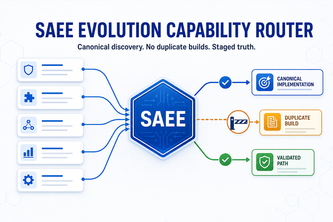
The description states that SAEE Evolution Capability Router is a developer tool built during an OpenAI hackathon to help coding agents discover, route to, and avoid duplicating existing capabilities within the SAEE Digital Biosphere Evolution Engine. The project claims to provide canonical capability inventories, lifecycle classification of capabilities, alias resolution, duplicate-build prevention, and staged truth separation.
The author states that this is a bounded extension to an existing system (SAEE), built using GPT-5.6 in Codex and deterministic Python with JSON contracts. It includes runtime loader, CLI routing commands, schema validation, governance registries, and dogfooding evidence. The tool is said to be testable offline, not execute unknown repositories, and not contact external systems.
The single most important open question is: What is the actual commercial traction or adoption of this tool beyond the hackathon context?
This project description provides no evidence of revenue, customers, or market adoption. It describes a self-contained extension to an existing system, built for a specific hackathon event, with no indication of broader deployment or usage.
What The Product Actually Is
The description states that SAEE Evolution Capability Router is:
- A developer tool
- An agent-readable capability router
- Built as an extension to the SAEE Digital Biosphere Evolution Engine
- Designed to help Codex and other coding agents discover existing capabilities
- To route to canonical implementations
- To block duplicate builds while preserving staged truth
The author states that it provides:
- A canonical, machine-readable capability inventory
- Classification of capabilities as implemented, partial, design_only, missing, deprecated, or superseded
- Resolution of public aliases to one canonical CLI, MCP, HTTP, or Python entrypoint
- Blocking of duplicate builds when equivalent capabilities already exist
- Separation of local code, synthetic validation, external integration, customer validation, and production readiness
- Fail-closed behavior for ambiguous routing or non-existent interfaces
The tool is said to be implemented in deterministic Python with JSON contracts, testable offline, and not executing unknown repositories or contacting external systems.
Positioning & Claim Evolution
The description states that the product was positioned as:
- An agent-readable developer tool
- A bounded extension to an existing Digital Biosphere Evolution Engine (SAEE)
- A solution to problems where agents lose track of what already exists in long-running AI codebases
- A tool to make capability evolution discoverable, composable, and safer for coding agents
The author claims the product addresses:
- Roadmaps outliving implementations
- Design documents being mistaken for shipped features
- Parallel agents rebuilding equivalent capabilities
The positioning evolved from:
- A hackathon project (OpenAI Build Week)
- To a tool that strengthens SAEE's Evolutionary Archive / Rollback Immune System
- Not to replace the Digital Biosphere Evolution Engine core
Target Customer & ICP
The description states that the target customer is:
- Codex and other coding agents
- Developers working within the SAEE ecosystem
- Users of the Digital Biosphere Evolution Engine
The author does not provide explicit information about:
- Specific customer segments beyond "coding agents"
- Customer personas or roles
- Market size or addressable market
- Customer acquisition strategy
Business Model & Pricing Evidence
The description states that:
- The tool is built as an extension to an existing system (SAEE)
- It was developed during a hackathon
- No pricing information, business model, or monetization strategy is provided
- The project does not mention any revenue streams or customer contracts
Technical & Delivery Signals
The description states that the tool:
- Was built using GPT-5.6 in Codex
- Uses deterministic Python with JSON contracts
- Is testable offline
- Does not execute unknown repositories
- Does not contact external systems
- Does not expand permissions
- Includes runtime loader, CLI routing commands, schema validation, duplicate-build gates, governance registries, and dogfooding evidence
The author states that:
- The implementation is deterministic Python with JSON contracts
- It can be tested offline
- It does not execute unknown repositories or contact external systems
- It was built from commit 9f74d153 through f6ac41f4
- The tool passes validation for canonical inventory, capability progress ledger, and governance registry
Traction & Maturity Signals
The description states:
- This is a hackathon project submitted to OpenAI Build Week 2026
- The tool was built during the official submission window
- It changes 74 files with 6,850 insertions and 40 deletions
- A clean snapshot at f6ac41f4 passes validation for:
- Canonical inventory (9/9 capabilities, 16/16 negative cases, 5/5 deterministic runs)
- Capability progress ledger (9/9 status projections, with duplicate-build prevention enabled)
- Governance registry (6/6 registries and 4/4 schemas)
The author states:
- The tool is not yet production ready
- Public MCP transport is not available
- External interoperability has not been validated
- Customer validation has not occurred
- Production readiness remains a future gate
Competitive Context
The description does not provide information about:
- Direct competitors
- Indirect substitutes
- Market positioning relative to existing tools
- Competitive advantages or differentiation
- Market dynamics or competitive landscape
Open Questions & Risks
Key risks and open questions identified from the description:
- The tool is described as a hackathon project with no evidence of commercial traction or adoption beyond the event
- No revenue, customer base, or market validation is mentioned
- The tool is not yet production ready according to the author's own statement
- No pricing model or business model is provided
- The tool is built for a specific ecosystem (SAEE) and may not be broadly applicable
- The project has only one team member (Bin Zhang)
- The project description lacks any evidence of product-market fit or market demand beyond the hackathon context
Questions the description leaves open
- What is the actual commercial traction or adoption of this tool beyond the hackathon?
- How does this tool integrate with existing development workflows and systems outside of SAEE?
- What is the business model for monetizing this tool?
- What are the specific use cases where this tool has been applied in real-world scenarios?
- How does the tool handle edge cases or failures in capability resolution?
- What is the roadmap for moving from the current state to production readiness?
- How does this tool compare to existing tools for capability discovery and management?
- What are the key technical challenges that remain unresolved?
- How is the tool being tested beyond the validation mentioned in the description?
- What are the plans for scaling beyond the current single developer team?
Overall Assessment
The description states that this project is:
- A hackathon submission to OpenAI Build Week 2026
- An extension to an existing system (SAEE)
- Built by a single developer (Bin Zhang)
- Not yet production ready
- Not validated for external interoperability or customer validation
- Not yet in production
The author states that:
- The tool is testable offline and deterministic
- It passes internal validation but has not been validated externally
- Public MCP transport, external interoperability, and customer validation are future gates
- The tool strengthens SAEE's Evolutionary Archive / Rollback Immune System but does not replace the core engine
There is no evidence of:
- Revenue generation
- Customer adoption or traction
- Market demand beyond the hackathon context
- Commercial viability or scalability
- Product-market fit
The project appears to be a proof-of-concept or prototype built during a hackathon, with no indication of commercial deployment or market validation. The single most important open question remains: What is the actual commercial traction or adoption of this tool beyond the hackathon context?
User Stories BotA demo video on every pull request
Get a demo video on every new feature
GitHub App that watches your pull requests and records a narrated, captioned demo.
Save time on demo prep and make informed decisions faster with a video walkthrough of every new feature.
Source
Submitted to the OpenAI 2026 hackathon on Devpost. Project home on Devpost. Back to the full gallery on Devpost.
This competitive analysis was produced by top-founders.com (opens in a new tab)
Generated by a language model from this project's public Devpost page — its tagline, the author's own write-up and any built-with tags listed there — as captured in August 2026. Short quotations are the author's words. It is an opinion on the idea as a business, not on the people behind it, and it reflects the description as published then. If the project has moved on, request a correction below. The analysis is not independent research and contains no verified traction, revenue or customer data.
An independent guide by KFG International LLC — not affiliated with, endorsed by, or connected to Devpost or OpenAI.