

Archive position — measured, not model output
0 likes on Devpost
2,263 of the 7,850 archived projects have more likes, and 5,587 share exactly 0 — so this project's #6,391 place in the like-ranked listing is a tie-break inside that group, not a ranking.
Projects (log scale)
Likes on Devpost. ▲ marks this project's group.
Show the figures
| Likes | Projects | Share of archive |
|---|---|---|
| 0 | 5,587 | 71.2% |
| 1 | 1,758 | 22.4% |
| 2 | 284 | 3.6% |
| 3–4 | 132 | 1.7% |
| 5–9 | 75 | 1.0% |
| 10+ | 14 | 0.2% |
 User Stories BotA demo video on every pull request
Get a demo video on every new feature
GitHub App that watches your pull requests and records a narrated, captioned demo.
Save time on demo prep and make informed decisions faster with a video walkthrough of every new feature.
Executive Summary
What the company appears to be
ResPulse is an offline-first disaster-response platform built as a mobile app (Flutter), backend (FastAPI), and command dashboard (React/Vite). It enables users to send SOS signals via Bluetooth Low Energy (BLE) that can be relayed by nearby phones when cellular networks are down. The system supports emergency guidance, local storage of sensitive data, and synchronization with a backend when connectivity returns.
What changed
The project is self-reported as a hackathon submission for the OpenAI 2026 hackathon. It was built in less than 48 hours by two team members (Anna Thomas, M A Allen Febi). No prior version or commercial product exists beyond this prototype.
Single most important open question
Is there any evidence of real-world testing or validation with actual disaster responders or affected communities?
What The Product Actually Is
The description states that ResPulse is an offline-first disaster-response platform. It includes:
- A Flutter mobile app for rescuees, relay devices, and responders.
- A FastAPI backend for synchronization, content distribution, and real-time updates.
- A React/Vite command dashboard with mapping capabilities.
Key features include:
- BLE-based SOS beaconing that relays signals over Bluetooth without cellular service.
- Offline maps, shelters, hazards, saved waypoints, field guides.
- Secure local storage of household, medical, mobility, and accessibility context.
- Battery-aware emergency modes.
- Hazard-specific emergency flows (earthquakes, floods, etc.).
- Regional preparedness packs for offline content download.
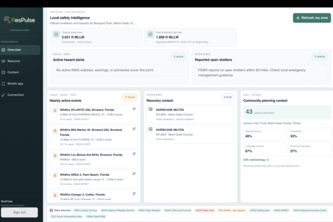
- Command dashboard with operational views, SITREPs, route overlays, and responder actions.
The system is described as end-to-end, offline-first, and designed to work even when network communication fails.
Evidence
- The project description explicitly lists these components and features.
- It describes how the mobile app stores critical state locally using Drift and SQLite.
- BLE packet design is detailed: 16-byte versioned packets with beacon identity, sequence number, relay limit, triage flags, battery level, timestamp, integrity check.
Inference The system is built for resilience in low-connectivity environments. However, no evidence of actual deployment or usage exists beyond the prototype.
Positioning & Claim Evolution
The description states that ResPulse aims to make phones useful even when the network is unavailable. It positions itself as a tool that preserves essentials during emergencies: distress signals, situation context, accessibility needs, and offline guidance.
It also claims to be more than just a collection of emergency screens — it has an end-to-end workflow with offline-first design principles.
Evidence
- The tagline: “Disasters bury people AND the network they'd call for help. So we made survivors the network.”
- The write-up emphasizes that the system treats offline operation as core, not optional.
- It distinguishes simulations from physical radio validation and clearly labels source attribution.
Inference The positioning reflects a focus on community-based rescue networks rather than centralized systems. However, this is a self-stated intent, not yet proven traction or adoption.
Target Customer & ICP
The description identifies multiple user types:
- Rescuees (people needing help)
- Nearby relay devices (phones that forward SOS signals)
- Field responders
- Command teams coordinating broader response efforts
It also mentions accessibility needs and power constraints as key considerations, suggesting a focus on vulnerable populations.
Evidence
- The write-up lists these roles explicitly.
- It notes the inclusion of medical, mobility, and accessibility context stored securely on devices.
Inference The ICP likely includes individuals in disaster-prone regions, humanitarian workers, and emergency responders. No evidence of specific customer segments or personas is provided.
Business Model & Pricing Evidence
There is no mention of pricing, monetization strategy, or business model in the description.
Evidence
- No revenue streams, subscriptions, or commercial partnerships are described.
- The project was submitted to a hackathon and has no indication of being sold or licensed.
Inference The project appears to be experimental or proof-of-concept. There is no evidence of any business model beyond its current prototype form.
Technical & Delivery Signals
The technical stack includes:
- Mobile: Flutter
- Backend: FastAPI
- Dashboard: React/Vite, Leaflet-based mapping
- AI: Gemma 3 1B model with EmbeddingGemma 300M retrieval embeddings
- Database: SQLAlchemy + Alembic
- Storage: Drift and SQLite
Key technical decisions:
- BLE protocol uses compact 16-byte packets.
- Local storage ensures data persistence during outages.
- WebSockets for live updates, REST endpoints for sync.
- Conflict resolution handled by backend authority.
Evidence
- The write-up details the architecture and implementation choices.
- It mentions AI being used for engineering support (not dispatching responders).
Inference The system is built with offline-first principles and strong attention to safety boundaries around data handling and AI use. However, no evidence of scalability or production readiness is present.
Traction & Maturity Signals
No traction or maturity indicators are provided in the description.
Evidence
- The project was submitted as a hackathon entry.
- No customer base, revenue, ARR, or adoption metrics are mentioned.
- No prior versions, funding rounds, or product launches are referenced.
Inference This is an early-stage prototype with no evidence of real-world usage or market traction. It lacks any signs of development beyond the initial build phase.
Competitive Context
There is no mention of competitors or competitive landscape in the description.
Evidence
- No references to existing tools, platforms, or solutions in the disaster response space are made.
- The write-up does not compare ResPulse with other systems.
Inference While similar concepts may exist (e.g., offline communication tools, BLE-based SOS apps), there is no evidence of awareness or positioning relative to competitors.
Open Questions & Risks
Several potential risks and open questions are evident from the description:
- No real-world testing: The system has not been validated in actual disasters.
- Limited team size: Only two developers built it, which raises questions about scalability and long-term maintenance.
- Unproven reliability: Despite claims of multi-phone relay logic, there is no evidence of physical device validation or performance under stress.
- AI safety boundaries: While AI is used for guidance, it's explicitly stated that it cannot dispatch responders or determine authoritative outcomes — this may limit its utility in high-stakes scenarios.
- No commercial viability: No business model or monetization strategy is evident.
Evidence
- The write-up notes challenges like BLE limitations and conflict handling.
- It acknowledges the need for physical-device validation.
- The project was built in a short timeframe with limited resources.
Inference This is a conceptual prototype with significant gaps in real-world applicability. Its readiness for deployment or scaling remains unproven.
Questions the description leaves open
- Has the system been tested in real-world conditions or simulated disaster scenarios?
- What are the limitations of the BLE relay mechanism, and how were they addressed?
- How does the system handle conflicts between multiple responders claiming the same incident?
- Are there any plans to integrate with existing emergency response systems or protocols?
- What is the roadmap for transitioning from prototype to a deployable solution?
- Have you considered legal or regulatory requirements for emergency communication tools?
- How do you plan to ensure data privacy and security in field operations?
Overall Assessment
Not evidenced.
Evidence
- No financials, funding history, or investment interest are mentioned.
- The project is described as a hackathon submission with no indication of commercial intent or strategic value beyond its prototype stage.
Inference At this point, there is insufficient evidence to assess whether ResPulse represents a viable opportunity for investment or partnership. It lacks demonstrated traction, scalability, or clear path to market.
User Stories BotA demo video on every pull request
Get a demo video on every new feature
GitHub App that watches your pull requests and records a narrated, captioned demo.
Save time on demo prep and make informed decisions faster with a video walkthrough of every new feature.
Source
Submitted to the OpenAI 2026 hackathon on Devpost. Project home on Devpost. Back to the full gallery on Devpost.
This competitive analysis was produced by top-founders.com (opens in a new tab)
Generated by a language model from this project's public Devpost page — its tagline, the author's own write-up and any built-with tags listed there — as captured in August 2026. Short quotations are the author's words. It is an opinion on the idea as a business, not on the people behind it, and it reflects the description as published then. If the project has moved on, request a correction below. The analysis is not independent research and contains no verified traction, revenue or customer data.
An independent guide by KFG International LLC — not affiliated with, endorsed by, or connected to Devpost or OpenAI.