

Archive position — measured, not model output
2 likes on Devpost
221 of the 7,850 archived projects have more likes, and 284 share exactly 2 — so this project's #504 place in the like-ranked listing is a tie-break inside that group, not a ranking.
Projects (log scale)
Likes on Devpost. ▲ marks this project's group.
Show the figures
| Likes | Projects | Share of archive |
|---|---|---|
| 0 | 5,587 | 71.2% |
| 1 | 1,758 | 22.4% |
| 2 | 284 | 3.6% |
| 3–4 | 132 | 1.7% |
| 5–9 | 75 | 1.0% |
| 10+ | 14 | 0.2% |
 User Stories BotA demo video on every pull request
Get a demo video on every new feature
GitHub App that watches your pull requests and records a narrated, captioned demo.
Save time on demo prep and make informed decisions faster with a video walkthrough of every new feature.
Executive Summary
Company: Yuvth.raw
Tagline: Your Semester has a Digital Twin. A proactive academic command center powered by AI Intelligence.
Self-reported basis: The entire analysis is based on the project description supplied by the caller — including the name, tagline, author's own write-up, and technology stack. No external corroboration or historical data is available.
What it appears to be: A student-focused academic assistant app built for hackathon use, leveraging AI to help manage attendance, class chat, note-taking, and exam prep. It is described as a digital twin of a semester that integrates with university portals (planned) and uses LLMs, RAG, and real-time communication.
What changed: The project was submitted to the OpenAI 2026 hackathon on Devpost. No evidence of prior development or commercial traction exists beyond this submission.
Single most important open question: Is there a viable path from a hackathon prototype to a product with real academic adoption, and does it have any sustainable business model?
What The Product Actually Is
The description states that Yuvth.raw is an app called Semester Copilot, which integrates AI into academic life. It focuses on four main areas:
- Smart Skip Engine: Calculates a risk score to determine if a student can safely skip class based on exam frequency, syllabus weight, and attendance projections.
- Classroom Chat: A real-time chat room with AI that answers questions using PDF notes from the class.
- AI Notes Studio: Automatically extracts text from lecture PDFs to generate summaries, flashcards, and quizzes.
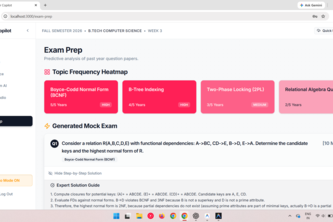
- Exam Prep: Parses past question papers to calculate topic probability and generate heat maps for revision.
The app is built using:
- Frontend: Next.js, Tailwind CSS, Shadcn UI, Framer Motion
- Backend: FastAPI (Python), SQLite
- AI & RAG: LLMs, PDF parsing, embeddings, cosine similarity
- Real-time features: WebSockets
Inference: The app is a student-focused tool designed to reduce academic friction through automation and AI. It is not a commercial product but a hackathon prototype.
Positioning & Claim Evolution
The description states that Yuvth.raw was built because the team was tired of:
- Juggling deadlines across PDF syllabuses
- Missing messages in WhatsApp study groups
- Manually calculating attendance to decide whether to skip class
They claim it is not a generic to-do list but an app that "actually helps plan and warns before mistakes are made."
Inference: The positioning evolved from solving personal pain points into a broader academic command center. It positions itself as a proactive assistant for students, not just a passive tool.
Target Customer & ICP
The description states the app is built for students, particularly those managing multiple classes and trying to balance attendance, study, and deadlines.
Inference: The target customer is a college or university student in a STEM or humanities field, likely in India or a similar academic environment where PDF syllabuses and WhatsApp groups are common. No evidence of segmentation beyond "student" exists.
Business Model & Pricing Evidence
The description does not state any business model or pricing strategy.
Not evidenced: No mention of monetization, subscription plans, freemium tiers, or revenue streams.
Technical & Delivery Signals
- Built with Next.js, FastAPI, SQLite, and LLMs
- Uses RAG pipeline for PDF parsing and AI chat
- Implements WebSockets for real-time chat
- Utilizes Playwright for testing
- Designed with Tailwind CSS, Shadcn UI, and Framer Motion
Inference: The technical stack suggests a lightweight, MVP-style product built for rapid development. It is not described as scalable or production-ready.
Traction & Maturity Signals
The description states that the project was submitted to the OpenAI 2026 hackathon, and it is described as a hackathon prototype.
Not evidenced: No evidence of:
- Revenue
- Customers
- User adoption
- Product-market fit
- Post-hackathon development or funding
Competitive Context
The description does not mention any competitors. It is unclear whether similar tools exist in the market, such as:
- Academic planning apps
- AI-powered note-taking tools
- Attendance tracking systems
- Study group platforms
Not evidenced: No competitive analysis or positioning against existing tools.
Open Questions & Risks
- No commercial traction or revenue: The product is described only as a hackathon prototype.
- Unproven AI reliability: The team mentions issues with hallucinations in the RAG pipeline, suggesting potential inaccuracies.
- Limited scalability: Built on SQLite and FastAPI; no evidence of cloud infrastructure or scaling plans.
- No monetization strategy: No indication of how the product would generate revenue.
- Unverified claims: The Smart Skip Engine and Exam Prep logic are described but not validated.
Questions the description leaves open
- What is your plan for transitioning from a hackathon prototype to a scalable, production-ready product?
- How do you intend to monetize this tool? Is there any market research or user feedback beyond the team's own experience?
- Have you tested the AI accuracy in real-world scenarios, especially with varying PDF quality and content?
- What are your plans for integrating with university portals like Canvas or Moodle?
- Do you have any data on how students would actually use this tool, or is it based purely on self-reported pain points?
Overall Assessment
Not evidenced: No evidence of:
- Revenue
- Customers
- Market traction
- Product-market fit
- Team traction or prior experience
Inference: This is a pre-product, pre-revenue prototype submitted to a hackathon. It shows technical capability but lacks commercial viability or strategic positioning.
Confidence level: Low — based entirely on self-reported claims and no external validation.
User Stories BotA demo video on every pull request
Get a demo video on every new feature
GitHub App that watches your pull requests and records a narrated, captioned demo.
Save time on demo prep and make informed decisions faster with a video walkthrough of every new feature.
Source
Submitted to the OpenAI 2026 hackathon on Devpost. Project home on Devpost. Back to the full gallery on Devpost.
This competitive analysis was produced by top-founders.com (opens in a new tab)
Generated by a language model from this project's public Devpost page — its tagline, the author's own write-up and any built-with tags listed there — as captured in August 2026. Short quotations are the author's words. It is an opinion on the idea as a business, not on the people behind it, and it reflects the description as published then. If the project has moved on, request a correction below. The analysis is not independent research and contains no verified traction, revenue or customer data.
An independent guide by KFG International LLC — not affiliated with, endorsed by, or connected to Devpost or OpenAI.