

Archive position — measured, not model output
0 likes on Devpost
2,263 of the 7,850 archived projects have more likes, and 5,587 share exactly 0 — so this project's #2,467 place in the like-ranked listing is a tie-break inside that group, not a ranking.
Projects (log scale)
Likes on Devpost. ▲ marks this project's group.
Show the figures
| Likes | Projects | Share of archive |
|---|---|---|
| 0 | 5,587 | 71.2% |
| 1 | 1,758 | 22.4% |
| 2 | 284 | 3.6% |
| 3–4 | 132 | 1.7% |
| 5–9 | 75 | 1.0% |
| 10+ | 14 | 0.2% |
 User Stories BotA demo video on every pull request
Get a demo video on every new feature
GitHub App that watches your pull requests and records a narrated, captioned demo.
Save time on demo prep and make informed decisions faster with a video walkthrough of every new feature.
Executive Summary
What the company appears to be
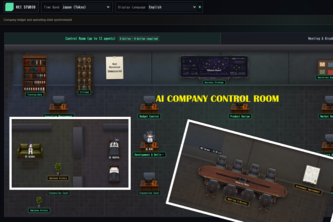
The author describes AI Company Control Room as a private operating system for an AI-native company. It envisions a company where AI employees perform tasks under human-defined budgets and authority, with all actions recorded as append-only, signed evidence.
What changed
The project was extended during OpenAI Build Week using Codex and GPT-5.6. The extension added live auditor-to-agent interviews, Ed25519-signed execution flows, model routing, localization support for nine languages (including Arabic), and runtime language switching without rebuilding.
Single most important open question
Is there any evidence of actual use or adoption beyond the author’s own development and demonstration? The description states no revenue, customers, or traction data exist beyond what is self-reported.
What The Product Actually Is
The description states that AI Company Control Room is a private operating system for an AI-native company. It includes:
- A "Living Office" visualization with eight core AI employees, critics, meeting rooms, and operational monitors.
- An operational loop: observe → plan → assign → execute → verify → record → learn.
- Human auditor sets budgets and authority limits; AI employees work within those boundaries.
- Actions are stored as append-only evidence using SHA-256 chains and Ed25519 signatures.
- The system refuses to present unsigned or unverified actions as complete.
- A working vertical slice demonstrates an auditor interviewing an AI employee, with the question stored, a model called, and the result signed.
This is described as not just a multi-agent chat interface but a product architecture built around accountability and evidence.
Evidence
- The author states: “AI Company Control Room is a private operating system for an AI-native company.”
- It includes “observe → plan → assign → execute → verify → record → learn” loop.
- “The human auditor establishes budgets and limited authority grants.”
- “Token usage, model routes, costs, approvals, dissent, decisions, and outcomes are stored as append-only evidence.”
- “The system refuses to present unsigned or unverified actions as completed.”
Inference This is a conceptual or prototype system designed to manage AI-driven company operations with strong emphasis on auditability and transparency.
Positioning & Claim Evolution
The author positions the product as more than a chat interface. It is described as an operating system for AI-native companies, where accountability is embedded into the architecture.
Key claims include:
- Accountability is part of the product design.
- Evidence chains (SHA-256), signed receipts (Ed25519), bounded retries, and fail-closed behavior are built-in features.
- Visual storytelling does not replace operational truth; only verified jobs count as done.
- The system separates visual representation from actual work status.
Evidence
- “This is not simply a multi-agent chat interface.”
- “AI Company Control Room treats accountability as part of the product architecture.”
- “SHA-256 evidence chains, append-only database rules, signed executor results, bounded retries, budget stops, independent dissent, and fail-closed model routing are designed into the operating system.”
Inference The positioning reflects a vision for AI-native enterprises that prioritize control, traceability, and integrity over automation alone.
Target Customer & ICP
The description does not clearly define a target customer or ideal customer profile (ICP). It implies a company or organization that wants to operate with AI employees while maintaining human oversight.
It suggests a use case for:
- AI-native companies.
- Organizations requiring high levels of auditability and control over AI decisions.
- Entities managing autonomous AI systems with defined budgets and authority.
Evidence
- “AI Company Control Room is a private operating system for an AI-native company.”
- “The human auditor establishes budgets and limited authority grants.”
Inference The ICP likely includes early-stage or forward-thinking enterprises exploring AI autonomy, particularly those in tech, R&D, or regulated industries where accountability matters.
Business Model & Pricing Evidence
There is no evidence of a business model or pricing structure in the description. The author does not mention any monetization strategy, customer acquisition plans, or revenue streams.
Evidence
- No mention of pricing.
- No indication of how the product would be sold or licensed.
- No reference to customers or commercial relationships.
Inference The project appears to be a prototype or proof-of-concept with no stated path to monetization.
Technical & Delivery Signals
The system is built using:
- Frontend: TypeScript, React, Next.js
- Backend: Cloudflare Workers, D1 (SQLite), R2 (object storage)
- ORM: Drizzle
- AI tools: Codex, GPT-5.6, Gemini, Gemma, OpenAI models
- Security: Ed25519 signatures, SHA-256 chains
- Localization: Nine languages including Arabic with RTL support
The system enforces append-only evidence and database triggers to prevent invalid state transitions.
Evidence
- “The interface is built with TypeScript, React, and Next.js-compatible tooling.”
- “Cloudflare Workers host the server-side application, Cloudflare D1 stores operational records, and R2 provides protected object storage.”
- “Database triggers enforce append-only evidence and reject invalid state transitions.”
- “SHA-256 chains protect evidence history, while Ed25519 signatures establish the boundary between the application and model executors.”
Inference The technical stack reflects a modern, cloud-native approach with strong emphasis on security and immutability.
Traction & Maturity Signals
There is no evidence of traction or adoption beyond the author’s own development. The project was submitted to an OpenAI hackathon and includes a demonstration vertical slice but lacks any data on users, customers, revenue, or usage metrics.
Evidence
- “The working demonstration completes one evidence-backed vertical slice.”
- “The product also separates visual storytelling from operational truth.”
- No mention of real-world deployment, user feedback, or performance data.
Inference This is a prototype or early-stage development effort with no demonstrated market traction.
Competitive Context
There is no mention of competitors in the description. The author does not reference existing platforms or tools that might compete with AI Company Control Room.
Evidence
- No competitor names, products, or market positioning provided.
- No discussion of how this differs from other AI management or orchestration systems.
Inference The competitive landscape is unknown based on the provided information. The author may be operating in a niche or undefined space.
Open Questions & Risks
Key risks and open questions include:
- Lack of evidence for traction, revenue, or customer adoption.
- No clear business model or monetization strategy.
- Prototype nature with no indication of scalability or production readiness.
- Heavy reliance on AI tools (Codex, GPT-5.6) for development — raises questions about long-term maintainability and control.
- The system is described as an operating system for AI-native companies, which may be a speculative future market.
Evidence
- “No revenue, customer or traction data is available beyond what they state.”
- “The working demonstration completes one evidence-backed vertical slice.”
Inference Without real-world usage or commercial viability, the project remains unproven in terms of practical utility and scalability.
Questions the description leaves open
- What specific use cases are you targeting for AI Company Control Room?
- How do you plan to monetize this product if it is not yet adopted by users?
- Can you describe the process of how an AI employee would be assigned a task and how that task gets executed, verified, and recorded?
- What are the limitations of the current prototype in terms of handling complex workflows or multi-agent coordination?
- How do you ensure that the system remains auditable and transparent without becoming overly burdensome for users?
- Are there any known issues with integrating external APIs or services that require signed receipts?
- What is your roadmap for moving from a prototype to a scalable, production-ready platform?
Overall Assessment
The description indicates this is an early-stage concept or prototype developed during a hackathon. There is no evidence of revenue, customers, or traction beyond the author’s own development and demonstration.
Evidence
- “Everything above is the authors' own account. It is not independently verified.”
- “No revenue, customer or traction data is available beyond what they state.”
Inference This project lacks commercial viability indicators and should be considered a speculative idea or proof-of-concept rather than an investment-ready opportunity.
User Stories BotA demo video on every pull request
Get a demo video on every new feature
GitHub App that watches your pull requests and records a narrated, captioned demo.
Save time on demo prep and make informed decisions faster with a video walkthrough of every new feature.
Source
Submitted to the OpenAI 2026 hackathon on Devpost. Project home on Devpost. Back to the full gallery on Devpost.
This competitive analysis was produced by top-founders.com (opens in a new tab)
Generated by a language model from this project's public Devpost page — its tagline, the author's own write-up and any built-with tags listed there — as captured in August 2026. Short quotations are the author's words. It is an opinion on the idea as a business, not on the people behind it, and it reflects the description as published then. If the project has moved on, request a correction below. The analysis is not independent research and contains no verified traction, revenue or customer data.
An independent guide by KFG International LLC — not affiliated with, endorsed by, or connected to Devpost or OpenAI.