

Archive position — measured, not model output
0 likes on Devpost
2,263 of the 7,850 archived projects have more likes, and 5,587 share exactly 0 — so this project's #6,393 place in the like-ranked listing is a tie-break inside that group, not a ranking.
Projects (log scale)
Likes on Devpost. ▲ marks this project's group.
Show the figures
| Likes | Projects | Share of archive |
|---|---|---|
| 0 | 5,587 | 71.2% |
| 1 | 1,758 | 22.4% |
| 2 | 284 | 3.6% |
| 3–4 | 132 | 1.7% |
| 5–9 | 75 | 1.0% |
| 10+ | 14 | 0.2% |
 User Stories BotA demo video on every pull request
Get a demo video on every new feature
GitHub App that watches your pull requests and records a narrated, captioned demo.
Save time on demo prep and make informed decisions faster with a video walkthrough of every new feature.
Executive Summary
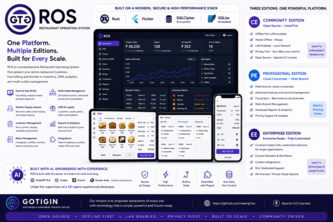
The description states that "Restaurant Operating System" (ROS) is a self-contained, offline-first platform for restaurants built by one developer, MEARAJ BHAGAD, as part of the OpenAI 2026 hackathon. The author claims it unifies tables, ordering, kitchen workflows, billing, inventory, reporting, and branch management into a single system. It uses Rust for core logic, Flutter for UI, and SQLite for local data storage, with AI tools like ChatGPT and Codex used during development. ROS is positioned as an enterprise-grade solution aiming to be fast, secure, and scalable, with plans for cloud sync, advanced reporting, and AI-powered insights.
The single most important open question is: What is the actual commercial traction or customer adoption of this system beyond its hackathon prototype?
This analysis is based entirely on self-reported information from the project description. No independent verification exists, and no evidence of revenue, customers, or deployment is provided.
What The Product Actually Is
The description states that ROS is an offline-first, enterprise-grade Restaurant Operating System designed to unify multiple restaurant functions into one platform. It includes POS, billing, inventory management, kitchen operations, customer management, analytics, and future AI-powered capabilities. The system is built using Rust for the core engine, Flutter for the UI, and SQLite for local data storage. It supports cross-platform deployment and has been developed with AI tools such as ChatGPT and Codex.
The author claims that ROS was built to work even without an internet connection, and that it will support cloud synchronization in future versions.
Positioning & Claim Evolution
The description states that ROS was created from the idea that restaurants deserve modern, reliable, and affordable software that works offline. It is positioned as a unified platform for restaurant operations, integrating multiple functions into one system. The author emphasizes its enterprise-grade nature, scalability, and performance.
The claim evolution shows a progression from a hackathon prototype to a commercial product intended for production deployment. The author notes that the project was not built as a demo but as a foundation for a real commercial offering, with plans to evolve beyond the hackathon stage.
Target Customer & ICP
The description states that ROS is designed for restaurants of all sizes and aims to be scalable across different business models within the hospitality industry. It includes features like branch management, multi-branch support, and customer management, suggesting a focus on mid-to-large restaurant chains or multi-location operators.
However, no specific customer segments or personas are identified beyond general restaurant use cases.
Business Model & Pricing Evidence
Not evidenced.
The description does not contain any information about pricing models, revenue streams, monetization strategies, or business model details. No claims are made regarding how the product will be sold or who will pay for it.
Technical & Delivery Signals
The description states that ROS is built using Rust for core logic, Flutter for UI, and SQLite for local data storage. It uses flutter_rust_bridge to connect these components. The system is designed to be offline-first with support for future cloud synchronization.
AI tools including ChatGPT 5.6 and Codex were used during development for architecture, implementation, debugging, documentation, and code refinement. The author also mentions that the project was developed within a hackathon timeframe while maintaining engineering quality.
Traction & Maturity Signals
Not evidenced.
There is no evidence of actual deployment, customer adoption, usage metrics, or performance data beyond the claim that it was built during a hackathon and will be deployed in production. No mention of existing users, beta testers, or real-world testing is provided.
Competitive Context
Not evidenced.
The description does not provide any information about competitors, market positioning relative to other restaurant management systems, or competitive advantages claimed by the product.
Open Questions & Risks
- Single-founder development: The system was built by one person (MEARAJ BHAGAD), which raises questions about scalability and long-term maintenance.
- Hackathon prototype: The project originated as a hackathon submission, suggesting limited time for product-market fit validation or robust testing.
- Unproven commercial viability: No evidence of revenue, customers, or production deployment exists beyond the author's claims.
- AI dependency: Heavy reliance on AI tools during development may indicate potential challenges in maintaining quality control without such assistance.
- Offline-first design limitations: While offline functionality is a feature, it may limit integration with centralized systems and real-time analytics.
Questions the description leaves open
- What specific restaurant use cases has the system been tested on?
- How many restaurants are currently using or planning to use this system in production?
- What is the timeline for moving from prototype to full commercial deployment?
- Are there any existing partnerships or pilot programs with restaurants?
- How does the offline-first architecture handle data synchronization when connectivity returns?
- What are the key differentiators of ROS compared to existing restaurant management platforms?
- Has the team conducted any market research or customer interviews before building this system?
- What is the plan for ongoing development and feature updates post-hackathon?
Overall Assessment
Not evidenced.
There is insufficient evidence to assess whether this represents a viable investment opportunity or partnership candidate. The description lacks data on commercial traction, financials, market demand, or competitive positioning. The product remains in an early-stage prototype phase with no demonstrated customer adoption or revenue generation.
User Stories BotA demo video on every pull request
Get a demo video on every new feature
GitHub App that watches your pull requests and records a narrated, captioned demo.
Save time on demo prep and make informed decisions faster with a video walkthrough of every new feature.
Source
Submitted to the OpenAI 2026 hackathon on Devpost. Project home on Devpost. Back to the full gallery on Devpost.
This competitive analysis was produced by top-founders.com (opens in a new tab)
Generated by a language model from this project's public Devpost page — its tagline, the author's own write-up and any built-with tags listed there — as captured in August 2026. Short quotations are the author's words. It is an opinion on the idea as a business, not on the people behind it, and it reflects the description as published then. If the project has moved on, request a correction below. The analysis is not independent research and contains no verified traction, revenue or customer data.
An independent guide by KFG International LLC — not affiliated with, endorsed by, or connected to Devpost or OpenAI.