

Archive position — measured, not model output
0 likes on Devpost
2,263 of the 7,850 archived projects have more likes, and 5,587 share exactly 0 — so this project's #6,395 place in the like-ranked listing is a tie-break inside that group, not a ranking.
Projects (log scale)
Likes on Devpost. ▲ marks this project's group.
Show the figures
| Likes | Projects | Share of archive |
|---|---|---|
| 0 | 5,587 | 71.2% |
| 1 | 1,758 | 22.4% |
| 2 | 284 | 3.6% |
| 3–4 | 132 | 1.7% |
| 5–9 | 75 | 1.0% |
| 10+ | 14 | 0.2% |
 User Stories BotA demo video on every pull request
Get a demo video on every new feature
GitHub App that watches your pull requests and records a narrated, captioned demo.
Save time on demo prep and make informed decisions faster with a video walkthrough of every new feature.
Executive Summary
What the company appears to be
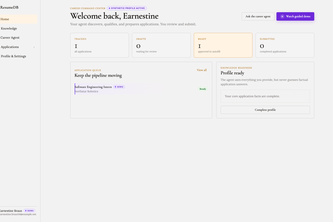
ResumeDB is a self-reported agent-native internship operating system for students. The project description states it is an end-to-end working system that learns from a resume and preferences to find roles, tailor applications, and autofill forms with human approval at every step.
What changed
The author describes building a complete workflow from job discovery to application submission using AI agents, with emphasis on human control, auditability, and structured reasoning. It is presented as a solution to the fragmentation of internship application tools.
The single most important open question
Is there evidence of actual student adoption or usage beyond the hackathon demo? The description states it is an end-to-end working system but provides no data on traction, revenue, customers, or real-world usage.
What The Product Actually Is
The description states ResumeDB is:
- An agent-native internship operating system
- A complete workflow from discovery to application
- A tool that learns a career knowledge base from resume, profile, experience, preferences, and reusable answers
- A system that finds roles, scores fit, identifies missing facts, and prepares application packages
- A Chrome extension that scans forms, previews field mappings, and fills supported answers
- An application with five explicit stages: not started, in progress, draft, ready, submitted
The product is described as:
- Built with React/TypeScript frontend and Python FastAPI backend
- Powered by OpenAI Codex with GPT-5.6
- Using streamed, multi-turn Codex sessions for career agent workflows
- Supporting strict JSON-schema output for bounded reasoning tasks
- Storing career data in local Git repository as YAML/Markdown
- Rendering tailored resumes into PDFs using Typst
- Operating through a hosted demo sandbox with synthetic data
Positioning & Claim Evolution
The description states ResumeDB positions itself as:
- An agent-native internship operating system
- A one durable source of truth and guided workflow from discovery to application
- A solution to the fragmentation of internship application tools (resume builder, job tracker, spreadsheet, notes app, AI chat, form filler)
- A tool that preserves a trustworthy career story
- An end-to-end working system, not just a resume generator
The claim evolution shows:
- Initial inspiration: internship applications are fragmented and require maintaining multiple tools
- Core positioning: one durable source of truth with guided workflow
- Key differentiators: human control model, Git-backed audit trail, evidence-linked tailoring, bring-your-own-agent MCP connection
- Evolution toward: making agent work observable and durable, balancing automation with user control
Target Customer & ICP
The description states:
- Primary users are students applying for internships
- The system is designed for students who want to preserve a trustworthy career story
- Students who need to find roles that actually fit their background
- Students who want to move applications forward without inventing facts or taking control away from themselves
The target customer is described as:
- Students applying for internships
- Users who want to avoid maintaining multiple fragmented tools (resume builder, job tracker, spreadsheet, notes app, AI chat, form filler)
- Users who value preserving a trustworthy career story
- Users who want human control over their application process
Business Model & Pricing Evidence
Not evidenced.
The description does not state:
- Any pricing model or pricing structure
- Revenue streams or monetization strategy
- Customer acquisition costs or lifetime value
- Subscription tiers or usage-based pricing
- Any commercial arrangements or business model details
Technical & Delivery Signals
The description states ResumeDB uses:
- React and TypeScript frontend built with Vite
- Python FastAPI backend exposing application API, streaming timelines over WebSockets, running job discovery pipeline
- OpenAI Codex with GPT-5.6 for agent workflows
- Streamed, multi-turn Codex sessions for Career Agent
- Strict JSON-schema output for bounded reasoning tasks (job extraction, fit analysis, application preparation)
- External job pages treated as untrusted data with model output validation
- Local Git repository for career data storage (YAML/Markdown)
- Typst for PDF rendering of tailored resumes
- Chrome extension for page capture, read-only mapping previews, semantic form filling, resume upload
- Vercel for web app and Railway for FastAPI service with persistent storage
- Synthetic demo sandbox for judges to exercise workflow without real data
Traction & Maturity Signals
Not evidenced.
The description does not state:
- Any actual users or customer base
- Revenue figures or financial performance
- Customer acquisition metrics or growth rates
- Product usage statistics or engagement data
- Any traction indicators beyond the hackathon demo
- Real-world adoption or user feedback
- Market penetration or competitive positioning
Competitive Context
Not evidenced.
The description does not state:
- Any direct competitors or market players
- Competitive advantages or differentiators in the marketplace
- Market size or addressable market
- Competitive landscape analysis
- Any positioning relative to existing internship application tools or career platforms
Open Questions & Risks
Inferences based on self-reported information:
Risk 1
The system is described as an end-to-end working system but lacks evidence of real-world usage beyond a hackathon demo. This suggests it may not have achieved product-market fit or traction.
Risk 2
The description states the hosted demo uses synthetic data and a sandbox environment, indicating that actual production use cases are unproven.
Risk 3
The team size is stated as three members (with one name duplicated), which may limit execution capacity for scaling beyond a prototype.
Risk 4
The system relies heavily on OpenAI Codex with GPT-5.6, which could create dependency risks if API availability or pricing changes.
Risk 5
The emphasis on human approval at every step suggests potential friction in the user experience that may limit adoption.
Questions the description leaves open
- What specific problems are students facing with current internship application processes that ResumeDB solves?
- How many students have actually used this system beyond the hackathon demo?
- What is the actual user journey and workflow for students using ResumeDB?
- How does the system handle edge cases or unusual job applications?
- What are the technical limitations of the current implementation that would need to be addressed for production use?
- How do you plan to monetize this product beyond the hackathon demo?
- What is the timeline for moving from prototype to production-ready system?
- How do you ensure data privacy and security for student information?
- What are the key metrics you track to measure success of the platform?
- How do you plan to scale beyond the current team size?
Overall Assessment
Not evidenced.
The description does not provide:
- Any financial data or valuation
- Revenue figures or business performance indicators
- Customer acquisition or retention metrics
- Market opportunity or competitive positioning data
- Any investment history or funding rounds
- Partnership opportunities or strategic value
The project is described as a hackathon submission with a working prototype, but there is no evidence of commercial traction, revenue, or customer adoption beyond the demo environment. The description states it is an end-to-end working system but provides no data on actual usage or market validation.
User Stories BotA demo video on every pull request
Get a demo video on every new feature
GitHub App that watches your pull requests and records a narrated, captioned demo.
Save time on demo prep and make informed decisions faster with a video walkthrough of every new feature.
Source
Submitted to the OpenAI 2026 hackathon on Devpost. Project home on Devpost. Back to the full gallery on Devpost.
This competitive analysis was produced by top-founders.com (opens in a new tab)
Generated by a language model from this project's public Devpost page — its tagline, the author's own write-up and any built-with tags listed there — as captured in August 2026. Short quotations are the author's words. It is an opinion on the idea as a business, not on the people behind it, and it reflects the description as published then. If the project has moved on, request a correction below. The analysis is not independent research and contains no verified traction, revenue or customer data.
An independent guide by KFG International LLC — not affiliated with, endorsed by, or connected to Devpost or OpenAI.