

Archive position — measured, not model output
0 likes on Devpost
2,263 of the 7,850 archived projects have more likes, and 5,587 share exactly 0 — so this project's #6,397 place in the like-ranked listing is a tie-break inside that group, not a ranking.
Projects (log scale)
Likes on Devpost. ▲ marks this project's group.
Show the figures
| Likes | Projects | Share of archive |
|---|---|---|
| 0 | 5,587 | 71.2% |
| 1 | 1,758 | 22.4% |
| 2 | 284 | 3.6% |
| 3–4 | 132 | 1.7% |
| 5–9 | 75 | 1.0% |
| 10+ | 14 | 0.2% |
 User Stories BotA demo video on every pull request
Get a demo video on every new feature
GitHub App that watches your pull requests and records a narrated, captioned demo.
Save time on demo prep and make informed decisions faster with a video walkthrough of every new feature.
Executive Summary
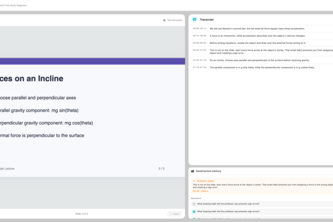
What the company appears to be: Reta is a native macOS application designed as a lecture companion for students. It follows prepared slide decks during lectures, captures spoken professor explanations not shown on slides, and stores these as searchable "Lecture Memory". The app allows users to later ask questions that are answered using stored evidence from the lecture transcript.
What changed: The project was built as part of a hackathon submission. It evolved from an ambitious vision including cloud sync, semantic embeddings, and multiple courses into a focused, offline-capable demo mode with deterministic local processing.
The single most important open question: Does Reta have any evidence of traction or adoption beyond the hackathon context? The description states no revenue, customers, or usage data exist beyond its self-reported development and demonstration.
What The Product Actually Is
The description states that Reta is a "native macOS lecture companion" which:
- Follows a prepared slide deck while a timestamped transcript advances
- Preserves professor's spoken explanations as searchable Lecture Memory
- Surfaces one restrained, source-linked Professor added insight
- Answers later questions using stored lecture evidence
- Separates Professor evidence from Slide evidence
- Shows timestamps and slide references for supported answers
- Jumps directly from a citation back to the supporting lecture moment
- Saves the completed lecture locally so it can be reviewed and reopened
The description also states that if the lecture does not contain enough evidence, Reta clearly says: "The professor has not addressed this yet."
Positioning & Claim Evolution
The author states that the inspiration behind Reta was to preserve the spoken context that never appears on slides — a problem they describe as students having to choose between listening carefully and taking complete notes.
The product's positioning evolved from an ambitious platform including accounts, cloud sync, semantic embeddings, generalized AI services, multiple courses, personalization, and cross-device review into a focused solution with:
- A reliable offline Demo Mode
- Deterministic local processing
- Manual Previous and Next controls when automatic matching is uncertain
- Source validity requirements (answers must resolve to real transcript segments)
The description indicates this was a deliberate decision to reduce scope for a hackathon submission.
Target Customer & ICP
The description states that Reta is designed for students who attend lectures and want to stay engaged while capturing professor explanations not shown on slides. It is positioned as a lecture companion for macOS users.
However, no specific customer segments or personas are identified beyond "students" and "lecturers". The description does not provide evidence of any market research or customer validation beyond the hackathon context.
Business Model & Pricing Evidence
The description makes no claims about pricing, revenue models, or monetization strategies. It states that Reta is a native macOS application built for educational use but provides no information on how it would be sold or whether there are any commercial arrangements.
Technical & Delivery Signals
The description states that Reta was built with:
- Swift and SwiftUI as a native macOS application
- PDFKit to render slide decks and extract text
- A timestamped JSON transcript fixture for Demo Mode
- Slide following using normalized lexical overlap with sequential slide bias
- Manual Previous and Next controls when automatic matching is uncertain
- Local token overlap, phrase matching, and alias map for question retrieval
- Extractive answers rather than generated prose
- Optional on-device microphone route (but Demo Mode works offline without network or microphone)
- GPT-5.6 used during development but not in the shipped app
The description also states that the app saves lectures locally as JSON snapshots and supports versioned, atomically replaced persistence.
Traction & Maturity Signals
Not evidenced. The description makes no claims about revenue, customers, usage metrics, or adoption beyond its hackathon demonstration. It explicitly states that the project is a "hackathon submission" with no archived history or independent verification.
Competitive Context
Not evidenced. The description does not mention any competitors or market positioning relative to existing solutions for lecture capture or educational technology.
Open Questions & Risks
- No traction evidence: The product exists only as a hackathon demo with no revenue, customers, or usage data
- Limited scope: The core functionality is restricted to macOS and offline Demo Mode
- Unproven market demand: No evidence of customer validation or market research beyond the author's own claims
- Single founder: Only one team member is mentioned (Rongzhi Chen)
- No commercialization path: No indication of how this would transition from a hackathon project to a product with users
Questions the description leaves open
- What specific market research or customer validation was conducted beyond the hackathon?
- How does the team plan to monetize this product if at all?
- What is the timeline for moving beyond the current demo mode to a full-featured product?
- Are there any plans to expand beyond macOS or support other platforms?
- What are the technical challenges in scaling from the current offline Demo Mode to cloud-based features?
- How does the team plan to validate that the professor's spoken explanations are actually captured and stored correctly?
Overall Assessment
Not evidenced. The description provides no information about funding rounds, valuations, or any commercial arrangements. It is a self-reported hackathon submission with no evidence of traction, revenue, or customer adoption beyond its own claims.
User Stories BotA demo video on every pull request
Get a demo video on every new feature
GitHub App that watches your pull requests and records a narrated, captioned demo.
Save time on demo prep and make informed decisions faster with a video walkthrough of every new feature.
Source
Submitted to the OpenAI 2026 hackathon on Devpost. Project home on Devpost. Back to the full gallery on Devpost.
This competitive analysis was produced by top-founders.com (opens in a new tab)
Generated by a language model from this project's public Devpost page — its tagline, the author's own write-up and any built-with tags listed there — as captured in August 2026. Short quotations are the author's words. It is an opinion on the idea as a business, not on the people behind it, and it reflects the description as published then. If the project has moved on, request a correction below. The analysis is not independent research and contains no verified traction, revenue or customer data.
An independent guide by KFG International LLC — not affiliated with, endorsed by, or connected to Devpost or OpenAI.