

Archive position — measured, not model output
0 likes on Devpost
2,263 of the 7,850 archived projects have more likes, and 5,587 share exactly 0 — so this project's #2,473 place in the like-ranked listing is a tie-break inside that group, not a ranking.
Projects (log scale)
Likes on Devpost. ▲ marks this project's group.
Show the figures
| Likes | Projects | Share of archive |
|---|---|---|
| 0 | 5,587 | 71.2% |
| 1 | 1,758 | 22.4% |
| 2 | 284 | 3.6% |
| 3–4 | 132 | 1.7% |
| 5–9 | 75 | 1.0% |
| 10+ | 14 | 0.2% |
 User Stories BotA demo video on every pull request
Get a demo video on every new feature
GitHub App that watches your pull requests and records a narrated, captioned demo.
Save time on demo prep and make informed decisions faster with a video walkthrough of every new feature.
Executive Summary
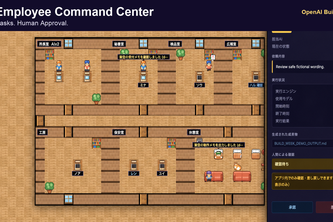
The description states that AI Employee Command Center is a local macOS application designed to connect real Codex task execution with human review. The author claims it displays AI role, execution engine, model used, deliverables, and human approval status. It was built as a hackathon submission by one person (macci Toyama) using Swift, AppKit, WebKit, JavaScript, Node.js, and Codex CLI. The project does not evidence revenue, customers, or traction beyond the author's own end-to-end tests with real Codex execution and fictional demo data.
Key open question
What is the actual commercial viability of this tool for managing AI-assisted workflows at scale?
What The Product Actually Is
The description states that AI Employee Command Center is a local macOS application. It combines:
- A native macOS shell built with Swift, AppKit, and WebKit
- A JavaScript-based interface
- A local Node.js runner
- Codex CLI task execution
- Isolated fictional demo data
- Safe local deliverable handling
The author claims it connects real Codex task execution with human review. For each task, it displays:
- Assigned AI role
- Execution engine
- Actual model selected
- Start and completion times
- Execution success or failure
- Generated deliverables
- Human approval
- Reasoned rejection and rework
The tool is described as not considering a task complete simply because an AI generated a file — only after human review and approval.
Positioning & Claim Evolution
The description states the author was inspired by visual AI workspace experiments but wanted to connect that to real workflows rather than fictional progress. The product's positioning appears to be:
- A local macOS tool for managing AI-assisted workflows
- Focused on transparency of AI execution and human review
- Designed to show which AI handled a task, what model was used, and whether results were human-approved
The claim evolution shows:
- Initial inspiration from visual AI workspaces
- Shift toward connecting visual metaphor to real workflow execution
- Emphasis on separating AI execution success from human approval
- Focus on transparency and distinction between demo data and live execution
Target Customer & ICP
Not evidenced.
Business Model & Pricing Evidence
Not evidenced.
Technical & Delivery Signals
The description states the application was built with:
- Swift, AppKit, WebKit (macOS native shell)
- JavaScript (interface)
- Node.js (runner)
- Codex CLI (task execution)
- GPT-5.6 (used during build week)
The author claims to have used Codex with GPT-5.6 to implement features including:
- Task-detail workflow
- Model recording
- Deliverable review, approval and rejection states
- Safer path handling
- Isolated demo environment
During Build Week, the author defined product direction, constrained scope, reviewed implementation plans, tested workflows, and made final product decisions.
Traction & Maturity Signals
The description states that during end-to-end tests:
- Two isolated tasks were actually executed with Codex using gpt-5.6-sol
- Both generated real Markdown deliverables
- One was rejected with a reason
- The other was approved and marked complete
The author also notes that the submission demonstrates this workflow without exposing private prompts, operational jobs, personal information, or local paths.
No evidence of revenue, customers, or adoption beyond these tests is provided.
Competitive Context
Not evidenced.
Open Questions & Risks
Inferences based on self-reported description:
- Single-person development: The project was built by one person (macci Toyama), suggesting limited scalability and potential knowledge gaps in product development.
- Limited scope: The tool is described as a hackathon submission with isolated demo data, indicating it may not be production-ready or designed for broader use cases.
- Local-only execution: The application is restricted to macOS and local execution, limiting its accessibility and integration capabilities.
- No commercial evidence: There is no evidence of revenue, customers, or market traction beyond the author's own tests.
- Unclear commercial viability: The description does not indicate how this tool would scale or be monetized in a business context.
Questions the description leaves open
- What specific workflows or use cases does this tool address that are currently underserved?
- How does the tool integrate with existing AI platforms or development environments beyond Codex?
- What is the plan for expanding beyond macOS and local execution?
- How would you envision scaling this tool for teams or organizations?
- What are the key differentiators from other workflow management or AI task tracking tools currently available?
- How do you plan to monetize this product if it's not already generating revenue?
Overall Assessment
Not evidenced.
The description states that this is a hackathon submission by one developer, with no evidence of revenue, customers, or traction beyond the author's own tests. The tool appears to be an experimental prototype focused on transparency in AI-assisted workflows rather than a commercial product. There is insufficient evidence to assess its commercial viability or potential for investment or partnership.
User Stories BotA demo video on every pull request
Get a demo video on every new feature
GitHub App that watches your pull requests and records a narrated, captioned demo.
Save time on demo prep and make informed decisions faster with a video walkthrough of every new feature.
Source
Submitted to the OpenAI 2026 hackathon on Devpost. Project home on Devpost. Back to the full gallery on Devpost.
This competitive analysis was produced by top-founders.com (opens in a new tab)
Generated by a language model from this project's public Devpost page — its tagline, the author's own write-up and any built-with tags listed there — as captured in August 2026. Short quotations are the author's words. It is an opinion on the idea as a business, not on the people behind it, and it reflects the description as published then. If the project has moved on, request a correction below. The analysis is not independent research and contains no verified traction, revenue or customer data.
An independent guide by KFG International LLC — not affiliated with, endorsed by, or connected to Devpost or OpenAI.