

Archive position — measured, not model output
0 likes on Devpost
2,263 of the 7,850 archived projects have more likes, and 5,587 share exactly 0 — so this project's #2,474 place in the like-ranked listing is a tie-break inside that group, not a ranking.
Projects (log scale)
Likes on Devpost. ▲ marks this project's group.
Show the figures
| Likes | Projects | Share of archive |
|---|---|---|
| 0 | 5,587 | 71.2% |
| 1 | 1,758 | 22.4% |
| 2 | 284 | 3.6% |
| 3–4 | 132 | 1.7% |
| 5–9 | 75 | 1.0% |
| 10+ | 14 | 0.2% |
 User Stories BotA demo video on every pull request
Get a demo video on every new feature
GitHub App that watches your pull requests and records a narrated, captioned demo.
Save time on demo prep and make informed decisions faster with a video walkthrough of every new feature.
Executive Summary
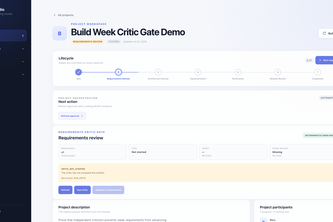
The description states that AI Engineering Studio is a self-hosted engineering workspace where specialized AI agents collaborate in a structured workflow. The system enforces independent review and human approval for project transitions, using immutable artifacts and cryptographic checksums to prevent stale approvals or reuse of prior decisions.
Key elements include:
- A team of specialized AI agents (Oliver, Mary, Winston, Amelia, Dana, Vex, Paige, Chris)
- Workflow from Requirements Review to Architecture Review with a Critic Gate
- Immutable versioning of artifacts and evidence
- Human founder approval required for transitions
- Docker-based reproducible deployment
- Use of GPT-5.6 via Codex
The author claims this is a vertical slice demonstrating one complete workflow transition, but no revenue, customers or traction data are provided.
Most important open question
What is the actual commercial viability of this system as an engineering tool? The description does not indicate whether there's any market demand for such a controlled AI engineering environment beyond the hackathon demo.
What The Product Actually Is
The description states that AI Engineering Studio is:
- A self-hosted engineering workspace
- A persistent team of specialized AI agents led by a human founder
- A system where agents produce work but cannot approve their own results
- A workflow tool that enforces independent criticism, immutable evidence, and explicit human decisions
- A system with versioned artifacts, durable agent runs, and immutable StageReview evidence
The product is described as implementing a "Critic Gate" that controls transitions between project stages (Requirements → Architecture), requiring:
- Independent review by a Critic agent
- Structured findings (PASS, REWORK, or STOP)
- Explicit human founder approval for advancement
- Immutable artifact versions and cryptographic checksums
Positioning & Claim Evolution
The description states the product is positioned as:
- A safer model for AI engineering where risks are identified from the beginning of projects
- An engineering workspace where specialized AI agents challenge each other
- A system that preserves evidence and moves projects forward only through independent review and human approval
The author's claim evolution shows:
- Initial inspiration: AI agents generate quickly but create new engineering risks
- Core positioning: A safer model with independent criticism, immutable evidence, and explicit human decisions
- Current state: Demonstrated vertical slice protecting transition from Requirements Review to Architecture Review
- Future vision: Extend same evidence-driven gates across architecture, implementation, security review, QA, documentation, and release
Target Customer & ICP
The description states:
- The target customer is a "human founder" leading a team of AI agents
- The system is designed for engineering teams that want to control AI-generated work
- The primary user is described as the "founder" who leads the workflow
- No specific industry, company size or role beyond "security professional" is mentioned
The description does not provide evidence of:
- Specific customer segments or personas
- Enterprise vs. individual use cases
- Market size or TAM
- Customer pain points beyond AI-generated risks
Business Model & Pricing Evidence
The description states:
- The system is self-hosted (no mention of SaaS model)
- No pricing information provided
- No evidence of revenue streams
- No customer acquisition or monetization strategy described
The description does not indicate:
- Whether the product will be sold as a SaaS, on-premises, or open source
- Any pricing tiers or models
- Customer lifetime value or unit economics
- Go-to-market strategy
Technical & Delivery Signals
The description states:
- Built with React and TypeScript for web console
- FastAPI and Python for backend
- PostgreSQL for persistent workflow state
- Alembic for database migrations
- Docker Compose for reproducible local deployment
- Playwright and Vitest for testing
- Pytest and PostgreSQL integration tests
- Codex with GPT-5.6 throughout development
Technical signals include:
- Versioned artifacts and cryptographic checksums
- Transactional and concurrency-safe operations
- Database constraints enforcing uniqueness and cross-project integrity
- Deterministic fake Critic provider for demo reproduction
- Fail-closed live provider path until execution isolation verified
- Immutable evidence preservation
- Exact provenance tracking
Traction & Maturity Signals
The description states:
- This is a vertical slice demonstrating one complete workflow transition
- The system was built for the OpenAI 2026 hackathon
- No revenue, customers or traction data provided beyond the demo
- The author mentions "accomplishments" but no metrics or adoption
Traction signals:
- Not evidenced
- No user base, customer acquisition, or usage metrics
- No market validation or product-market fit evidence
- No commercial relationships or partnerships mentioned
Competitive Context
The description states:
- No direct competitors mentioned
- The author positions the system as a safer model for AI engineering
- Focus on independent review and human control over AI-generated work
- No mention of existing tools in this space
Competitive signals:
- Not evidenced
- No analysis of existing AI engineering tools or platforms
- No comparison to similar systems or market positioning
- No evidence of competitive advantages or differentiation
Open Questions & Risks
The description states:
- The most difficult part was making the Critic response trustworthy enough to control a real workflow transition
- Implementation had to prevent stale approvals from authorizing newer requirements
- Challenges included preventing reviews from being attached to wrong project or artifact
- Need for execution isolation verification before live provider path
- Demo behavior depending on external APIs (mentioned as challenge but not resolved)
Key risks:
- Trustworthiness of the Critic agent implementation
- Execution isolation and security verification needed before production use
- No evidence of market demand or customer validation
- Self-hosted model may limit adoption compared to SaaS solutions
- Limited scope (only Requirements → Architecture transition demonstrated)
- Dependency on Codex with GPT-5.6 for development
Questions the description leaves open
- What specific engineering risks are you trying to solve that current AI tools don't address?
- How do you plan to validate the trustworthiness of the Critic agent in production?
- What is your go-to-market strategy for enterprise adoption?
- How does this solution compare to existing workflow management or code review platforms?
- What are the key technical challenges that remain before this can be used in production?
- How do you plan to handle model drift and ensure consistent performance over time?
- What is your roadmap for expanding beyond the current Requirements → Architecture transition?
- How will you address the complexity of managing multiple specialized agents?
- What are the security implications of self-hosting this system?
- How do you plan to monetize this product if it's self-hosted?
Overall Assessment
The description states:
- This is a vertical slice demonstrating one complete workflow transition
- The author built it for a hackathon
- No revenue, customers or traction data provided
- The system is self-hosted with no clear monetization model
Assessment:
- Not evidenced - No commercial viability assessment possible
- Confidence: Low - Only a hackathon demo exists with no market validation
- Risk level: High - No evidence of product-market fit, revenue model or customer traction
- Investment potential: Unclear - Requires further validation of market demand and technical feasibility before considering investment or partnership opportunities
User Stories BotA demo video on every pull request
Get a demo video on every new feature
GitHub App that watches your pull requests and records a narrated, captioned demo.
Save time on demo prep and make informed decisions faster with a video walkthrough of every new feature.
Source
Submitted to the OpenAI 2026 hackathon on Devpost. Project home on Devpost. Back to the full gallery on Devpost.
This competitive analysis was produced by top-founders.com (opens in a new tab)
Generated by a language model from this project's public Devpost page — its tagline, the author's own write-up and any built-with tags listed there — as captured in August 2026. Short quotations are the author's words. It is an opinion on the idea as a business, not on the people behind it, and it reflects the description as published then. If the project has moved on, request a correction below. The analysis is not independent research and contains no verified traction, revenue or customer data.
An independent guide by KFG International LLC — not affiliated with, endorsed by, or connected to Devpost or OpenAI.