

Archive position — measured, not model output
0 likes on Devpost
2,263 of the 7,850 archived projects have more likes, and 5,587 share exactly 0 — so this project's #6,400 place in the like-ranked listing is a tie-break inside that group, not a ranking.
Projects (log scale)
Likes on Devpost. ▲ marks this project's group.
Show the figures
| Likes | Projects | Share of archive |
|---|---|---|
| 0 | 5,587 | 71.2% |
| 1 | 1,758 | 22.4% |
| 2 | 284 | 3.6% |
| 3–4 | 132 | 1.7% |
| 5–9 | 75 | 1.0% |
| 10+ | 14 | 0.2% |
 User Stories BotA demo video on every pull request
Get a demo video on every new feature
GitHub App that watches your pull requests and records a narrated, captioned demo.
Save time on demo prep and make informed decisions faster with a video walkthrough of every new feature.
Executive Summary
Project: Retouch Lite
Self-reported basis: The analysis is based entirely on the author’s own description of Retouch Lite, submitted as part of a hackathon project on Devpost. No external verification, revenue, customer or traction data is available beyond what is stated in the description.
What it appears to be: Retouch Lite is a self-contained Python-based tool that automates portrait retouching using image processing and local AI logic. It allows users to upload a portrait photo or short video, select from preset looks or describe desired edits in natural language, and preview results side-by-side with the original.
What changed: The project evolved from an algorithmic prototype into a full user experience, emphasizing simplicity and usability over feature complexity. It was built as a hackathon submission and is currently offline, using local keyword mapping instead of external AI services.
Single most important open question: Is there evidence that Retouch Lite can scale beyond the hackathon prototype to support real-world adoption, including more sophisticated natural language understanding, video handling, and export capabilities?
What The Product Actually Is
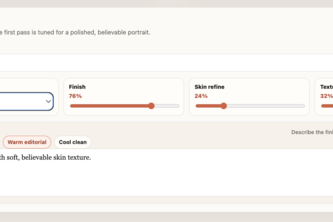
The description states that Retouch Lite is a Python-based tool for portrait retouching. It uses OpenCV and a local retouching engine built by the author. It supports uploading portraits or short videos, selecting from preset looks, adjusting skin refinement and texture manually, or describing desired edits in natural language (e.g., “warm editorial” or “soft natural lighting”). The system shows original and edited versions side-by-side for comparison.
- Evidenced: Yes — the author describes the tool’s functionality and interface.
- Inferred: No — no evidence of actual product delivery, customer usage, or technical performance beyond prototype stage.
Positioning & Claim Evolution
The author claims Retouch Lite brings professional portrait retouching into a fully automated workflow. It is positioned as a simplified alternative to traditional editing software that uses "dozens of sliders" and requires learning complex tools.
- Evidenced: Yes — the author states this in both the inspiration and what it does sections.
- Inferred: No — no evidence of market positioning, branding, or customer feedback on the product’s value proposition.
The claim has evolved from a hackathon prototype to a vision for a tool that could be used day-to-day. The author notes they “held back on feature creep” and focused on usability, indicating an early-stage evolution toward a more polished experience.
Target Customer & ICP
The description does not state the target customer or ideal customer profile (ICP). It implies the product is for individuals who want to edit portraits without needing professional editing skills, but no explicit segmentation or persona is defined.
- Evidenced: No — no mention of specific user types, demographics, or use cases.
- Inferred: The author suggests a general audience interested in portrait editing, but this is not confirmed.
Business Model & Pricing Evidence
There is no evidence of a business model or pricing structure. The project is described as a hackathon prototype with no mention of monetization, subscriptions, or paid features.
- Evidenced: No — the description does not include any financial or commercial details.
- Inferred: No — no indication of how the product would be sold or funded.
Technical & Delivery Signals
The project is built using Python, OpenCV, and a local retouching engine. It uses GPT-5.6 to assist in development but does not rely on external AI services for core functionality. The system supports drag-and-drop uploads, live previews, and text-based look descriptions.
- Evidenced: Yes — the author describes the tech stack and delivery features.
- Inferred: No — no evidence of scalability, performance metrics, or production deployment.
The project is offline and does not require API keys. It currently maps common phrases to local presets, but the author plans to replace this with a GPT-powered system for richer input interpretation.
Traction & Maturity Signals
There is no evidence of traction, customers, or adoption beyond the hackathon submission. The product is described as a prototype and has not been released to users or commercialized.
- Evidenced: No — no data on usage, revenue, or customer base.
- Inferred: No — no signs of market validation or product maturity beyond the initial build.
Competitive Context
The description does not mention competitors or the broader marketplace. It implies Retouch Lite is an alternative to traditional editing software that uses many sliders, but no comparison to existing tools or platforms is made.
- Evidenced: No — no mention of competitive landscape.
- Inferred: The author suggests a gap in the market for simpler tools, but this is not confirmed.
Open Questions & Risks
- Prototype-only status: The product is described as a hackathon prototype with no evidence of real-world testing or adoption.
- No monetization strategy: No business model or pricing structure is evident.
- Limited functionality: The current system uses keyword mapping instead of advanced NLP, which may limit scalability and user experience.
- Offline-only design: The lack of external AI services may restrict capabilities in the long term.
- Single-person team: The project was built by one person (Looi Brian), raising questions about future development capacity.
Questions the description leaves open
- What is the current state of the retouching engine? Is it ready for production use?
- How does the keyword-to-preset mapping system work, and what are its limitations?
- Are there plans to integrate external AI services or APIs in the near term?
- What is the roadmap for video support, export options, and project saving?
- Has the product been tested with real users beyond the hackathon?
- How does the team plan to scale beyond a single developer?
Overall Assessment
Not evidenced: No data on financials, traction, or commercial viability is available.
Confidence level: Low — this is a self-reported prototype with no external validation or evidence of product-market fit, revenue, or customer adoption.
Assessment: Retouch Lite appears to be an early-stage idea with potential but lacks the evidence to support investment or partnership interest. It would require further development, user testing, and commercialization planning before any strategic move could be justified.
User Stories BotA demo video on every pull request
Get a demo video on every new feature
GitHub App that watches your pull requests and records a narrated, captioned demo.
Save time on demo prep and make informed decisions faster with a video walkthrough of every new feature.
Source
Submitted to the OpenAI 2026 hackathon on Devpost. Project home on Devpost. Back to the full gallery on Devpost.
This competitive analysis was produced by top-founders.com (opens in a new tab)
Generated by a language model from this project's public Devpost page — its tagline, the author's own write-up and any built-with tags listed there — as captured in August 2026. Short quotations are the author's words. It is an opinion on the idea as a business, not on the people behind it, and it reflects the description as published then. If the project has moved on, request a correction below. The analysis is not independent research and contains no verified traction, revenue or customer data.
An independent guide by KFG International LLC — not affiliated with, endorsed by, or connected to Devpost or OpenAI.