

Archive position — measured, not model output
1 like on Devpost
505 of the 7,850 archived projects have more likes, and 1,758 share exactly 1 — so this project's #513 place in the like-ranked listing is a tie-break inside that group, not a ranking.
Projects (log scale)
Likes on Devpost. ▲ marks this project's group.
Show the figures
| Likes | Projects | Share of archive |
|---|---|---|
| 0 | 5,587 | 71.2% |
| 1 | 1,758 | 22.4% |
| 2 | 284 | 3.6% |
| 3–4 | 132 | 1.7% |
| 5–9 | 75 | 1.0% |
| 10+ | 14 | 0.2% |
 User Stories BotA demo video on every pull request
Get a demo video on every new feature
GitHub App that watches your pull requests and records a narrated, captioned demo.
Save time on demo prep and make informed decisions faster with a video walkthrough of every new feature.
Executive Summary
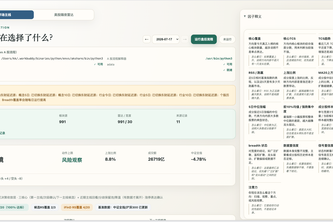
The description states that A-Share Market Rotation Signal Lab is a free-data-first system designed to detect, track, and validate A-share market rotation signals across multiple time horizons (T+1 to T+20). It is built as a local Python application with SQLite backend and dashboard interface. The system freezes signals as historical snapshots, tracks them over time, and evaluates performance using cumulative returns, excess returns, and risk metrics.
The author describes the project as evolving from a market-rotation dashboard into a signal validation platform that does not place trades or alter live decisions but measures whether existing signals remain useful across different market environments. The system uses free data sources like AKShare and Tonghuashun (THS), with paid iFinD access only as an emergency fallback.
Key commercial due-diligence questions include: What is the actual business model? How does this product relate to current market practices or existing solutions? Is there any evidence of traction, customers, or revenue generation beyond the author's own development work?
The single most important open question is whether this system has any commercial application beyond personal use or academic research — i.e., if it can be monetized or adopted by others in a way that generates value.
What The Product Actually Is
- The description states that the product is a local Python application with a SQLite data layer and dashboard interface.
- It detects and tracks A-share market-rotation signals such as:
- Primary mainlines
- Secondary confirmations
- Candidate or warming sectors
- Upgrades
- Cooling sectors
- Signals are frozen as historical snapshots to prevent rewriting after outcomes become known.
- The system follows signals over multiple horizons (T+1, T+3, T+5 for short-term; T+10, T+20 for medium-term).
- It calculates performance metrics including:
- Cumulative return
- Excess return versus CSI All Share and CSI 300
- Maximum favorable excursion (MFE)
- Maximum adverse excursion (MAE)
- Maximum drawdown
- Basket coverage
- Whether the signal succeeded or transitioned correctly
- The system groups results by signal type, market environment, and episode.
- It includes a read-only Signal Validation Center showing:
- Short-term and medium-term performance
- Results by signal type and market environment
- Candidate-to-active transitions
- Upgrade-to-mainline transitions
- Mainline persistence
- Cooling-to-weakness outcomes
- Recent events and window maturity
- Historical backfill is clearly separated from real-time observations.
- The system prioritizes free data sources like AKShare, Tonghuashun (THS), and local caches; paid iFinD access used only as emergency fallback.
Positioning & Claim Evolution
- The description states that the project began as a market-rotation dashboard and evolved into a free-data-first signal validation platform.
- The author’s stated purpose is to answer a question most dashboards leave unanswered: “After a signal is generated, did it actually work?”
- The system is positioned not to place trades or automatically change investment decisions but to measure whether the system’s existing signals remain useful across different market environments.
- It emphasizes that the platform is not altering live decisions, and future calibration will require sufficient samples, historical replay, shadow testing, versioning, and explicit approval.
- The author claims the system is designed so that validation informs future rule review without silently changing the live strategy.
Target Customer & ICP
- Not evidenced. The description does not identify any specific customer segments or target users beyond the author’s own use case.
Business Model & Pricing Evidence
- Not evidenced. There is no mention of pricing, monetization, or business model in the description.
- The system is described as a free-data-first platform using only free data sources.
- It is built for personal or internal use and not presented as a commercial product or service.
Technical & Delivery Signals
- Built as a local Python application with a SQLite data layer and dashboard interface.
- Uses free data sources such as:
- AKShare
- Tonghuashun (THS)
- Local historical caches
- Paid iFinD access only as emergency fallback
- Data acquisition architecture prioritizes free sources, with explicit provenance tracking, freshness validation, and coverage information.
- Signal lifecycle includes:
- Pending → Official
- Pending → Aborted
- Signals are frozen first, tracked over future trading days, verified when windows mature, and only then finalized.
- Re-running the pipeline is idempotent and does not overwrite valid results.
- The dashboard shows:
- Short-term and medium-term performance
- Results by signal type and market environment
- Candidate-to-active transitions
- Upgrade-to-mainline transitions
- Mainline persistence
- Cooling-to-weakness outcomes
- Real-time samples versus historical backfill samples
- Historical backfill is clearly separated from real-time observations.
- The system distinguishes between:
- Data quality
- Sample sufficiency
- Historical reference results
- Real-time algorithm fit
Traction & Maturity Signals
- Not evidenced. There is no mention of revenue, customers, or adoption beyond the author’s own development work.
- The description states that the system contains:
- 98 historical backfill events
- 35 episodes
- 490 verification windows
- 278 mature windows
- 202 pending windows
- 10 insufficient-data windows
- 0 iFinD calls for the free-data backfill
- These numbers reflect internal development and historical data processing, not external usage or commercial traction.
Competitive Context
- Not evidenced. The description does not reference any competitors or existing products in the market.
- No comparison to other tools or platforms for A-share market rotation signal detection or validation is provided.
Open Questions & Risks
- Lack of commercial application: The system is described as a personal tool, not a product for sale or adoption by others.
- No evidence of monetization: There is no indication that the project intends to generate revenue or attract customers.
- Limited scalability: Built as a local Python app with SQLite backend; unclear if it can scale beyond individual use.
- Free-data-first approach may limit functionality: Heavy reliance on free data sources could restrict access to richer or more timely information.
- No external validation or feedback loops: The system is self-contained and does not appear to integrate with or influence broader market practices.
Questions the description leaves open
- What is the intended commercial use case for this platform?
- Are there any plans to monetize or offer this as a service?
- How would you envision integrating this into existing investment workflows or platforms?
- Is there any interest from institutional investors or financial firms in adopting or using this system?
- What are the technical limitations of scaling this beyond a single-user, local setup?
- How does this platform differ from or complement other tools currently used for A-share market analysis?
Overall Assessment
- Not evidenced. There is no evidence of revenue, customers, or traction to support an investment or partnership decision.
- The project appears to be a personal development effort rather than a commercial product or service.
- No indication that the system has been adopted by others or offers any clear path to monetization or growth.
- The author describes it as a tool for measuring signal validity, not placing trades or altering live decisions — suggesting limited commercial relevance beyond personal use.
User Stories BotA demo video on every pull request
Get a demo video on every new feature
GitHub App that watches your pull requests and records a narrated, captioned demo.
Save time on demo prep and make informed decisions faster with a video walkthrough of every new feature.
Source
Submitted to the OpenAI 2026 hackathon on Devpost. Project home on Devpost. Back to the full gallery on Devpost.
This competitive analysis was produced by top-founders.com (opens in a new tab)
Generated by a language model from this project's public Devpost page — its tagline, the author's own write-up and any built-with tags listed there — as captured in August 2026. Short quotations are the author's words. It is an opinion on the idea as a business, not on the people behind it, and it reflects the description as published then. If the project has moved on, request a correction below. The analysis is not independent research and contains no verified traction, revenue or customer data.
An independent guide by KFG International LLC — not affiliated with, endorsed by, or connected to Devpost or OpenAI.