

Archive position — measured, not model output
1 like on Devpost
505 of the 7,850 archived projects have more likes, and 1,758 share exactly 1 — so this project's #515 place in the like-ranked listing is a tie-break inside that group, not a ranking.
Projects (log scale)
Likes on Devpost. ▲ marks this project's group.
Show the figures
| Likes | Projects | Share of archive |
|---|---|---|
| 0 | 5,587 | 71.2% |
| 1 | 1,758 | 22.4% |
| 2 | 284 | 3.6% |
| 3–4 | 132 | 1.7% |
| 5–9 | 75 | 1.0% |
| 10+ | 14 | 0.2% |
 User Stories BotA demo video on every pull request
Get a demo video on every new feature
GitHub App that watches your pull requests and records a narrated, captioned demo.
Save time on demo prep and make informed decisions faster with a video walkthrough of every new feature.
Executive Summary
What the company appears to be
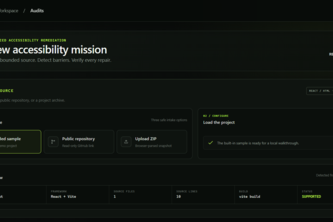
Access Forge is a developer tool that automates accessibility repair workflows by transforming accessibility findings into bounded, explainable, and independently verified source-code repairs. It accepts React or HTML projects via GitHub repository, ZIP upload, or sample project, and uses GPT-5.6 for structured repair planning while applying deterministic checks for verification.
What changed
The author describes a shift from generic accessibility scanning to an integrated audit-to-repair system that separates AI generation from verification. The tool is built with a focus on safety, reproducibility, and trustworthiness, especially in how it handles untrusted inputs and prevents fabricated evidence.
Single most important open question
Does the described workflow actually deliver on its promise of verified repairs without modifying the original repository? This hinges on whether the deterministic verification engine can reliably validate GPT-generated changes, and whether the system is robust enough to handle real-world edge cases in production environments.
What The Product Actually Is
The description states that Access Forge is a tool that:
- Accepts projects through:
- A React sample included with the tool
- Public GitHub repositories (read-only access)
- Locally uploaded ZIP archives
- Compiles user-defined journeys into editable steps and scans source code for accessibility barriers.
- Provides findings including:
- Affected file and line number
- Source-code excerpt
- Severity and WCAG criterion
- Plain-language explanation
- Bounded repair guidance
- Uses GPT-5.6 to generate a structured repair plan based on the user journey, reproduced findings, and source files.
- Applies repairs only to an isolated copy of the project.
- Sends repaired files to a verification endpoint that reruns deterministic accessibility rules.
- Exports:
- A reviewable source patch
- A repaired ZIP file
- A structured evidence report
- Never modifies the original repository.
The system is built with React, TypeScript, Next.js, OpenAI’s Responses API, GPT-5.6, Zod for schema validation, JSZip, and deterministic JavaScript analysis.
Inference Access Forge appears to be a prototype or proof-of-concept tool aimed at developers who want to automate accessibility fixes in their frontend codebases. It is not described as a commercial product with customers or revenue streams.
Positioning & Claim Evolution
The author states that Access Forge was built to close the gap between accessibility testing and actual repair:
“Accessibility testing often stops at a list of warnings. Developers still have to locate the responsible code, understand the problem, choose a safe repair, verify it, and prepare something that can be reviewed or merged.”
It positions itself as an alternative to generic scanners by offering:
- Bounded, explainable repairs
- Independent verification
- No modification of the original repository
The tool explicitly avoids claiming:
- Browser screenshots
- Live DOM replay
- Full WCAG certification
Instead, it emphasizes:
- Static source analysis
- Deterministic checks
- Clear authority boundaries between AI planning and verification
Inference Access Forge is positioned as a developer-centric tool for improving accessibility workflows, not as a replacement for human accessibility experts. It aims to reduce friction in the repair process while maintaining trust through transparency.
Target Customer & ICP
The description does not name specific customers or personas. However, it implies:
- Developers working on React or HTML projects
- Teams looking to improve accessibility compliance
- Users who want to automate parts of their accessibility workflow
It also notes that the tool supports:
- React and Next.js projects
- Static HTML projects
- Vite-based builds
Inference The ICP likely includes frontend developers, engineering teams, or product managers focused on accessibility. The tool is not described as targeting enterprise clients or large-scale deployment.
Business Model & Pricing Evidence
There is no mention of pricing, monetization, or business model in the description.
Not evidenced
Technical & Delivery Signals
The system consists of four main services:
- Project intake: Loads bounded source files and detects framework, package manager, build configuration.
- Audit engine: Runs deterministic accessibility rules across multiple source files.
- Repair engine: Combines GPT-5.6 structured plan with controlled transformations.
- Verification engine: Reruns deterministic rules against patched files.
Key technical elements include:
- Use of GPT-5.6 via OpenAI Responses API
- Structured outputs using Zod schema
- JSZip for handling ZIP archives
- Deterministic JavaScript analysis and repair rules
- Read-only intake pipeline with security limits
The system includes fallback mode when GPT-5.6 or network is unavailable.
Inference Access Forge is built as a secure, modular tool that separates AI planning from verification. It uses modern frontend tech (React, Next.js) and integrates with OpenAI APIs for structured output generation.
Traction & Maturity Signals
The description does not provide any evidence of:
- Revenue
- Customers
- User adoption
- Product usage metrics
- Market traction
It is described as a hackathon submission to the OpenAI 2026 hackathon, and the author notes it’s a prototype.
Not evidenced
Competitive Context
The description does not mention competitors or existing tools in the accessibility space. It only states that Access Forge aims to be different from generic scanners by providing bounded, explainable repairs with independent verification.
Not evidenced
Open Questions & Risks
- Verification reliability: The system relies on deterministic checks to validate GPT-generated repairs. It is unclear whether this approach will scale or handle complex edge cases.
- AI dependency: While the tool uses GPT-5.6 for planning, it does not claim to replace human judgment. However, if the AI fails to produce accurate plans, the entire workflow may be compromised.
- Security assumptions: The system assumes that input projects are safe and reproducible, but real-world usage could introduce unexpected behaviors or vulnerabilities.
- Limited scope: The current version only supports static source analysis; future browser runner is described as a next phase. This suggests limited maturity in runtime behavior verification.
Inference Access Forge is a promising concept with strong safety mechanisms, but its effectiveness depends heavily on the robustness of both AI planning and deterministic verification components.
Questions the description leaves open
- How does the deterministic verification engine handle edge cases where GPT-generated repairs are ambiguous or incomplete?
- What are the limitations of the current static analysis approach in detecting real-world accessibility issues?
- Has the tool been tested with actual production codebases, or is it limited to sample projects?
- Are there any known failures or false positives in the current verification process?
- How does the system handle large or complex projects that exceed file size or count limits?
- What are the plans for integrating CI/CD pipelines or GitHub pull request automation?
- How does Access Forge ensure that GPT-5.6 responses align with actual user journeys and not just abstracted inputs?
Overall Assessment
The description indicates a prototype tool built as part of a hackathon submission, with no evidence of commercial traction or revenue.
Not evidenced
Given the self-reported nature of the information and lack of third-party validation, this is a speculative assessment. The tool shows potential for addressing a real developer pain point but lacks demonstrated market readiness or scalability.
If the founders are seeking investment or partnership, they should demonstrate:
- Early user feedback
- Proof-of-concept with real-world projects
- A clearer path to monetization or integration into existing workflows
Until such evidence is provided, Access Forge remains an unproven concept with strong technical foundations but unknown commercial viability.
User Stories BotA demo video on every pull request
Get a demo video on every new feature
GitHub App that watches your pull requests and records a narrated, captioned demo.
Save time on demo prep and make informed decisions faster with a video walkthrough of every new feature.
Source
Submitted to the OpenAI 2026 hackathon on Devpost. Project home on Devpost. Back to the full gallery on Devpost.
This competitive analysis was produced by top-founders.com (opens in a new tab)
Generated by a language model from this project's public Devpost page — its tagline, the author's own write-up and any built-with tags listed there — as captured in August 2026. Short quotations are the author's words. It is an opinion on the idea as a business, not on the people behind it, and it reflects the description as published then. If the project has moved on, request a correction below. The analysis is not independent research and contains no verified traction, revenue or customer data.
An independent guide by KFG International LLC — not affiliated with, endorsed by, or connected to Devpost or OpenAI.