

Archive position — measured, not model output
1 like on Devpost
505 of the 7,850 archived projects have more likes, and 1,758 share exactly 1 — so this project's #516 place in the like-ranked listing is a tie-break inside that group, not a ranking.
Projects (log scale)
Likes on Devpost. ▲ marks this project's group.
Show the figures
| Likes | Projects | Share of archive |
|---|---|---|
| 0 | 5,587 | 71.2% |
| 1 | 1,758 | 22.4% |
| 2 | 284 | 3.6% |
| 3–4 | 132 | 1.7% |
| 5–9 | 75 | 1.0% |
| 10+ | 14 | 0.2% |
 User Stories BotA demo video on every pull request
Get a demo video on every new feature
GitHub App that watches your pull requests and records a narrated, captioned demo.
Save time on demo prep and make informed decisions faster with a video walkthrough of every new feature.
Executive Summary
Project: AccessPilot
Self-reported basis: The description is entirely from the author’s own submission to the OpenAI 2026 hackathon on Devpost. No external verification or archived evidence exists for this analysis.
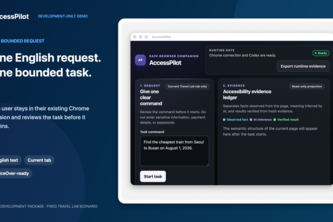
AccessPilot is a macOS companion tool designed for VoiceOver users, intended to assist with browser-based tasks through AI interpretation while maintaining strict control over sensitive inputs and actions. It operates as a development-only prototype, combining an Electron app, Chrome extension, and Swift native messaging relay. The system uses GPT-5.6 for semantic inference but enforces deterministic policy boundaries that prevent model-driven execution of sensitive operations.
The product claims to support only bounded AI assistance — interpreting page semantics without acting on them directly — with explicit user confirmation before any sensitive input or action. It separates observed facts from AI inference, and requires fresh verification after each browser action.
Most Important Open Question: Does the described architecture and workflow actually enforce its stated security and control boundaries in practice, especially across trust boundaries like renderer, desktop process, and browser page?
What The Product Actually Is
The description states that AccessPilot is a development-only macOS companion for VoiceOver users, built using Electron, Swift, TypeScript, and GPT-5.6.
It consists of:
- An Electron macOS companion
- A Chrome Connector extension
- A Swift native-messaging relay
- Closed TypeScript protocols
- An isolated Codex CLI profile
The system is designed to:
- Allow users to describe a task in plain English while staying in the current Chrome tab
- Separate observed page facts from GPT-5.6 semantic inference
- Present planned actions in an accessible command workspace
- Require one-time confirmation before every sensitive L2 field input
- Take fresh page snapshots after each approved action, re-resolving targets and verifying postconditions
It does not insert ARIA labels or modify the DOM for accessibility repair.
Inference: The product appears to be a proof-of-concept prototype built during a hackathon, focused on secure interaction between AI and assistive technology in macOS environments.
Positioning & Claim Evolution
The author states that AccessPilot was inspired by the challenge of helping blind and low-vision users navigate forms that are visually understandable but poorly exposed to assistive tech. The core question explored was whether AI could help interpret broken semantics without becoming an unbounded browser agent.
Key claims:
- AI is used for interpretation, not authority
- The system enforces explicit approval before sensitive input
- It supports bounded semantic annotations and plans
- It verifies postconditions after every action
- It filters sensitive data (passwords, OTPs, identity data) from model inputs or logs
The positioning evolves from a general exploration of AI-assisted accessibility to a specific focus on secure, deterministic interaction with assistive technologies, where AI supports understanding but does not execute.
Inference: The project positions itself as a secure and trustworthy tool for accessibility, emphasizing control over AI interpretation rather than delegation of action.
Target Customer & ICP
The description states that AccessPilot is designed for VoiceOver users, particularly those who are blind or low-vision.
It targets:
- Users navigating web forms with poor assistive technology exposure
- Developers or researchers working on accessibility tools
- A narrow audience within the macOS ecosystem
There is no indication of broader customer segments, such as enterprise clients or general consumers. The product is described as development-only, suggesting it is not yet intended for end-user consumption.
Inference: The ICP is limited to a niche group of VoiceOver users and developers involved in accessibility research or development.
Business Model & Pricing Evidence
Not evidenced.
The description does not mention any pricing, monetization strategy, or business model. It is presented as a hackathon submission with no commercial traction or revenue data.
Technical & Delivery Signals
The system uses:
- Electron for macOS companion
- Chrome Connector extension
- Swift native-messaging relay
- GPT-5.6 for semantic interpretation
- Codex CLI profile for schema enforcement and testing
- TypeScript and Vitest for frontend logic and testing
- Zod for schema validation
Key technical features:
- Separation of observed facts from AI inference
- Fresh page snapshot verification after each action
- One-time confirmation before sensitive input
- Filtering of L3/L4 flows (passwords, OTPs, etc.) from model or action paths
- No Node, shell, credential, connector, or raw action authority in renderer code
Inference: The architecture is designed with strong security and control boundaries, aiming to avoid unauthorized access or execution.
Traction & Maturity Signals
Not evidenced.
There is no mention of:
- Revenue
- Customers
- Adoption
- Product usage metrics
- Deployment history
The project is described as a development-only prototype built during a hackathon. It includes:
- 1,068 TypeScript and Vitest checks plus 55 Swift tests (1,123 total)
- A deterministic English demo with burned-in captions
- No simulated behavior or product simulation
Inference: The project is in early development stage, likely not yet released to users.
Competitive Context
Not evidenced.
The description does not reference existing competitors or similar products. It focuses on the novelty of its approach to secure AI-assisted accessibility rather than market positioning or competitive analysis.
Open Questions & Risks
- Unverified claims: The system’s security and control boundaries are self-reported, with no independent validation.
- Development-only scope: No indication of production readiness or user adoption.
- Limited trust model: Relies heavily on strict architectural separation across multiple trust zones (renderer, desktop main process, native messaging, browser page).
- No commercialization path: No evidence of monetization or business model beyond the hackathon submission.
Inference: The project is a secure prototype but lacks real-world testing and commercial viability indicators.
Questions the description leaves open
- How was the trust boundary enforcement validated in practice? Was there any adversarial testing?
- What are the actual limitations of GPT-5.6 in interpreting page semantics, and how does the system handle edge cases or ambiguous inputs?
- Is there a plan to expand beyond macOS or support other assistive technologies like screen readers on Windows?
- How would the system behave if a browser extension or native relay failed during an operation?
- What is the long-term vision for moving from a development-only prototype to a production-ready tool?
Overall Assessment
Not evidenced.
There is no indication of funding, investor interest, or partnership discussions. The project is described as a hackathon submission with no commercial traction or financial backing.
Inference: This is a proof-of-concept prototype with strong technical design but no demonstrated market readiness or investment interest. It may be suitable for early-stage R&D or accessibility-focused grants, but not for traditional investment or partnership evaluation.
User Stories BotA demo video on every pull request
Get a demo video on every new feature
GitHub App that watches your pull requests and records a narrated, captioned demo.
Save time on demo prep and make informed decisions faster with a video walkthrough of every new feature.
Source
Submitted to the OpenAI 2026 hackathon on Devpost. Project home on Devpost. Back to the full gallery on Devpost.
This competitive analysis was produced by top-founders.com (opens in a new tab)
Generated by a language model from this project's public Devpost page — its tagline, the author's own write-up and any built-with tags listed there — as captured in August 2026. Short quotations are the author's words. It is an opinion on the idea as a business, not on the people behind it, and it reflects the description as published then. If the project has moved on, request a correction below. The analysis is not independent research and contains no verified traction, revenue or customer data.
An independent guide by KFG International LLC — not affiliated with, endorsed by, or connected to Devpost or OpenAI.