

Archive position — measured, not model output
1 like on Devpost
505 of the 7,850 archived projects have more likes, and 1,758 share exactly 1 — so this project's #517 place in the like-ranked listing is a tie-break inside that group, not a ranking.
Projects (log scale)
Likes on Devpost. ▲ marks this project's group.
Show the figures
| Likes | Projects | Share of archive |
|---|---|---|
| 0 | 5,587 | 71.2% |
| 1 | 1,758 | 22.4% |
| 2 | 284 | 3.6% |
| 3–4 | 132 | 1.7% |
| 5–9 | 75 | 1.0% |
| 10+ | 14 | 0.2% |
 User Stories BotA demo video on every pull request
Get a demo video on every new feature
GitHub App that watches your pull requests and records a narrated, captioned demo.
Save time on demo prep and make informed decisions faster with a video walkthrough of every new feature.
Executive Summary
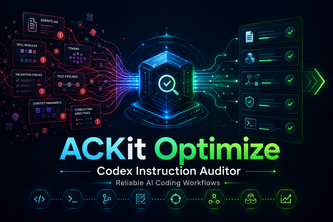
What the company appears to be: ACKit Optimize — Codex Instruction Auditor is a command-line tool designed to audit and optimize instruction files (e.g., AGENTS.md) used by AI coding agents like Codex. It operates offline, does not rewrite source files, and generates non-destructive optimization proposals.
What changed: The project evolved from an earlier tool called AgentContextKit into a new component named ACKit Optimize during the OpenAI Build Week 2026 hackathon. This version adds functionality for auditing instruction layers before they are used in AI coding workflows.
Single most important open question: Is there any evidence of real-world usage or adoption beyond the author's own development environment and synthetic demo?
What The Product Actually Is
The description states that ACKit Optimize is a command-line tool named ackit optimize. It discovers and resolves scope, inheritance, and precedence across AGENTS.md and other instruction surfaces. It detects duplicates, contradictions, conflicts, vague rules, and unsafe actions. It produces reports in multiple formats (console, JSON, Markdown, SARIF, HTML) and generates an explicit-path optimization proposal without modifying source files.
- Claimed functionality: Instruction auditing and optimization for AI coding agents.
- Technical implementation: Cross-platform C#/.NET 10 CLI application.
- Key features:
- Detects conflicts and token waste
- Generates execution-ready goals
- Turns user corrections into regression tests
- Runs locally without API key or network service
- Non-destructive workflow (no
--applymode) - Supports multiple output formats
Inference: The tool is built for developers working with AI agents in software repositories. It appears to be a static analysis tool focused on instruction quality.
Not evidenced: No actual product usage, customer feedback, or real-world deployment data.
Positioning & Claim Evolution
The author positions ACKit Optimize as a tool that audits and optimizes the instruction layer supplied to Codex and other AI coding agents. It aims to prevent "expensive, confusing, or unsafe" outcomes by detecting issues in AGENTS.md and related files.
- Original context: Built during OpenAI Build Week 2026.
- Evolution from AgentContextKit: The tool was extended from a previous offline-first repository preparation tool.
- Core value proposition: Ensures quality of AI agent instructions through deterministic local analysis, reducing ambiguity and repetition while preserving safety.
Claim: The tool helps developers maintain clean, safe, and effective AI coding workflows.
Inference: It targets developers who use AI agents in software projects where instruction consistency is critical.
Not evidenced: No evidence of market positioning beyond the hackathon submission or any commercial messaging.
Target Customer & ICP
The description implies that ACKit Optimize serves developers working with AI coding agents (e.g., Codex), particularly those managing complex repositories with scattered or inconsistent instructions across multiple files like AGENTS.md.
- Target persona: Software engineers or DevOps practitioners using AI-assisted development tools.
- Use case: Auditing and optimizing instruction sets for AI agents in software projects.
- ICP (Ideal Customer Profile): Teams that rely on structured agent instructions, especially those with evolving codebases where instruction consistency matters.
Inference: Likely used by teams building or maintaining AI coding workflows in large-scale software development environments.
Not evidenced: No stated customers, user personas, or market segmentation data.
Business Model & Pricing Evidence
The description does not contain any information about pricing, monetization strategy, or business model.
- No pricing details
- No indication of paid features or subscriptions
- No mention of licensing models
Not evidenced: No evidence of a commercial business model or revenue streams.
Technical & Delivery Signals
The tool is implemented as a cross-platform C#/.NET 10 command-line application. It integrates with existing architecture rather than being a standalone prototype.
- Technology stack: .NET 10, C#, bash, PowerShell, YAML, JSON, Markdown, Git, GitHub Actions.
- Delivery method: CLI-based tool; no web UI or API mentioned.
- Key technical features:
- Deterministic behavior
- Offline-first operation
- No required API keys
- Supports multiple output formats (SARIF, HTML, JSON, etc.)
- Non-destructive workflow
Inference: The tool is designed for developers who value reproducibility and control over their development environments.
Not evidenced: No evidence of scalability, cloud integration, or enterprise delivery mechanisms.
Traction & Maturity Signals
There is no evidence of traction, adoption, or user engagement beyond the author’s own development and demo.
- Team size: 0
- No customers or users mentioned
- No revenue or ARR data
- No product usage metrics
- No public releases or downloads
Not evidenced: No signs of real-world use, product maturity, or user feedback.
Competitive Context
The description does not provide any information about competitors or competitive landscape.
- No mention of competing tools
- No comparison to existing instruction auditing or optimization solutions
- No indication of market presence
Not evidenced: No evidence of competitive positioning or awareness of similar offerings.
Open Questions & Risks
Several potential risks and open questions are present based on the self-reported description:
- Lack of traction: No users, customers, or adoption data.
- No commercialization effort: No pricing, monetization, or go-to-market strategy.
- Limited scope: Tool is CLI-only, offline-first, and non-destructive — may limit its appeal to teams needing more interactive or integrated solutions.
- Hackathon origin: Submitted as part of a hackathon; no indication of long-term product development.
- No team or funding: No team size or funding rounds indicated.
Inference: The tool appears to be a proof-of-concept or prototype, not yet a mature commercial offering.
Questions the description leaves open
- What is the intended target market for this tool?
- Are there any early adopters or users who have tested it in real repositories?
- How does the tool plan to evolve beyond its current CLI-only, non-destructive model?
- Is there a roadmap for integrating with IDEs or CI/CD pipelines?
- What are the plans for monetization or commercial viability?
- Has the author considered how this tool might be integrated into existing AI agent workflows?
Overall Assessment
Confidence level: Low — based entirely on self-reported information.
- Not evidenced: No revenue, customers, traction, or business model.
- Not evidenced: No team, funding, or product maturity indicators.
- Not evidenced: No competitive analysis or market positioning.
Assessment: This is a prototype tool submitted as part of a hackathon. It shows technical capability but lacks evidence of commercial viability, adoption, or traction. It should not be considered a viable investment or partnership opportunity without further evidence of real-world usage and product development progress.
User Stories BotA demo video on every pull request
Get a demo video on every new feature
GitHub App that watches your pull requests and records a narrated, captioned demo.
Save time on demo prep and make informed decisions faster with a video walkthrough of every new feature.
Source
Submitted to the OpenAI 2026 hackathon on Devpost. Project home on Devpost. Back to the full gallery on Devpost.
This competitive analysis was produced by top-founders.com (opens in a new tab)
Generated by a language model from this project's public Devpost page — its tagline, the author's own write-up and any built-with tags listed there — as captured in August 2026. Short quotations are the author's words. It is an opinion on the idea as a business, not on the people behind it, and it reflects the description as published then. If the project has moved on, request a correction below. The analysis is not independent research and contains no verified traction, revenue or customer data.
An independent guide by KFG International LLC — not affiliated with, endorsed by, or connected to Devpost or OpenAI.