

Archive position — measured, not model output
0 likes on Devpost
2,263 of the 7,850 archived projects have more likes, and 5,587 share exactly 0 — so this project's #2,480 place in the like-ranked listing is a tie-break inside that group, not a ranking.
Projects (log scale)
Likes on Devpost. ▲ marks this project's group.
Show the figures
| Likes | Projects | Share of archive |
|---|---|---|
| 0 | 5,587 | 71.2% |
| 1 | 1,758 | 22.4% |
| 2 | 284 | 3.6% |
| 3–4 | 132 | 1.7% |
| 5–9 | 75 | 1.0% |
| 10+ | 14 | 0.2% |
 User Stories BotA demo video on every pull request
Get a demo video on every new feature
GitHub App that watches your pull requests and records a narrated, captioned demo.
Save time on demo prep and make informed decisions faster with a video walkthrough of every new feature.
Executive Summary
Company: AI Font Studio
Self-reported basis: The description is entirely self-reported and unverified, based on a Devpost submission for the OpenAI 2026 hackathon. No external corroboration exists.
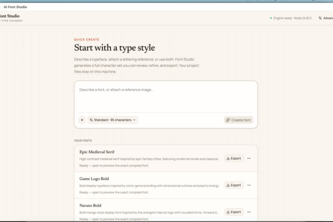
What it appears to be: A tool that generates fonts from uploaded images or text, built using AI agents (Claude, Codex, Pi) in a hackathon context. The author describes it as a byproduct of workflow development for AI tools and mentions a demo posted on Facebook with early interest.
What changed: The project evolved from an idea to a working prototype with two workflow iterations, but remains unfinished. It is not evidenced to have launched or gained traction beyond the author's own posting.
Single most important open question: Is there any evidence of revenue, customer adoption or product-market fit beyond the author’s own account and demo?
What The Product Actually Is
- The description states: “Generate font from text or image using codex oauth.”
- The author describes building a font-generation tool using AI agents (Claude, Codex, Pi).
- It was built as part of an OpenAI hackathon project.
- The product is described as a prototype with two workflow iterations, where the second version simplified UI and reused outputs from the first.
- The author notes that the main work left includes refining details, improving export speed, and output quality.
Not evidenced: No information on actual font generation output, UI design, or whether it functions beyond the author’s own testing.
Positioning & Claim Evolution
- The tagline: “Generate font from uploaded image.”
- The author states: “I had hard time to search for similar font, or even couldn't do it. Sometimes I wish I just threw an image and got the font.”
- The project evolved from a personal problem (finding fonts) into a tool that could automate this process.
- The author claims the idea works, but does not describe how it differentiates from existing tools or whether it addresses a market need beyond their own use case.
Inference: The positioning appears to be a niche solution for designers or art companies needing font generation from images. It is not clear if this is a standalone product or part of a larger workflow.
Target Customer & ICP
- The author states: “I have an art company, sometimes, customers just throw an image, then tell us to draw using that font.”
- This implies the target customer is likely creative professionals or agencies working in visual design.
- The tool may be aimed at those who need to replicate fonts from images quickly.
Not evidenced: No explicit customer segmentation, buyer personas, or market size data. No evidence of actual customers or user feedback beyond the author’s own experience.
Business Model & Pricing Evidence
- The author mentions: “I posted the demo on my Facebook, a few people ordered it at the price $19.”
- This is the only reference to pricing or sales activity.
- No information on whether this was a real sale, a pre-order, or just an informal interest.
Inference: There may be a potential freemium or paid model, but no evidence of a formal business model or monetization strategy beyond one informal order.
Technical & Delivery Signals
- The author used AI tools (Claude, Codex, Pi) to build the project.
- The development process involved:
- Research and documentation using Codex
- Architecture planning
- Workflow implementation using Claude and Fable 5
- UI scaffolding and logging systems for debugging
- Two workflow iterations were completed.
- The author notes that Codex was used to improve output quality and speed.
Not evidenced: No information on codebase, scalability, or technical architecture beyond the author’s own process. No evidence of product delivery or deployment.
Traction & Maturity Signals
- The author states: “a few people ordered it at the price $19.”
- This is the only indication of traction.
- The project was submitted to a hackathon and is described as a prototype.
- No evidence of revenue, customer base, or product adoption beyond one informal order.
Not evidenced: No data on user engagement, retention, or product usage. No sign of market validation or growth.
Competitive Context
- Not evidenced: No mention of competitors or existing tools in the font generation space.
- The author does not reference similar products or platforms that might address this problem.
- No evidence of competitive analysis or differentiation strategy.
Open Questions & Risks
- Unproven market demand: Only one informal order is reported, with no data on customer interest or willingness to pay.
- Prototype-only status: The project is described as a hackathon prototype, not a finished product.
- No revenue or traction evidence: No data on monetization, users, or adoption.
- Self-reported development process: Reliance on AI tools and workflows without independent verification of output quality or functionality.
- Lack of commercialization strategy: No indication of plans for scaling, marketing, or distribution.
Questions the description leaves open
- What is the actual use case for this tool in a business context?
- How does it compare to existing font generation tools or AI-based design tools?
- Is there any evidence of customer feedback beyond one informal order?
- What are the technical limitations of the current prototype, and how do you plan to address them?
- Are there any plans for monetization beyond the $19 demo order?
- How scalable is the current AI workflow approach?
Overall Assessment
- Not evidenced: No financials, revenue, or customer data.
- The project is described as a hackathon prototype with no commercial traction.
- The author’s own account suggests early interest but not product-market fit or scalability.
- The tool appears to be in an exploratory phase, not a product-ready state.
Assessment: Not ready for investment or partnership. Requires further validation of market demand, product functionality, and commercial viability.
User Stories BotA demo video on every pull request
Get a demo video on every new feature
GitHub App that watches your pull requests and records a narrated, captioned demo.
Save time on demo prep and make informed decisions faster with a video walkthrough of every new feature.
Source
Submitted to the OpenAI 2026 hackathon on Devpost. Project home on Devpost. Back to the full gallery on Devpost.
This competitive analysis was produced by top-founders.com (opens in a new tab)
Generated by a language model from this project's public Devpost page — its tagline, the author's own write-up and any built-with tags listed there — as captured in August 2026. Short quotations are the author's words. It is an opinion on the idea as a business, not on the people behind it, and it reflects the description as published then. If the project has moved on, request a correction below. The analysis is not independent research and contains no verified traction, revenue or customer data.
An independent guide by KFG International LLC — not affiliated with, endorsed by, or connected to Devpost or OpenAI.