

Archive position — measured, not model output
0 likes on Devpost
2,263 of the 7,850 archived projects have more likes, and 5,587 share exactly 0 — so this project's #2,481 place in the like-ranked listing is a tie-break inside that group, not a ranking.
Projects (log scale)
Likes on Devpost. ▲ marks this project's group.
Show the figures
| Likes | Projects | Share of archive |
|---|---|---|
| 0 | 5,587 | 71.2% |
| 1 | 1,758 | 22.4% |
| 2 | 284 | 3.6% |
| 3–4 | 132 | 1.7% |
| 5–9 | 75 | 1.0% |
| 10+ | 14 | 0.2% |
 User Stories BotA demo video on every pull request
Get a demo video on every new feature
GitHub App that watches your pull requests and records a narrated, captioned demo.
Save time on demo prep and make informed decisions faster with a video walkthrough of every new feature.
Executive Summary
What the company appears to be
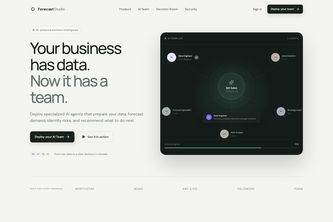
AI Forecast Studio is a self-reported SaaS product that presents itself as a "Data Science Team as a Service." The author describes it as an AI-powered platform where users upload business data (CSV or Excel), and a team of specialized AI agents — including a Chief Data Scientist, Forecast Specialist, Data Engineer, Risk Analyst, and Business Strategy Lead — collaboratively analyze the data and produce executive-level forecasts and recommendations. The system is built using GPT-5.6 and Codex, with a deterministic forecasting engine underlying the outputs.
What changed
The project was submitted as part of the OpenAI 2026 hackathon by a single developer (Miguel Angel Figueroa Muñoz) in three days. It is described as an experimental prototype or proof-of-concept, not yet a commercial product with users or revenue.
Single most important open question
Is there evidence of any traction, revenue, or customer adoption beyond the author’s own description? The project is self-reported and unverified — no third-party data, no customers, no financials, and no product in production.
What The Product Actually Is
The description states that AI Forecast Studio is a Data Science Team as a Service. It works by allowing users to upload business data (CSV or Excel) and then engages a team of AI agents — each with a specialized role:
- Atlas – Chief Data Scientist
- Maya – Forecast Specialist
- Noah – Data Engineer
- Owen – Risk Analyst
- Ava – Business Strategy Lead
These agents collaborate in real time, performing tasks like dataset validation, trend detection, model testing, risk analysis, and business recommendation generation. The output is described as an executive briefing, not a chart or dashboard.
The system uses:
- GPT-5.6 for coordination and explanation
- Codex for implementation of workflows, UI, API integrations, etc.
- A deterministic forecasting engine to generate numbers (not GPT-generated forecasts)
- A multi-agent architecture built in three days by one developer
Inference The product is described as a self-contained AI-powered analytical workflow, not a traditional dashboard or BI tool.
Positioning & Claim Evolution
The author states that the platform flips the premise of existing forecasting tools, which assume users understand statistics and ML. Instead, AI Forecast Studio aims to give any business “its own AI data science team.”
Claim
The product is positioned as an AI-powered consulting team, not a tool.
Evolution of claim
- Initial positioning: “What if any business could hire its own data science team in under 30 seconds?”
- Core value proposition: A team-based, non-technical interface to forecasting and business intelligence.
- Future vision: A full AI business intelligence platform with real-time integrations, industry-specific strategies, and executive meetings.
Inference The positioning is evolving from a hackathon prototype to a SaaS product in development, but there is no evidence of any commercial traction or user feedback.
Target Customer & ICP
The description states that the platform targets:
- Small and medium businesses (SMBs)
- Businesses that generate data daily
- Businesses that cannot afford data scientists, forecasting specialists, or BI teams
Inference The target customer is likely a non-technical business owner or manager, who wants actionable insights without needing to understand statistical modeling.
Not evidenced No specific industry, use case, or customer segment is named. No evidence of any actual customers or personas.
Business Model & Pricing Evidence
The description states that AI Forecast Studio is a SaaS product and that the long-term goal is to offer it as a service globally.
Inference The business model is likely SaaS-based, but there is no pricing information, subscription tiers, or monetization strategy described.
Not evidenced No revenue model, pricing structure, or monetization plan is provided.
Technical & Delivery Signals
The system is built using:
- GPT-5.6 for reasoning and coordination
- Codex for implementation of workflows, UI, API integrations, etc.
- A deterministic forecasting engine that generates numbers, not GPT-generated forecasts
- Built in three days by one developer
- Technologies include: FastAPI, Next.js, React, Python, PostgreSQL, Supabase, TailwindCSS, TypeScript
Inference The platform is built using a hybrid AI + deterministic approach, with a strong emphasis on rapid development and minimal user interaction.
Not evidenced No evidence of scalability, performance metrics, or production deployment details.
Traction & Maturity Signals
The project was submitted as part of the OpenAI 2026 hackathon. It was built by one person in three days, with no mention of any users, customers, or feedback.
Inference The product is a prototype or proof-of-concept, not yet a mature product or service.
Not evidenced No revenue, customer base, usage metrics, or product adoption data are provided.
Competitive Context
The author states that existing tools assume the user understands statistics and ML, which they do not. They aim to offer a team-based AI experience, rather than a dashboard or chatbot.
Inference The competitive space includes:
- Traditional BI platforms
- Forecasting dashboards
- AI-powered analytics tools
- Chatbots or conversational AI for business intelligence
However, the description does not name any specific competitors or describe how this product differentiates from them in practice.
Not evidenced No competitive analysis, market positioning, or differentiation strategy is provided.
Open Questions & Risks
- Single developer team: The entire system was built by one person — raises concerns about scalability, maintainability, and long-term support.
- No commercial traction: No evidence of users, customers, or revenue.
- Unverified claims: The product is described as a SaaS platform but lacks any evidence of production use or monetization.
- AI dependency: Heavy reliance on GPT-5.6 and Codex may not be sustainable or scalable without further development.
- No validation of forecasting accuracy: While the system uses a deterministic engine, there’s no evidence that it has been tested or validated in real-world scenarios.
Questions the description leaves open
- What is the current status of the product? Is it live, in beta, or still in prototype form?
- Have you conducted any user testing or received feedback from actual SMBs?
- How does the deterministic forecasting engine work, and what models are used?
- What is your monetization strategy and pricing model?
- Are there any plans to scale beyond a single developer team?
- How do you plan to handle data privacy and security for business users?
- What is the roadmap for product development beyond the hackathon version?
Overall Assessment
Not evidenced: No financials, revenue, or customer data are available.
Self-reported only: The description is entirely self-reported and unverified.
Confidence level: Low
This is a preliminary prototype submitted as part of a hackathon. It presents an interesting concept — a team-based AI for business intelligence — but lacks any evidence of traction, revenue, or product maturity. The author describes it as a SaaS platform in development, but there is no indication that it has moved beyond the experimental phase.
Inference: While the idea shows promise, the current state is not suitable for investment or partnership without further evidence of product-market fit, user adoption, or commercial viability.
User Stories BotA demo video on every pull request
Get a demo video on every new feature
GitHub App that watches your pull requests and records a narrated, captioned demo.
Save time on demo prep and make informed decisions faster with a video walkthrough of every new feature.
Source
Submitted to the OpenAI 2026 hackathon on Devpost. Project home on Devpost. Back to the full gallery on Devpost.
This competitive analysis was produced by top-founders.com (opens in a new tab)
Generated by a language model from this project's public Devpost page — its tagline, the author's own write-up and any built-with tags listed there — as captured in August 2026. Short quotations are the author's words. It is an opinion on the idea as a business, not on the people behind it, and it reflects the description as published then. If the project has moved on, request a correction below. The analysis is not independent research and contains no verified traction, revenue or customer data.
An independent guide by KFG International LLC — not affiliated with, endorsed by, or connected to Devpost or OpenAI.