

Archive position — measured, not model output
0 likes on Devpost
2,263 of the 7,850 archived projects have more likes, and 5,587 share exactly 0 — so this project's #2,483 place in the like-ranked listing is a tie-break inside that group, not a ranking.
Projects (log scale)
Likes on Devpost. ▲ marks this project's group.
Show the figures
| Likes | Projects | Share of archive |
|---|---|---|
| 0 | 5,587 | 71.2% |
| 1 | 1,758 | 22.4% |
| 2 | 284 | 3.6% |
| 3–4 | 132 | 1.7% |
| 5–9 | 75 | 1.0% |
| 10+ | 14 | 0.2% |
 User Stories BotA demo video on every pull request
Get a demo video on every new feature
GitHub App that watches your pull requests and records a narrated, captioned demo.
Save time on demo prep and make informed decisions faster with a video walkthrough of every new feature.
Executive Summary
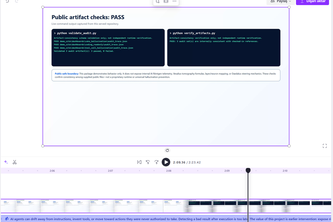
The description states that the project is a safety tool for AI agents, designed to detect hallucination and agent-drift risk at token level, and intervene before unsafe continuations execute. It presents a demonstration of three agent-safety scenarios with replay dashboards, audit JSON documents, and trace files. The author claims this approach allows early detection and safe rewrites, with auditable replay traces.
The project is presented as a prototype or demo submitted to an OpenAI hackathon, built using Python, JavaScript, Node.js, and Playwright, with GPT-5.6 and Codex used during Build Week for validation and documentation enhancements. The system separates prior proprietary work from new public-facing components.
Key open question
What is the actual commercial viability of this safety intervention approach? The description does not indicate any revenue, customers, or adoption beyond a hackathon submission.
What The Product Actually Is
The description states that the product is an AI safety tool that:
- Detects hallucination and agent-drift risk at token level
- Stops unsafe continuations before execution
- Produces safe rewrites
- Provides auditable replay traces
It includes:
- A public-safe demo presenting three agent-safety scenarios
- A standalone replay dashboard
- An audit JSON document
- A frame-by-frame JSON Lines trace
- A readable Markdown report
- Trigger token, stop status, intervention type, and policy fields
The system is described as demonstrating prevention-oriented approach: expose risk while an unsafe continuation is forming, stop it before execution, provide a safe rewrite, and preserve an auditable record of the intervention.
Positioning & Claim Evolution
The description states that this project was inspired by a safety goal: "make emerging hallucination and agent-drift risk visible early enough to stop an unsafe continuation before the demonstrated action executes."
It positions itself as:
- A prevention-oriented approach to AI safety
- A tool that stops unsafe continuations before execution
- A system that provides safe rewrites and auditable replay traces
The project claims to demonstrate a "stop-before-execution" interface pattern, where the system makes interventions visible before unsafe actions advance.
Target Customer & ICP
Not evidenced. The description does not identify specific target customers or ideal customer profiles beyond general AI agent safety concerns.
Business Model & Pricing Evidence
Not evidenced. There is no information provided about pricing, business model, monetization strategy, or revenue streams.
Technical & Delivery Signals
The description states that the system was built using:
- Python for artifact generation and validation
- HTML, CSS, JavaScript for replay dashboards
- JSON and JSON Lines for audit records
- Node.js with Playwright for deterministic browser recording
It was built with tools including: codex, css3, github, gpt-5.6, html5, javascript, json, node.js, openai, playwright, python, schema.
The system includes:
- An audit JSON Schema
- Structural audit validation
- Cross-file artifact-consistency verification
- Portable repository paths
- Disclosure and testing documentation
- A clear prior-work versus Build Week record
- An isolated Playwright-based automated demo recorder
Traction & Maturity Signals
Not evidenced. The description does not provide any information about traction, customers, revenue, or adoption beyond the hackathon submission.
Competitive Context
Not evidenced. The description does not mention competitors, market positioning, or competitive landscape.
Open Questions & Risks
- The project is presented as a hackathon submission with no evidence of commercial traction
- The description states that proprietary research and core implementation details were not exposed
- The system only demonstrates proxy safety behavior, not actual runtime safeguards
- No evidence of revenue, customers, or market adoption
- The demonstration does not claim universal hallucination prevention
- The project is described as a "public-safe demo" with limited scope
Questions the description leaves open
- What specific AI agent use cases are you targeting with this solution?
- How does your approach scale to production environments with multiple concurrent agents?
- What are the technical limitations of your current demonstration that would need to be addressed for commercial deployment?
- Can you describe the proprietary research and implementation details that were not included in the public demo?
- What is your roadmap for transitioning from this prototype to a commercial product?
- How do you plan to monetize this safety solution?
Overall Assessment
Not evidenced. The description provides no information about funding rounds, valuations, or investment status beyond the hackathon submission. No evidence of commercial traction, revenue, or customer adoption is provided.
User Stories BotA demo video on every pull request
Get a demo video on every new feature
GitHub App that watches your pull requests and records a narrated, captioned demo.
Save time on demo prep and make informed decisions faster with a video walkthrough of every new feature.
Source
Submitted to the OpenAI 2026 hackathon on Devpost. Project home on Devpost. Back to the full gallery on Devpost.
This competitive analysis was produced by top-founders.com (opens in a new tab)
Generated by a language model from this project's public Devpost page — its tagline, the author's own write-up and any built-with tags listed there — as captured in August 2026. Short quotations are the author's words. It is an opinion on the idea as a business, not on the people behind it, and it reflects the description as published then. If the project has moved on, request a correction below. The analysis is not independent research and contains no verified traction, revenue or customer data.
An independent guide by KFG International LLC — not affiliated with, endorsed by, or connected to Devpost or OpenAI.