

Archive position — measured, not model output
0 likes on Devpost
2,263 of the 7,850 archived projects have more likes, and 5,587 share exactly 0 — so this project's #2,484 place in the like-ranked listing is a tie-break inside that group, not a ranking.
Projects (log scale)
Likes on Devpost. ▲ marks this project's group.
Show the figures
| Likes | Projects | Share of archive |
|---|---|---|
| 0 | 5,587 | 71.2% |
| 1 | 1,758 | 22.4% |
| 2 | 284 | 3.6% |
| 3–4 | 132 | 1.7% |
| 5–9 | 75 | 1.0% |
| 10+ | 14 | 0.2% |
 User Stories BotA demo video on every pull request
Get a demo video on every new feature
GitHub App that watches your pull requests and records a narrated, captioned demo.
Save time on demo prep and make informed decisions faster with a video walkthrough of every new feature.
Executive Summary
The description states that AI Health Assistant is a self-reported web application built as a hackathon project to simplify healthcare information using AI models. The author describes it as an educational tool integrating features like symptom checking, BMI calculation, and first aid guidance, developed with Python, Streamlit, and OpenAI APIs.
Key commercial due-diligence questions:
- Is there any evidence of user adoption or engagement beyond the single developer?
- What is the actual product-market fit for this type of tool?
- How does the team plan to transition from a hackathon prototype to a scalable business?
The most important open question: What traction, revenue or customer data exists beyond the author's self-reporting?
What The Product Actually Is
The description states that AI Health Assistant is:
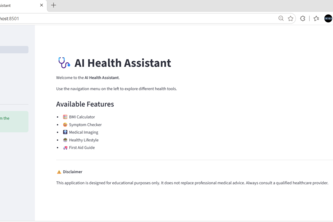
- A web application built using Python and Streamlit
- Integrated with OpenAI/OpenRouter APIs for AI functionality
- Deployed via Streamlit Community Cloud
- Designed to be simple, interactive, and easy to navigate
- Includes features such as:
- BMI Calculator
- AI-powered Symptom Checker
- Medical Imaging Guide (MRI, CT Scan, PET Scan, Ultrasound)
- Healthy Lifestyle Guide
- First Aid Assistant
The author states that the application was built for a hackathon and is not yet monetized or scaled.
Positioning & Claim Evolution
The description states:
- The product is positioned as an AI assistant designed to simplify healthcare information
- It aims to support early disease awareness and provide educational guidance using modern AI models
- The goal is to improve health awareness and encourage informed decision-making
- It is described as not replacing healthcare professionals but supporting them through education
The author claims the application was built to address confusion around online health information for non-medical users, and that it demonstrates how AI can be used to improve health education and accessibility.
Target Customer & ICP
The description states:
- The target audience is individuals without a medical background who search online for basic health information
- Users are described as those who encounter confusing or unreliable sources when looking up health topics
- The application aims to provide educational guidance in an accessible and user-friendly way
- It is designed for people seeking early disease awareness and health education
Not evidenced: specific customer segments, personas, or market size.
Business Model & Pricing Evidence
The description states:
- No explicit pricing model is mentioned
- The application is described as a web-based tool with no indication of monetization
- The author mentions future features like appointment scheduling, medicine reminders, and medical report analysis that may be monetized
- There is no evidence of revenue streams, subscriptions, or paid tiers
Technical & Delivery Signals
The description states:
- Built using Python and Streamlit
- Integrated with OpenAI/OpenRouter APIs for AI functionality
- Deployed on Streamlit Community Cloud
- Uses Git and GitHub for version control
- API keys managed via python-dotenv and Streamlit Secrets
- The application is described as responsive and interactive
The author notes technical challenges during development including:
- Learning Git/GitHub workflows
- Deployment issues
- Dependency management
- Secure API key handling
Traction & Maturity Signals
The description states:
- This is a hackathon project submitted to the OpenAI 2026 hackathon
- The team size is listed as one person (Eisha Ashraf)
- No evidence of user adoption, engagement metrics, or customer base
- No revenue data or monetization details are provided
- The author mentions future versions and additional features but no current traction
Not evidenced: any form of product-market fit, user retention, or business momentum.
Competitive Context
The description states:
- No direct competitors are named
- The application is positioned as an educational health guidance tool
- It integrates multiple healthcare tools into a single platform
- Features include symptom checking, BMI calculation, and first aid information
Not evidenced: competitive landscape analysis, market positioning relative to existing solutions, or differentiation from other health apps.
Open Questions & Risks
The description states:
- The project is a single-developer hackathon effort with no evidence of scaling beyond the author
- No revenue model or monetization strategy is evident
- The application is not currently generating income or user engagement
- The team size is one person, suggesting limited capacity for growth or product development
- The product is described as educational and supportive rather than replacement for healthcare professionals
Inference: Without traction, revenue, or customer data, the project may be a prototype with unclear commercial viability.
Questions the description leaves open
- What specific user feedback has been gathered from potential customers?
- How does the team plan to transition from a hackathon prototype to a scalable product?
- Are there any existing users or pilot programs?
- What is the long-term monetization strategy beyond the features mentioned in the write-up?
- How will the team address regulatory compliance and liability concerns in healthcare applications?
- What are the plans for expanding beyond the current feature set?
Overall Assessment
The description states:
- This is a self-reported hackathon project with no evidence of commercial traction
- The author describes it as educational and supportive rather than replacement for medical professionals
- No revenue, customer base, or business model details are provided
- The team size is one person, suggesting limited capacity for rapid scaling
Inference: Based on the self-reported nature of the description and lack of evidence for any commercial viability, this appears to be a prototype with no demonstrated product-market fit or business momentum. The project does not currently show signs of being ready for investment or partnership consideration.
The author states that the application is designed to improve health awareness and encourage informed decision-making but provides no data on user engagement, adoption rates, or revenue generation.
User Stories BotA demo video on every pull request
Get a demo video on every new feature
GitHub App that watches your pull requests and records a narrated, captioned demo.
Save time on demo prep and make informed decisions faster with a video walkthrough of every new feature.
Source
Submitted to the OpenAI 2026 hackathon on Devpost. Project home on Devpost. Back to the full gallery on Devpost.
This competitive analysis was produced by top-founders.com (opens in a new tab)
Generated by a language model from this project's public Devpost page — its tagline, the author's own write-up and any built-with tags listed there — as captured in August 2026. Short quotations are the author's words. It is an opinion on the idea as a business, not on the people behind it, and it reflects the description as published then. If the project has moved on, request a correction below. The analysis is not independent research and contains no verified traction, revenue or customer data.
An independent guide by KFG International LLC — not affiliated with, endorsed by, or connected to Devpost or OpenAI.