

Archive position — measured, not model output
1 like on Devpost
505 of the 7,850 archived projects have more likes, and 1,758 share exactly 1 — so this project's #519 place in the like-ranked listing is a tie-break inside that group, not a ranking.
Projects (log scale)
Likes on Devpost. ▲ marks this project's group.
Show the figures
| Likes | Projects | Share of archive |
|---|---|---|
| 0 | 5,587 | 71.2% |
| 1 | 1,758 | 22.4% |
| 2 | 284 | 3.6% |
| 3–4 | 132 | 1.7% |
| 5–9 | 75 | 1.0% |
| 10+ | 14 | 0.2% |
 User Stories BotA demo video on every pull request
Get a demo video on every new feature
GitHub App that watches your pull requests and records a narrated, captioned demo.
Save time on demo prep and make informed decisions faster with a video walkthrough of every new feature.
Executive Summary
What the company appears to be
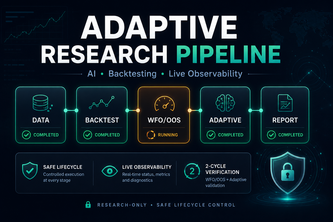
The project described is a self-reported research platform for evaluating systematic trading strategies. The author states it is an AI-powered, multi-asset, research-only system that performs transparent, multi-stage backtesting and live runtime observability. It is designed to assess strategy robustness, stability, and out-of-sample performance without enabling live execution or automatic trade placement.
What changed
The project was submitted as part of the OpenAI 2026 hackathon. The author describes a system built over several weeks with a focus on integrity, observability, safety, and honest failure states in research pipelines.
Single most important open question — the commercial due-diligence read
Is there evidence that this platform has been used by anyone beyond its creator for actual strategy evaluation or research? The description is entirely self-reported and lacks any indication of adoption, usage, or traction.
What The Product Actually Is
The description states that Adaptive Research Pipeline Observatory is a research-only, multi-asset platform for evaluating systematic trading strategies. It includes:
- Configurable research runs across assets, symbols, timeframes, and date ranges
- A Data Integrity Gate to validate market data before research begins
- Walk-Forward Optimization using independent out-of-sample windows
- Registry-driven strategy definitions and parameter spaces
- Edge Habitat Discovery to identify market conditions where a strategy works or fails
- Robustness diagnostics, including drawdown, trade-count, and overfitting checks
- A Strategy Factory dashboard for observing active research stages and progress
- Explicit readiness gates separating research completion from production readiness
- Safe cancellation, runtime inspection, resource guards, and isolated worker processes
It is explicitly stated that the platform does not automatically place trades, enable live execution, or treat a completed backtest as production-ready.
Confidence Low — all details are self-reported. No evidence of actual use, customers, or revenue.
Positioning & Claim Evolution
The author positions the system as an alternative to traditional backtesting that focuses on honesty and transparency, rather than just profit or Sharpe ratio. Key claims include:
- The platform evaluates whether a strategy’s edge is real, stable, repeatable, robust, and valid out of sample
- It makes uncertainty visible instead of hiding it behind dashboard success metrics
- It avoids treating a profitable backtest as proof of validity
The system is described as intentionally research-only and advisory-only, not for execution or automation.
Inference The positioning reflects an attempt to address perceived flaws in current trading strategy evaluation tools — particularly over-reliance on single backtests and lack of robustness checks.
Confidence Low — claims are self-reported, no external validation or market feedback provided.
Target Customer & ICP
The description does not identify specific customer segments or personas. However, it implies a target audience of:
- Quantitative researchers or developers working in systematic trading
- Users who want to validate strategies rigorously before deployment
- Those seeking tools that emphasize integrity and transparency over quick wins
It is implied that the platform is aimed at individuals or small teams doing research, not institutional clients or end-users.
Confidence Very low — no explicit customer targeting or segmentation described.
Business Model & Pricing Evidence
There is no evidence of a business model or pricing structure in the description. The project is presented as a research tool, not a commercial product. It is described as:
- A hackathon submission
- Built by one person (rashedgpt2806-ai)
- Intended for exploration and comparison across assets
No mention of monetization, licensing, subscriptions, or fees.
Confidence Not evidenced — no indication of any commercial intent or revenue model.
Technical & Delivery Signals
The system is built using:
- Python
- Flask-based dashboard
- Modular architecture with distinct layers:
- Research configuration
- Data integrity
- Research engine
- Walk-forward validation
- Adaptive analysis
- Environment intelligence
- Observability
- Safety boundaries
Key technical features include:
- Isolated worker processes
- Heartbeat-based worker tracking
- Cooperative cancellation checkpoints
- Idempotent cancellation behavior
- Registry-driven strategy definitions
- Resource and parameter-grid guards
- Stale-lock detection
- Progress tracking across stages
The platform is described as intentionally research-only, with execution-related capabilities disabled by default.
Confidence Medium — the technical architecture is detailed, but no evidence of production use or scalability beyond a single developer.
Traction & Maturity Signals
There is no evidence of traction, adoption, or usage beyond the author’s own development. The project is:
- A hackathon submission
- Built by one individual
- Not publicly deployed or hosted
- Not referenced in any external sources
No customer base, user feedback, or performance data are provided.
Confidence Very low — no signs of real-world use or product maturity.
Competitive Context
The description does not mention competitors. However, based on the stated functionality (backtesting, walk-forward optimization, regime analysis), it likely competes with:
- Traditional backtesting platforms (e.g., QuantConnect, Backtrader, Alpaca)
- Research-focused tools for algorithmic trading
- Systems that provide robustness diagnostics or out-of-sample validation
The platform’s emphasis on honesty, transparency, and safety may differentiate it from tools that prioritize speed or ease of use over integrity.
Confidence Low — no competitive landscape described or referenced.
Open Questions & Risks
- No external validation or usage: The system is entirely self-reported with no evidence of adoption or real-world testing.
- Single developer: Built by one person, which raises questions about scalability and long-term maintenance.
- Not a commercial product: No indication of monetization or market readiness.
- Hackathon project: Likely not production-ready or designed for enterprise use.
- No public deployment or hosting: The platform appears to exist only in source form.
Confidence Medium — risks are inferred from lack of evidence, not stated facts.
Questions the description leaves open
- Has the system been used by anyone other than yourself?
- What specific problems in current backtesting tools does this address?
- Are there any plans to commercialize or deploy this beyond a research tool?
- How would you scale this for multiple users or larger datasets?
- Have you tested it on real market data, or is it limited to synthetic or sample datasets?
- What are the limitations of the current architecture in terms of performance or extensibility?
Overall Assessment
There is no evidence that this project has reached a stage where it could be considered for investment or partnership. It is described as a hackathon submission built by one person, with no traction, revenue, or customer base.
The platform is presented as a research tool, not a product ready for market. Its value lies in its design principles and integrity — but without real-world use or commercialization, it remains an idea or prototype.
Confidence Very low — no basis for investment or partnership consideration at this time.
User Stories BotA demo video on every pull request
Get a demo video on every new feature
GitHub App that watches your pull requests and records a narrated, captioned demo.
Save time on demo prep and make informed decisions faster with a video walkthrough of every new feature.
Source
Submitted to the OpenAI 2026 hackathon on Devpost. Project home on Devpost. Back to the full gallery on Devpost.
This competitive analysis was produced by top-founders.com (opens in a new tab)
Generated by a language model from this project's public Devpost page — its tagline, the author's own write-up and any built-with tags listed there — as captured in August 2026. Short quotations are the author's words. It is an opinion on the idea as a business, not on the people behind it, and it reflects the description as published then. If the project has moved on, request a correction below. The analysis is not independent research and contains no verified traction, revenue or customer data.
An independent guide by KFG International LLC — not affiliated with, endorsed by, or connected to Devpost or OpenAI.