

Archive position — measured, not model output
1 like on Devpost
505 of the 7,850 archived projects have more likes, and 1,758 share exactly 1 — so this project's #521 place in the like-ranked listing is a tie-break inside that group, not a ranking.
Projects (log scale)
Likes on Devpost. ▲ marks this project's group.
Show the figures
| Likes | Projects | Share of archive |
|---|---|---|
| 0 | 5,587 | 71.2% |
| 1 | 1,758 | 22.4% |
| 2 | 284 | 3.6% |
| 3–4 | 132 | 1.7% |
| 5–9 | 75 | 1.0% |
| 10+ | 14 | 0.2% |
 User Stories BotA demo video on every pull request
Get a demo video on every new feature
GitHub App that watches your pull requests and records a narrated, captioned demo.
Save time on demo prep and make informed decisions faster with a video walkthrough of every new feature.
Executive Summary
What the company appears to be
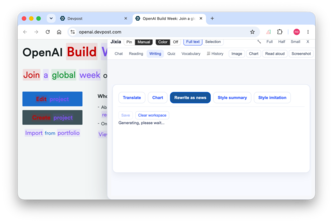
ADHDGoFly Plugin is a self-reported browser extension for Chrome and Edge that integrates AI-powered tools into web browsing to support ADHD users in reading, learning, and retaining information. The product is described as an "AI enhanced" tool that allows users to highlight text, ask questions, generate summaries, quizzes, vocabulary cards, and charts from webpage content.
What changed
The author reports a significant upgrade from an existing in-page panel into a more structured AI workspace called “Jixia,” which includes modules for chat, quiz, explain, vocabulary, and chart generation. The project was built using tools like Codex, GPT-5.6, and various browser APIs.
Single most important open question
Is there any evidence of user adoption or feedback from actual ADHD users beyond the author's own experience?
What The Product Actually Is
The description states that ADHDGoFly is a browser extension (Chrome/Edge Manifest V3) designed to turn webpages into an AI learning workspace. It operates as a floating panel within the current webpage and supports:
- Highlighting text
- Asking contextual questions about the page
- Generating summaries, outlines, explanations, keywords, and writing transformations
- Creating comprehension quizzes with history
- Building vocabulary review cards
- Collecting and analyzing images via OCR
- Generating diagrams and data charts from page context
- Resuming previous work through unified history
The extension is built using JavaScript, HTML/CSS, local storage, manifest files, and integrates with AI models such as OpenAI’s GPT-5.6 and others.
Confidence Low — all details are self-reported by the author without independent verification or demonstration of functionality beyond code structure.
Positioning & Claim Evolution
The author positions ADHDGoFly as an ADHD-friendly, text-highlighting browser extension that enhances reading and learning through AI integration. The goal is not to replace reading but to reduce context switching and provide structure, feedback, and momentum for users with ADHD.
Key claims include:
- Reducing the difficulty of focusing on reading.
- Providing a complete reading and learning workspace within the browser.
- Supporting multilingual part-of-speech highlighting.
- Enabling structured workflows around reading, testing, vocabulary, and visual understanding.
Inference The positioning suggests a niche market solution targeting individuals with ADHD who struggle with traditional reading methods. However, no evidence of customer validation or market traction is provided.
Target Customer & ICP
The description states that the product targets ADHD users, specifically those who find it hard to focus on reading and benefit from structured learning tools.
There is no explicit segmentation beyond this demographic. No mention of:
- Age groups
- Geographic markets
- Educational levels
- Use cases beyond personal reading
Confidence Low — the ICP is inferred from the author’s stated intent, not validated by any data or user research.
Business Model & Pricing Evidence
No information is provided about pricing, monetization strategy, or business model. The project is described as a hackathon submission and does not reference:
- Revenue streams
- Subscription plans
- Freemium offerings
- Paid features
- Partnerships or licensing models
Confidence Not evidenced — the author focuses on functionality rather than commercial aspects.
Technical & Delivery Signals
The product is built as a browser extension using Manifest V3, leveraging technologies like:
- JavaScript, HTML/CSS
- Local storage
- Browser APIs (e.g., manifest.json)
- AI integration via OpenAI GPT-5.6 and Codex
- Charting libraries: Mermaid, ECharts, RoughJS
- OCR/visual recognition using GLM-4V-Flash
The author describes iterative development using Codex and GPT-5.6, including:
- Modular code design (Chat, Quiz, Explain, Vocabulary, UI event modules)
- Image workflow with filtering, batch selection, OCR, and history tracking
- Chart workflow supporting deterministic rendering, editing, export formats (SVG/JSON/HTML/PNG)
Confidence Medium — technical details are described in depth but lack independent validation or demonstration.
Traction & Maturity Signals
There is no evidence of:
- User adoption or retention metrics
- Customer feedback or testimonials
- Product usage data
- Revenue or monetization
- Market traction or growth indicators
The project was submitted to a hackathon and described as a "Build Week" demo. It has not been released publicly beyond the author’s own development environment.
Confidence Not evidenced — no signs of product-market fit or real-world usage.
Competitive Context
No competitive analysis is provided in the description. The author does not reference:
- Direct competitors
- Indirect substitutes
- Market size or positioning
- Differentiation from existing tools (e.g., Notion, Obsidian, Readwise, etc.)
Confidence Not evidenced — no competitive landscape information.
Open Questions & Risks
- No independent validation: The entire description is self-reported and unverified.
- Single-person team: Only one developer is listed (gongde yu), raising concerns about scalability or long-term maintenance.
- Unproven market demand: No evidence of user feedback, customer interviews, or real-world usage beyond the author’s personal experience.
- Limited commercial viability: No pricing model, monetization strategy, or business plan described.
- Technical complexity without demonstration: While detailed architecture is described, no live demo or functional prototype is shown.
Inference The product appears to be a proof-of-concept rather than a scalable solution.
Questions the description leaves open
- What specific feedback have you received from ADHD users?
- Have you tested the extension with real users in a controlled setting?
- How do you plan to monetize this tool?
- Are there any plans for expanding beyond Chrome/Edge browsers?
- What are your long-term goals for the product beyond the hackathon submission?
Overall Assessment
Not evidenced — There is no evidence of traction, revenue, or customer validation to support an investment or partnership decision.
The project appears to be a personal development effort by one individual aimed at solving a personal challenge. It lacks commercial readiness, market validation, and any indication of scalability or monetization strategy.
Confidence Very low — this is a self-reported idea with no external corroboration or evidence of real-world impact.
User Stories BotA demo video on every pull request
Get a demo video on every new feature
GitHub App that watches your pull requests and records a narrated, captioned demo.
Save time on demo prep and make informed decisions faster with a video walkthrough of every new feature.
Source
Submitted to the OpenAI 2026 hackathon on Devpost. Project home on Devpost. Back to the full gallery on Devpost.
This competitive analysis was produced by top-founders.com (opens in a new tab)
Generated by a language model from this project's public Devpost page — its tagline, the author's own write-up and any built-with tags listed there — as captured in August 2026. Short quotations are the author's words. It is an opinion on the idea as a business, not on the people behind it, and it reflects the description as published then. If the project has moved on, request a correction below. The analysis is not independent research and contains no verified traction, revenue or customer data.
An independent guide by KFG International LLC — not affiliated with, endorsed by, or connected to Devpost or OpenAI.