

Archive position — measured, not model output
1 like on Devpost
505 of the 7,850 archived projects have more likes, and 1,758 share exactly 1 — so this project's #523 place in the like-ranked listing is a tie-break inside that group, not a ranking.
Projects (log scale)
Likes on Devpost. ▲ marks this project's group.
Show the figures
| Likes | Projects | Share of archive |
|---|---|---|
| 0 | 5,587 | 71.2% |
| 1 | 1,758 | 22.4% |
| 2 | 284 | 3.6% |
| 3–4 | 132 | 1.7% |
| 5–9 | 75 | 1.0% |
| 10+ | 14 | 0.2% |
 User Stories BotA demo video on every pull request
Get a demo video on every new feature
GitHub App that watches your pull requests and records a narrated, captioned demo.
Save time on demo prep and make informed decisions faster with a video walkthrough of every new feature.
Executive Summary
What the company appears to be
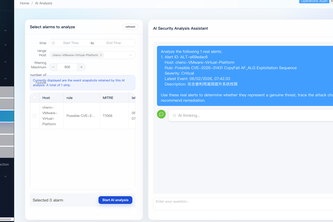
Aegis is described as an open-source AI-native host security platform that integrates large language models with eBPF telemetry, Sigma rules, and vulnerability intelligence to automate parts of the security workflow—specifically, from detection through remediation. It aims to reduce manual effort in security operations by enabling AI-assisted analysis, script generation, and threat response.
What changed
The project was built as part of a hackathon submission and is presented as an early-stage prototype with a distributed architecture using Go, Vue, PostgreSQL, Kafka, and eBPF. It includes features like real-time monitoring, AI-generated scripts for remediation, dynamic detection package deployment, and visualized attack path reconstruction.
Single most important open question
Is there any evidence of actual use or traction beyond the hackathon prototype? The description does not indicate whether Aegis has been deployed in production environments or adopted by users outside of its creators.
Note: This analysis is based entirely on the self-reported, unverified project description provided by the author. No external data, revenue figures, customer names, or adoption metrics are available.
What The Product Actually Is
The description states that Aegis is an open-source AI-native host security platform with the following capabilities:
- Host security auditing and vulnerability management.
- Runtime threat detection using eBPF.
- Integration of Sigma rules for detection.
- AI-generated scripts for inspection, remediation, verification, and self-healing.
- Automated response actions based on policies and MITRE ATT&CK techniques.
- Attack investigation through ReAct-based AI agents that reconstruct attack paths.
- Dynamic generation and deployment of eBPF detection packages.
- Audit trail and safety controls over AI-generated tasks.
It also mentions a frontend built with Vue 3, backend services in Go, and integration with Kafka, PostgreSQL, Redis, MinIO, and OpenAI-compatible models.
Inference: The product appears to be a hybrid system combining real-time telemetry (eBPF), rule-based detection (Sigma), AI reasoning (ReAct agent), and automation (script execution). However, no evidence of actual deployment or performance data is provided.
Positioning & Claim Evolution
The author positions Aegis as an AI-native host security platform designed to make advanced protection accessible to both security specialists and DevOps teams. The core claim is that AI should not only explain security events but also complete entire workflows—from discovery to remediation—while keeping humans in control of high-risk operations.
They emphasize:
- AI integration with trusted tools and structured evidence.
- Safety boundaries through approval workflows, blacklists, and audit trails.
- Real-time runtime detection using eBPF.
- Unified workflow from baseline checks to automated remediation.
Inference: The positioning reflects a shift toward AI-assisted engineering in cybersecurity, where automation is coupled with human oversight. However, this is a stated intent rather than demonstrated traction or adoption.
Target Customer & ICP
The description indicates that Aegis targets:
- Security specialists.
- DevOps teams.
It aims to make advanced protection accessible to both groups by integrating AI into workflows that traditionally require manual intervention.
Not evidenced: No specific customer segments, personas, or use cases beyond general security and DevOps roles are detailed. There is no indication of target industries, organization sizes, or decision-makers involved in procurement.
Business Model & Pricing Evidence
The description does not provide any information about:
- Revenue streams.
- Pricing models.
- Monetization strategy.
- Subscription tiers or licensing terms.
It only mentions that Aegis is open-source and built for real-time security workloads.
Not evidenced: No evidence of a business model or pricing structure exists in the provided description.
Technical & Delivery Signals
The system architecture includes:
- Backend services implemented in Go.
- Frontend built with Vue 3.
- Data storage via PostgreSQL, Redis, MinIO.
- Event streaming through Kafka.
- eBPF telemetry collection adapted for different kernel versions.
- AI integration via OpenAI-compatible models using a worker-queue architecture.
- ReAct-based agent for planning and reflection.
- Support for Docker Compose and offline Linux package deployment.
Inference: The technical stack suggests a distributed, scalable system designed for real-time security operations. However, no performance benchmarks, scalability tests, or production stability data are included.
Traction & Maturity Signals
The description states that Aegis was developed as part of an OpenAI 2026 hackathon submission and includes:
- End-to-end workflow from document ingestion to remediation.
- Script security audit system covering multiple types of scripts.
- Unified telemetry and AI analysis.
- Real-time visualization of AI planning and attack traces.
It also notes that the next stage will include a conversational interface and integration with external systems like SIEM, CMDB, EDR, etc.
Not evidenced: No evidence of user adoption, customer feedback, or real-world deployment. The project is described as a prototype submitted to a hackathon, not a product in active use.
Competitive Context
The description does not mention direct competitors or how Aegis compares to existing host security platforms such as CrowdStrike, SentinelOne, or similar solutions.
Not evidenced: No competitive landscape analysis or differentiation from other tools is provided.
Open Questions & Risks
Key risks and open questions based on the self-reported information:
- Unproven traction: The project is presented as a hackathon prototype with no evidence of real-world usage.
- AI safety concerns: While the description mentions layered safety controls, it does not detail how these are implemented or tested in practice.
- Limited team size: Only one member (chen chen) is listed on the team, raising questions about scalability and long-term maintenance.
- Open-source nature: The platform being open-source may limit monetization opportunities unless a clear path to paid services or enterprise support is outlined.
Inference: These are potential challenges for commercial viability, but they cannot be confirmed without further evidence.
Questions the description leaves open
- Has Aegis been tested in any real-world environments beyond the hackathon?
- What specific safety mechanisms are in place to prevent AI-generated scripts from causing harm?
- Are there plans for monetization or commercial support beyond open-source distribution?
- How does Aegis handle data privacy and compliance, especially when processing sensitive telemetry?
- Can you describe how the ReAct agent handles ambiguous or conflicting inputs during attack path reconstruction?
- What is the current status of eBPF compatibility across different Linux distributions and kernel versions?
- Are there any partnerships or integrations with existing SIEM or EDR platforms planned?
Overall Assessment
The description presents Aegis as a promising concept for AI-native host security, combining real-time telemetry, rule-based detection, and AI reasoning in a unified platform.
However, due to the lack of evidence regarding:
- Revenue
- Customers
- Traction
- Product-market fit
- Commercial strategy
This is an early-stage idea with significant potential but no demonstrated commercial viability or market validation.
Confidence level: Low. The project description is self-reported and unverified; it lacks any indicators of real-world adoption, performance metrics, or financial data. It remains a conceptual prototype at this stage.
User Stories BotA demo video on every pull request
Get a demo video on every new feature
GitHub App that watches your pull requests and records a narrated, captioned demo.
Save time on demo prep and make informed decisions faster with a video walkthrough of every new feature.
Source
Submitted to the OpenAI 2026 hackathon on Devpost. Project home on Devpost. Back to the full gallery on Devpost.
This competitive analysis was produced by top-founders.com (opens in a new tab)
Generated by a language model from this project's public Devpost page — its tagline, the author's own write-up and any built-with tags listed there — as captured in August 2026. Short quotations are the author's words. It is an opinion on the idea as a business, not on the people behind it, and it reflects the description as published then. If the project has moved on, request a correction below. The analysis is not independent research and contains no verified traction, revenue or customer data.
An independent guide by KFG International LLC — not affiliated with, endorsed by, or connected to Devpost or OpenAI.