

Archive position — measured, not model output
1 like on Devpost
505 of the 7,850 archived projects have more likes, and 1,758 share exactly 1 — so this project's #524 place in the like-ranked listing is a tie-break inside that group, not a ranking.
Projects (log scale)
Likes on Devpost. ▲ marks this project's group.
Show the figures
| Likes | Projects | Share of archive |
|---|---|---|
| 0 | 5,587 | 71.2% |
| 1 | 1,758 | 22.4% |
| 2 | 284 | 3.6% |
| 3–4 | 132 | 1.7% |
| 5–9 | 75 | 1.0% |
| 10+ | 14 | 0.2% |
 User Stories BotA demo video on every pull request
Get a demo video on every new feature
GitHub App that watches your pull requests and records a narrated, captioned demo.
Save time on demo prep and make informed decisions faster with a video walkthrough of every new feature.
Executive Summary
What the company appears to be
AegisOps AI is a self-reported human-in-the-loop hospital operations decision intelligence platform. The project description states it helps hospitals prioritize patients, allocate scarce resources, validate AI plans, and simulate operational impact before human approval.
What changed
This is a hackathon submission (OpenAI 2026) with no evidence of commercial traction or product-market fit beyond the authors' own account. The platform appears to be conceptual and not yet deployed in real hospitals.
Single most important open question
Is there any evidence that hospitals are willing to adopt this system, or that it solves a real operational problem that exists today?
What The Product Actually Is
The description states that AegisOps AI is:
- A human-in-the-loop hospital operations decision intelligence platform
- Designed to support real-time operational decision making
- Enables hospitals to:
- Register patients quickly using rapid triage intake
- Import multiple patients at once for emergency scenarios
- Automatically prioritize patients using a deterministic rule engine
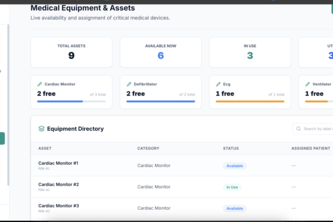
- Monitor live availability of beds, doctors, departments, and medical equipment
- Generate AI-assisted operational recommendations
- Validate every AI recommendation before it reaches hospital staff
- Suggest alternative allocation plans when resources are unavailable
- Simulate operational impact before decisions are approved
- Maintain a complete audit trail for transparency
The system uses:
- A rule engine for patient prioritization
- Large language models (GPT-4.1-mini, GPT-5.6) for AI recommendations
- Structured data inputs including patient priority, hospital occupancy, available doctors, beds, equipment, and waiting queue
- An AI Operations Copilot that answers natural language questions about hospital operations
- A Simulation Engine to predict impact of decisions without affecting live data
Inference: The platform combines deterministic logic with AI for operational decision support. It is not an autonomous system but requires human approval for all actions.
Positioning & Claim Evolution
The description states that AegisOps AI:
- Is designed to help hospitals make better operational decisions
- Does not diagnose diseases or prescribe treatments
- Acts as an intelligent assistant that provides recommendations, explains reasoning, and predicts operational impact
- Keeps healthcare professionals in complete control of every critical decision
- Is not meant to replace healthcare professionals
The platform is positioned as:
- An operational decision-support system
- A human-in-the-loop AI workflow
- A real-time hospital intelligence platform
Inference: The positioning emphasizes trustworthiness, transparency, and human oversight. It claims to solve the problem of hospitals having "excellent systems at storing information" but lacking real-time decision support.
Target Customer & ICP
The description states that AegisOps AI is designed for:
- Hospitals operating in fast-changing, resource-constrained environments
- Specifically during peak hours or emergencies
- Staff who must balance patient urgency with limited beds, doctors, equipment, and treatment spaces
Inference: The primary customer is hospital administrators or operational staff managing real-time capacity allocation. The ICP appears to be hospitals facing resource constraints in emergency or high-volume scenarios.
Business Model & Pricing Evidence
Not evidenced.
The description does not state:
- How the platform would be monetized
- Whether it would be sold as a SaaS subscription, one-time license, or other model
- What pricing structure (if any) is envisioned
- Who pays for the solution (hospital, department, staff)
Technical & Delivery Signals
The description states that the platform:
- Combines deterministic backend logic with large language models
- Uses structured information including patient priority, hospital occupancy, available doctors, beds, equipment, and waiting queue
- Implements an AI provider fallback mechanism (OpenAI API with fallback to other models)
- Is built using technologies like:
- Codex, FastAPI, GPT-4.1-mini, GPT-5.6, Next.js, OpenAPI, Python, Supabase, Tailwind, TypeScript, Vercel
- Has a rule engine for urgency scoring and priority assignment
- Includes an AI Operations Copilot that understands natural language queries
- Features a Simulation Engine to predict operational impact before changes are applied
Inference: The technical stack suggests a modern web-based platform with AI integration, backend validation, and simulation capabilities. It is built for reliability with fallback strategies.
Traction & Maturity Signals
Not evidenced.
The description does not state:
- Any revenue or customer data
- Whether the system has been deployed in any hospital
- How many users or hospitals are involved
- Any pilot programs or real-world testing
- Product usage metrics or adoption rates
The project is described as a hackathon submission (OpenAI 2026), indicating it is not yet commercially viable or deployed.
Competitive Context
Not evidenced.
The description does not state:
- Who the competitors are
- What existing solutions already exist in this space
- How AegisOps AI differentiates from current hospital operations systems or AI platforms
- Whether there are similar products or platforms already operating in hospitals
Open Questions & Risks
Inferences based on self-reported description:
- No commercial traction: The platform is described as a hackathon submission with no evidence of real-world deployment or adoption.
- Unproven trustworthiness claims: The description states the system is designed to be trustworthy, but there is no evidence of how this has been tested or validated in practice.
- Human-in-the-loop model may slow decision-making: Requiring human approval for every action could reduce the speed advantage that AI is supposed to provide.
- AI validation layer complexity: The need for backend validation of AI recommendations adds system complexity and potential failure points.
- No pricing or monetization strategy: No indication of how the platform would be sold or funded.
- Unverified assumptions about hospital workflows: The description assumes hospitals have certain data structures and operational needs, but these are not confirmed.
Questions the description leaves open
- What specific hospital workflows does this system aim to improve, and how do you know those problems exist?
- Have you spoken with actual hospital staff or administrators about their decision-making processes?
- How do you plan to integrate with existing hospital systems (e.g., EHRs)?
- What is your roadmap for moving from a hackathon prototype to a production-ready system?
- How will you ensure the AI recommendations are accurate and actionable in real-time?
- What would be the cost of deploying this system in a real hospital?
- Are there any regulatory or compliance issues that need to be addressed for healthcare use?
Overall Assessment
Not evidenced.
The description does not provide:
- Any financial data
- Evidence of traction or revenue
- Customer feedback or pilot results
- Market size or growth potential
- Founders' track record or team experience beyond this project
Inference: This is a conceptual prototype submitted for a hackathon. There is no evidence of commercial viability, product-market fit, or any meaningful business development. It cannot be evaluated as an investment or partnership opportunity at this stage.
User Stories BotA demo video on every pull request
Get a demo video on every new feature
GitHub App that watches your pull requests and records a narrated, captioned demo.
Save time on demo prep and make informed decisions faster with a video walkthrough of every new feature.
Source
Submitted to the OpenAI 2026 hackathon on Devpost. Project home on Devpost. Back to the full gallery on Devpost.
This competitive analysis was produced by top-founders.com (opens in a new tab)
Generated by a language model from this project's public Devpost page — its tagline, the author's own write-up and any built-with tags listed there — as captured in August 2026. Short quotations are the author's words. It is an opinion on the idea as a business, not on the people behind it, and it reflects the description as published then. If the project has moved on, request a correction below. The analysis is not independent research and contains no verified traction, revenue or customer data.
An independent guide by KFG International LLC — not affiliated with, endorsed by, or connected to Devpost or OpenAI.