

Archive position — measured, not model output
1 like on Devpost
505 of the 7,850 archived projects have more likes, and 1,758 share exactly 1 — so this project's #525 place in the like-ranked listing is a tie-break inside that group, not a ranking.
Projects (log scale)
Likes on Devpost. ▲ marks this project's group.
Show the figures
| Likes | Projects | Share of archive |
|---|---|---|
| 0 | 5,587 | 71.2% |
| 1 | 1,758 | 22.4% |
| 2 | 284 | 3.6% |
| 3–4 | 132 | 1.7% |
| 5–9 | 75 | 1.0% |
| 10+ | 14 | 0.2% |
 User Stories BotA demo video on every pull request
Get a demo video on every new feature
GitHub App that watches your pull requests and records a narrated, captioned demo.
Save time on demo prep and make informed decisions faster with a video walkthrough of every new feature.
Executive Summary
What the company appears to be
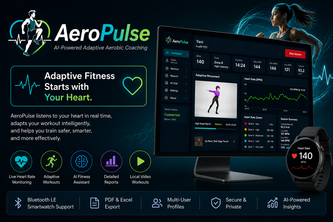
AeroPulse is a self-reported AI-powered desktop aerobic coaching application designed to provide personalized workout experiences using real-time heart-rate monitoring from smartwatches. The author states it aims to make exercise safer, more effective, and less repetitive by adapting workouts based on individual physical conditions.
What changed
The project evolved from a personal solution for the founder's mother into what the author describes as an AI-powered fitness platform with adaptive coaching capabilities, offline media support, and AI fitness assistant features.
Single most important open question
Does AeroPulse have any evidence of user adoption or commercial traction beyond the hackathon prototype?
Analysis basis
This report is based entirely on the self-reported project description provided by the author. All claims are unverified and should be treated as stated by the author, not proven facts. The analysis reflects only what was explicitly described in the submission.
What The Product Actually Is
The description states that AeroPulse is:
- A desktop application built for Windows using .NET 8, C#, WPF
- An AI-powered aerobic coaching tool that connects to smartwatches via Bluetooth Low Energy (BLE)
- Designed to provide adaptive workout guidance based on real-time heart rate data, BMI, workout progress, and user goals
- A personal fitness companion with an AI assistant for workout analysis and lifestyle guidance
- Capable of generating workout reports in PDF and Excel formats
- An offline-first experience using locally stored exercise videos and music
The author also mentions that the application uses:
- Local JSON storage
- OpenAI-compatible API for AI features
- Windows Bluetooth Low Energy APIs
- A rule-based adaptive engine with specific formulas for determining workout intensity
Note
The product is described as a desktop-only solution, not a mobile app or web platform.
Positioning & Claim Evolution
The author states that AeroPulse was inspired by personal experience helping their mother with health recovery and aims to solve the problem of inconsistent physical activity among people in Indonesia.
Positioning claims include:
- "Adaptive Fitness Starts with Your Heart"
- An application that understands each user's body in real time
- A personal fitness coach that adapts workouts dynamically
- A tool that makes exercise safer, more effective, and less repetitive
- A solution for people who want to exercise safely according to their own body's needs
The evolution of the claim is from a simple personal project (helping one person) to a broader platform with:
- Multi-user support
- AI fitness assistant
- Cross-platform reporting capabilities
- Future plans for mobile apps, cloud sync, and expanded wearable device compatibility
Inference The positioning appears to be shifting from a niche solution to a scalable health-tech platform, but this is not evidenced by any commercial data or user feedback.
Target Customer & ICP
The author states that AeroPulse is intended for:
- People who want to become healthier
- Individuals looking to improve fitness, lose weight, or recover from physical conditions
- Anyone regardless of age, body weight, fitness level, or background
- Users seeking a safer way to exercise according to their own body's needs
The target audience includes:
- Patients recovering from nerve-related health problems (as exemplified by the founder’s mother)
- People with insufficient physical activity (as per Indonesian Ministry of Health data cited)
- Individuals who struggle with maintaining consistent workout routines
- Users interested in personalized aerobic workouts using wearable technology
Note
No specific customer segments, personas, or market size estimates are provided. The positioning is broad and aspirational.
Business Model & Pricing Evidence
The description does not contain any information about:
- Revenue streams
- Pricing models
- Monetization strategy
- Subscription plans or one-time purchases
- Customer acquisition costs
- Unit economics
Finding
Not evidenced. No commercial business model or pricing structure is described.
Technical & Delivery Signals
Technical details provided by the author include:
- Built as a native Windows desktop application
- Uses C#, WPF, .NET 8
- Communicates with smartwatches via Bluetooth Low Energy (BLE)
- Integrates with OpenAI-compatible API for AI features
- Stores workout data locally using JSON
- Generates reports in PDF and Excel
- Supports offline media playback with local video/music storage
Challenges mentioned:
- Integration of BLE wearable devices
- Filtering invalid heart-rate readings
- Building a reliable BLE connection manager
- Generating dynamic PDF reports
Inference The technical stack suggests a focused, lightweight desktop solution. However, the lack of cloud integration or mobile support indicates limited scalability.
Traction & Maturity Signals
The author describes AeroPulse as:
- A hackathon submission
- A prototype with limited smartwatch compatibility (only Huafit P22)
- Not yet released to the public
- Not monetized or generating revenue
No evidence of:
- Users or customers
- Revenue or ARR
- Product-market fit
- Market traction
- Customer feedback or usage metrics
Finding
Not evidenced. The project is described as a hackathon prototype with no commercial traction.
Competitive Context
The author does not provide any information about:
- Competitors in the fitness or wearable tech space
- Market analysis or competitive positioning
- Differentiation from existing solutions
- Industry trends or market size
Finding
Not evidenced. No competitive landscape is described.
Open Questions & Risks
Key risks identified from the self-report:
- Limited device compatibility – Only supports one smartwatch model (Huafit P22)
- No cloud infrastructure or cross-platform support – Desktop-only, no mobile apps or sync
- Unproven commercial viability – No revenue, customers, or monetization strategy
- Dependency on proprietary BLE protocols – Many wearables do not expose standard BLE services
- AI integration risks – Reliance on OpenAI-compatible API without clarity on data privacy or cost implications
- Offline-first design may limit scalability – Local media storage and no cloud sync could hinder growth
Inference The project appears to be a proof-of-concept with significant limitations in scalability, monetization, and interoperability.
Questions the description leaves open
- What is the actual user base or testing done beyond the hackathon?
- How do you plan to expand support for additional smartwatch brands?
- Are there any plans for monetization or revenue generation?
- What are the technical and legal implications of using OpenAI-compatible APIs in a fitness application?
- How does the adaptive algorithm handle edge cases or unusual heart-rate patterns?
- Have you considered how to ensure data privacy and compliance with health regulations (e.g., HIPAA, GDPR)?
- What is your roadmap for mobile app development and cloud integration?
- How do you plan to validate the effectiveness of the adaptive coaching model?
Overall Assessment
Assessment Not evidenced.
The author describes AeroPulse as a hackathon prototype with no commercial traction, revenue, or customer data. While it shows technical capability in building a desktop application with BLE integration and AI features, there is no indication of market demand, product-market fit, or scalability beyond the current scope.
Confidence level Low — based entirely on self-reported content with no external validation or evidence of adoption or monetization.
User Stories BotA demo video on every pull request
Get a demo video on every new feature
GitHub App that watches your pull requests and records a narrated, captioned demo.
Save time on demo prep and make informed decisions faster with a video walkthrough of every new feature.
Source
Submitted to the OpenAI 2026 hackathon on Devpost. Project home on Devpost. Back to the full gallery on Devpost.
This competitive analysis was produced by top-founders.com (opens in a new tab)
Generated by a language model from this project's public Devpost page — its tagline, the author's own write-up and any built-with tags listed there — as captured in August 2026. Short quotations are the author's words. It is an opinion on the idea as a business, not on the people behind it, and it reflects the description as published then. If the project has moved on, request a correction below. The analysis is not independent research and contains no verified traction, revenue or customer data.
An independent guide by KFG International LLC — not affiliated with, endorsed by, or connected to Devpost or OpenAI.