

Archive position — measured, not model output
0 likes on Devpost
2,263 of the 7,850 archived projects have more likes, and 5,587 share exactly 0 — so this project's #2,487 place in the like-ranked listing is a tie-break inside that group, not a ranking.
Projects (log scale)
Likes on Devpost. ▲ marks this project's group.
Show the figures
| Likes | Projects | Share of archive |
|---|---|---|
| 0 | 5,587 | 71.2% |
| 1 | 1,758 | 22.4% |
| 2 | 284 | 3.6% |
| 3–4 | 132 | 1.7% |
| 5–9 | 75 | 1.0% |
| 10+ | 14 | 0.2% |
 User Stories BotA demo video on every pull request
Get a demo video on every new feature
GitHub App that watches your pull requests and records a narrated, captioned demo.
Save time on demo prep and make informed decisions faster with a video walkthrough of every new feature.
Executive Summary
What the company appears to be
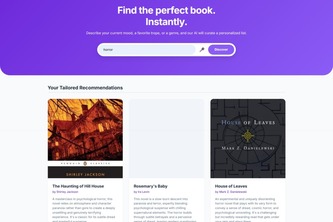
The description states that AI Librarian is a voice-activated web app powered by Google Gemini, designed to curate personalized book recommendations based on user mood, reading history, genre preferences and ratings. It is described as a full-stack, voice-enabled application with user authentication, recommendation logic using an LLM, and integration with a database and Open Library API.
What changed
This project was submitted to the OpenAI 2026 hackathon, indicating it is a prototype or proof-of-concept built in a short timeframe. It is not evidenced to have launched as a commercial product or gained users beyond its creators.
The single most important open question
Is there any evidence of traction, revenue, or user adoption that would suggest this is more than a hackathon project?
Note: This analysis is based entirely on the self-reported, unverified description provided by the author. No independent verification, archived data, or third-party sources are available.
What The Product Actually Is
- The description states that AI Librarian is a voice-activated web app.
- It uses Google Gemini 2.5 Flash API as its core logic engine.
- It is built with Flask (Python) for the backend, and HTML/CSS/JavaScript for the frontend.
- It integrates with a PostgreSQL database (Neon/Supabase) using psycopg2.
- It uses the browser's native Web Speech API for voice input.
- Book covers are fetched dynamically from the Open Library Covers API using AI-generated ISBNs.
- The app supports user account creation, Email OTP login, and saving recommendation history.
Inference: The system appears to be a full-stack prototype, not a commercial product. It is described as a hackathon submission.
Positioning & Claim Evolution
- The author states that the inspiration came from "reader's block" — the frustration of traditional search engines being rigid.
- The app aims to recreate the experience of talking to a seasoned librarian, allowing users to describe their mood or preferences in natural language.
- It positions itself as a tool for personalized book discovery using AI, with an emphasis on voice interaction and emotional matching.
Inference: This is a self-positioned consumer-facing tool that leverages AI for personalized content curation. The positioning is not evidenced to have evolved beyond the hackathon prototype stage.
Target Customer & ICP
- The description does not name specific customer segments or personas.
- It implies a general reader audience who may be seeking book recommendations based on mood, genre, or reading history.
- It suggests a consumer-facing use case, where users interact directly with the app to get personalized suggestions.
Inference: The ICP is likely general readers, but no explicit segmentation or targeting data is provided.
Business Model & Pricing Evidence
- No pricing information or business model is stated in the description.
- The app appears to be a free web application with user account features (login, history).
- There is no mention of monetization, subscriptions, or paid tiers.
Inference: The business model is not evidenced. It may be non-commercial or intended for demonstration only.
Technical & Delivery Signals
- Built using Flask, Python, PostgreSQL, and Vanilla JavaScript.
- Uses Google Gemini API for AI logic, with prompt engineering to enforce JSON output.
- Implements voice recognition via Web Speech API.
- Deployed on Render using Gunicorn, with environment variables for security.
- The team resolved deployment issues related to:
- AI output formatting
- psycopg2 compatibility
- Mobile responsiveness
- Cold start behavior
Inference: The technical stack and delivery approach are consistent with a full-stack prototype. No evidence of production-grade infrastructure or scaling.
Traction & Maturity Signals
- The project was submitted to the OpenAI 2026 hackathon, indicating it is a prototype.
- There is no evidence of:
- Revenue
- Customers
- User adoption
- Product-market fit
- Live deployment beyond the hackathon context
Inference: No traction or maturity signals are evident. It remains a hackathon project.
Competitive Context
- The description does not mention specific competitors.
- It is positioned as an AI-powered, voice-enabled book recommendation tool.
- It appears to compete with:
- Traditional search engines (e.g., Google Books)
- Personalized recommendation platforms (e.g., Goodreads, LibraryThing)
- Voice-activated assistants for content discovery
Inference: No competitive analysis or positioning against existing players is provided.
Open Questions & Risks
- The app is described as a hackathon project, not a commercial product.
- No evidence of:
- Revenue
- Customers
- Product-market fit
- Scalable infrastructure
- The team size is 2, which may limit execution capacity.
- The use of Google Gemini API implies dependency on external AI services, with potential cost and availability risks.
Inference: High risk that this remains a prototype without commercial viability or traction.
Questions the description leaves open
- Is this project intended to evolve into a commercial product?
- What is the current status of user testing or feedback?
- Are there plans for monetization or revenue generation?
- How do you plan to scale beyond the current prototype?
- What are your long-term goals for the platform and its features?
Overall Assessment
- The description states that this is a hackathon submission.
- No evidence of:
- Revenue
- Customers
- Product-market fit
- Commercial traction
- It is described as a full-stack prototype, not a product in the market.
Assessment: Not evidenced to be a viable commercial opportunity. Likely a demonstration project with no current or near-term commercialization evidence.
User Stories BotA demo video on every pull request
Get a demo video on every new feature
GitHub App that watches your pull requests and records a narrated, captioned demo.
Save time on demo prep and make informed decisions faster with a video walkthrough of every new feature.
Source
Submitted to the OpenAI 2026 hackathon on Devpost. Project home on Devpost. Back to the full gallery on Devpost.
This competitive analysis was produced by top-founders.com (opens in a new tab)
Generated by a language model from this project's public Devpost page — its tagline, the author's own write-up and any built-with tags listed there — as captured in August 2026. Short quotations are the author's words. It is an opinion on the idea as a business, not on the people behind it, and it reflects the description as published then. If the project has moved on, request a correction below. The analysis is not independent research and contains no verified traction, revenue or customer data.
An independent guide by KFG International LLC — not affiliated with, endorsed by, or connected to Devpost or OpenAI.