

Archive position — measured, not model output
0 likes on Devpost
2,263 of the 7,850 archived projects have more likes, and 5,587 share exactly 0 — so this project's #4,441 place in the like-ranked listing is a tie-break inside that group, not a ranking.
Projects (log scale)
Likes on Devpost. ▲ marks this project's group.
Show the figures
| Likes | Projects | Share of archive |
|---|---|---|
| 0 | 5,587 | 71.2% |
| 1 | 1,758 | 22.4% |
| 2 | 284 | 3.6% |
| 3–4 | 132 | 1.7% |
| 5–9 | 75 | 1.0% |
| 10+ | 14 | 0.2% |
 User Stories BotA demo video on every pull request
Get a demo video on every new feature
GitHub App that watches your pull requests and records a narrated, captioned demo.
Save time on demo prep and make informed decisions faster with a video walkthrough of every new feature.
Executive Summary
What the company appears to be
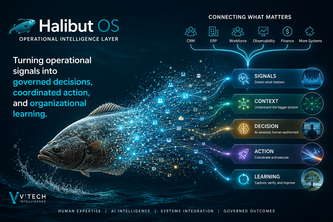
Halibut OS · Operational Intelligence Layer is a self-described operational intelligence platform designed to sit above existing business systems (CRM, ERP, etc.) and connect operational events into shared business context. It claims to detect risks, explain issues, recommend actions, route decisions to appropriate owners, record outcomes, and build organizational knowledge.
What changed
The project was submitted as a hackathon entry to the OpenAI 2026 hackathon. It is described as a prototype built in a short timeframe with a single team member (Isha Labelle). No prior traction or commercial deployment is evidenced.
Single most important open question
Is there sufficient evidence of real business need, technical feasibility at scale, or market alignment to justify further investment or partnership consideration?
Analysis basis
This report is based entirely on the self-reported project description provided by the author. It contains no independent verification, archived data, third-party sources, or historical context beyond what was submitted.
What The Product Actually Is
The description states that Halibut OS is an “operational intelligence layer” that sits above business systems and connects operational events into a shared business context. It claims to:
- Receive operational events from systems, workflows, documents, and human inputs.
- Detect risks, delays, anomalies, and dependencies.
- Explain why an issue matters and what business areas may be affected.
- Recommend practical next actions based on available context.
- Route important decisions to the appropriate human owner.
- Record decisions, approvals, actions, and outcomes for accountability.
- Build organizational knowledge from completed operational cases.
It is described as a modular intelligence architecture with five main capabilities:
- Signal ingestion
- Context mapping
- AI-assisted reasoning
- Human authorization
- Decision memory
The prototype uses cloud-native architecture, web interface, edge-based services, and OpenAI models for contextual analysis and decision support.
Inference The product is described as a platform that integrates with existing enterprise tools rather than replacing them. It appears to be focused on improving decision-making processes through structured data flow and AI-assisted reasoning.
Positioning & Claim Evolution
The author positions Halibut OS as an alternative to fragmented business intelligence systems, arguing that the problem is not lack of data but lack of connected context at decision time.
Key claims include:
- It helps people make better decisions without removing human authority.
- It avoids creating another generic AI dashboard or chatbot.
- It demonstrates how AI can become part of a governed operational process.
- It focuses on structured decision-making over isolated metrics.
- It emphasizes human-in-the-loop design to ensure reliability and accountability.
The project evolved from a hackathon prototype into a vision for a configurable platform with future features like scenario simulation, policy-based workflows, multilingual support, and industry-specific modules.
Claim vs Fact
These are self-reported claims about positioning and functionality. No evidence of actual customer feedback, market validation, or performance metrics is provided.
Target Customer & ICP
The description does not explicitly name target customers or define an ideal customer profile (ICP). However, it implies a focus on:
- Organizations with complex business operations.
- Enterprises using multiple disconnected systems (CRM, ERP, etc.).
- Teams needing to coordinate decisions across departments.
- Businesses seeking to improve decision-making through structured context and AI.
It mentions expansion into SMEs, service operations, education, manufacturing, and distributed workforces — suggesting a broad B2B scope.
Inference Based on the description, the ICP likely includes mid-to-large enterprises with operational complexity who want to integrate AI into their existing workflows without replacing current systems.
Business Model & Pricing Evidence
No business model or pricing information is provided in the self-reported description. The project is described as a prototype built for a hackathon and not yet commercially deployed.
Not evidenced There is no mention of monetization strategy, revenue streams, or pricing structure.
Technical & Delivery Signals
The author describes the system as:
- Cloud-native architecture
- Web interface with edge-based services
- Authenticated user access
- Structured operational data handling
- Use of OpenAI models for contextual analysis and decision support
- Support for Codex during development (for implementation, code review, debugging)
It includes five core components: signal ingestion, context mapping, AI-assisted reasoning, human authorization, and decision memory.
Inference The technical approach suggests a modular, scalable system that integrates with existing enterprise tools. However, no evidence of actual delivery or production deployment is given.
Traction & Maturity Signals
The project was submitted as a hackathon entry to the OpenAI 2026 hackathon and is described as a prototype built in a short timeframe by one person (Isha Labelle). No revenue, customers, or adoption data are mentioned.
Not evidenced There is no evidence of traction, user base, or commercial maturity beyond the initial prototype phase.
Competitive Context
The description does not reference specific competitors. However, it implies a space that overlaps with:
- Business intelligence platforms
- Workflow automation tools
- AI decision support systems
- Organizational knowledge management solutions
- Enterprise AI platforms
It positions itself as an alternative to generic dashboards or chatbots by emphasizing structured context and human-in-the-loop decision-making.
Inference The competitive landscape likely includes established players in business intelligence, workflow automation, and enterprise AI. However, no direct competitor analysis is provided.
Open Questions & Risks
- Unproven market demand: No evidence of customer validation or real-world use cases.
- Single-founder prototype: Built by one person; unclear if there's a scalable team behind it.
- Lack of commercial traction: No revenue, customers, or product-market fit data.
- Ambiguity in execution: The project is described as a hackathon demo with limited scope and functionality.
- No pricing or monetization strategy: Unclear how the platform will be monetized.
- Technical feasibility at scale: While described as cloud-native, no evidence of scalability or performance metrics.
Inference These are risks based on the lack of evidence for commercial viability, team capacity, or product maturity.
Questions the description leaves open
- What specific operational challenges do you observe in organizations that led to this idea?
- How do you plan to validate demand for this solution before full-scale development?
- Can you describe the technical architecture in more detail? Is there a roadmap for scaling beyond the prototype?
- Have you identified any early adopters or pilot customers willing to test the concept?
- What are your plans for building out the platform beyond the hackathon version?
- How do you intend to integrate with existing enterprise systems (CRM, ERP, etc.) in practice?
- What is your go-to-market strategy and how do you plan to reach potential users?
- Are there any regulatory or compliance considerations related to decision recording and AI-assisted actions?
Overall Assessment
There is no evidence of commercial traction, revenue, customer adoption, or validated market demand for Halibut OS. The project is described as a hackathon prototype built by one individual with no indication of ongoing development or team expansion.
While the concept aligns with trends in operational intelligence and AI-assisted decision-making, there is insufficient evidence to assess whether it addresses a real business need or has a viable path to market.
Confidence level Low. The description provides only a conceptual framework and initial prototype details — no data on performance, user feedback, or commercial viability.
Recommendation
Not ready for investment or partnership consideration without further evidence of traction, validation, or team capability.
User Stories BotA demo video on every pull request
Get a demo video on every new feature
GitHub App that watches your pull requests and records a narrated, captioned demo.
Save time on demo prep and make informed decisions faster with a video walkthrough of every new feature.
Source
Submitted to the OpenAI 2026 hackathon on Devpost. Project home on Devpost. Back to the full gallery on Devpost.
This competitive analysis was produced by top-founders.com (opens in a new tab)
Generated by a language model from this project's public Devpost page — its tagline, the author's own write-up and any built-with tags listed there — as captured in August 2026. Short quotations are the author's words. It is an opinion on the idea as a business, not on the people behind it, and it reflects the description as published then. If the project has moved on, request a correction below. The analysis is not independent research and contains no verified traction, revenue or customer data.
An independent guide by KFG International LLC — not affiliated with, endorsed by, or connected to Devpost or OpenAI.