

Archive position — measured, not model output
0 likes on Devpost
2,263 of the 7,850 archived projects have more likes, and 5,587 share exactly 0 — so this project's #6,404 place in the like-ranked listing is a tie-break inside that group, not a ranking.
Projects (log scale)
Likes on Devpost. ▲ marks this project's group.
Show the figures
| Likes | Projects | Share of archive |
|---|---|---|
| 0 | 5,587 | 71.2% |
| 1 | 1,758 | 22.4% |
| 2 | 284 | 3.6% |
| 3–4 | 132 | 1.7% |
| 5–9 | 75 | 1.0% |
| 10+ | 14 | 0.2% |
 User Stories BotA demo video on every pull request
Get a demo video on every new feature
GitHub App that watches your pull requests and records a narrated, captioned demo.
Save time on demo prep and make informed decisions faster with a video walkthrough of every new feature.
Executive Summary
What the company appears to be
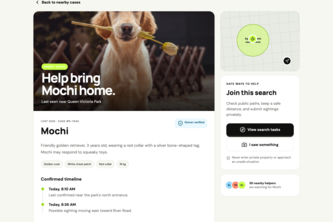
Reunite is a privacy-first community search network that helps people coordinate safe searches for lost pets and precious belongings. The project is described as a self-contained MVP built by one developer (Vu Quang Hoa Le) using Next.js, TypeScript, OpenAI APIs, and Vercel. It focuses on structured sighting reports, approximate location sharing, and AI-assisted evidence triage without making automated decisions.
What changed
The author states that this is a personal project built during a hackathon (OpenAI 2026), with no prior version or product history. The MVP represents an early-stage prototype focused on one user journey: discovering a case, reviewing a sighting, and analyzing evidence through AI-assisted triage.
Single most important open question
Is there any evidence of traction, revenue, customer adoption, or market validation beyond the author's own development effort?
Note: This analysis is based entirely on self-reported information from the project description. No third-party verification or historical data are available. All claims are attributed to the author’s own account.
What The Product Actually Is
- The description states that Reunite is a privacy-first community search network.
- It enables users to discover active search missions nearby, review case details and safety guidance, submit structured sighting reports, and share approximate search areas without exposing exact private locations.
- AI-assisted evidence triage organizes incoming clues by identifying similarities, inconsistencies, and uncertainty, but does not confirm identities or direct interventions.
- The system is designed for use with lost pets and precious belongings; missing-person functionality is reserved for future collaboration with verified organizations.
Inference: The product appears to be a web-based platform that integrates AI into a community-driven search coordination workflow. It is not a marketplace, nor does it involve monetization or direct user payments at this stage.
Positioning & Claim Evolution
- The author positions Reunite as a tool for coordinating safe searches for lost items and pets.
- The tagline “Reunite is a privacy-first community search network that helps people coordinate safe searches for lost pets and precious belongings” reflects the core value proposition.
- The description emphasizes emotional resonance, community support, and responsible use of technology.
- There is no indication of prior positioning or evolution in messaging beyond this single self-reported version.
Claim: Reunite aims to bring fragmented efforts together across different channels (police, shelters, social media) to improve coordination.
Not evidenced: Prior versions, market positioning shifts, or competitive differentiation strategies.
Target Customer & ICP
- The description states that Reunite targets individuals who have lost pets or precious belongings.
- It also mentions that vulnerable people are intentionally excluded from the current scope due to safety and moderation concerns.
- Users are expected to be those seeking help in locating something meaningful, not necessarily professionals or organizations.
Inference: The primary ICP is emotionally invested individuals (owners, family members) who need support coordinating searches for lost items or animals.
Not evidenced: Specific demographics, user personas, or segmentation beyond general categories.
Business Model & Pricing Evidence
- No pricing model or monetization strategy is described.
- The project is presented as a personal hackathon effort with no indication of revenue streams.
- There is no mention of subscriptions, transaction fees, partnerships, or paid features.
Claim: Reunite has no stated business model or pricing structure.
Not evidenced: Any form of monetization, customer acquisition cost, or revenue path.
Technical & Delivery Signals
- Built with Next.js (App Router), TypeScript, OpenAI Responses API, GPT-5.6, Zod for validation, Vercel deployment.
- Uses server-side API routes to handle structured data and AI processing without exposing keys in the browser.
- Includes a public demo mode that works even when live API quota is unavailable.
- Source code is hosted on GitHub with documentation.
- The author mentions using Codex as a development collaborator.
Inference: The technical stack suggests a modern, full-stack web application built for security and scalability.
Not evidenced: Production readiness, performance metrics, or infrastructure scaling plans.
Traction & Maturity Signals
- The project was submitted to the OpenAI 2026 hackathon.
- It includes a working end-to-end demonstration with a public repository.
- The MVP focuses on one complete user journey: discovering a case, reviewing a sighting, and analyzing evidence.
- No mention of users, customers, or adoption metrics beyond the author’s own development.
Claim: Reunite is an early-stage MVP with a functional prototype.
Not evidenced: Any form of traction, usage statistics, or user feedback loops.
Competitive Context
- The description does not reference existing competitors.
- It implies that current solutions for coordinating lost item searches are fragmented and lack integration.
- No mention of how Reunite compares to platforms like Facebook Lost & Found, Nextdoor, or local animal shelter systems.
Inference: Reunite may address a gap in community-based search coordination tools.
Not evidenced: Competitor landscape, market size, or competitive advantages.
Open Questions & Risks
- The project is entirely self-built by one person (Vu Quang Hoa Le), suggesting limited scalability and potential lack of team structure.
- No evidence of funding, partnerships, or external validation.
- AI integration relies on a single model (GPT-5.6) and API key, which could pose risks if access changes or becomes unavailable.
- The focus on privacy and human oversight is strong, but there is no indication of how moderation or trust will scale beyond the MVP.
Open question: Lack of traction, revenue, or user base raises questions about viability or market demand.
Not evidenced: Risk mitigation strategies or long-term sustainability plans.
Questions the description leaves open
- What is your plan for scaling beyond a single developer?
- How do you intend to validate the need for this product in real-world usage?
- Have you considered how to onboard verified organizations (e.g., shelters, authorities)?
- What are the technical and legal implications of handling sensitive data like sightings and locations?
- Are there any plans for monetization or long-term business sustainability?
Overall Assessment
- Reunite is a personal hackathon project with no demonstrated traction, revenue, or customer base.
- The author describes a clear vision and technical execution, but the product remains in early-stage prototype form.
- There is no evidence of market validation, funding, or team structure beyond one individual.
Assessment: Not ready for investment or partnership at this time.
Confidence level: Low — based on minimal self-reported evidence and lack of external data.
Next step: If further development occurs, a follow-up due diligence would be warranted once there is evidence of traction or product-market fit.
User Stories BotA demo video on every pull request
Get a demo video on every new feature
GitHub App that watches your pull requests and records a narrated, captioned demo.
Save time on demo prep and make informed decisions faster with a video walkthrough of every new feature.
Source
Submitted to the OpenAI 2026 hackathon on Devpost. Project home on Devpost. Back to the full gallery on Devpost.
This competitive analysis was produced by top-founders.com (opens in a new tab)
Generated by a language model from this project's public Devpost page — its tagline, the author's own write-up and any built-with tags listed there — as captured in August 2026. Short quotations are the author's words. It is an opinion on the idea as a business, not on the people behind it, and it reflects the description as published then. If the project has moved on, request a correction below. The analysis is not independent research and contains no verified traction, revenue or customer data.
An independent guide by KFG International LLC — not affiliated with, endorsed by, or connected to Devpost or OpenAI.