

Archive position — measured, not model output
0 likes on Devpost
2,263 of the 7,850 archived projects have more likes, and 5,587 share exactly 0 — so this project's #6,405 place in the like-ranked listing is a tie-break inside that group, not a ranking.
Projects (log scale)
Likes on Devpost. ▲ marks this project's group.
Show the figures
| Likes | Projects | Share of archive |
|---|---|---|
| 0 | 5,587 | 71.2% |
| 1 | 1,758 | 22.4% |
| 2 | 284 | 3.6% |
| 3–4 | 132 | 1.7% |
| 5–9 | 75 | 1.0% |
| 10+ | 14 | 0.2% |
 User Stories BotA demo video on every pull request
Get a demo video on every new feature
GitHub App that watches your pull requests and records a narrated, captioned demo.
Save time on demo prep and make informed decisions faster with a video walkthrough of every new feature.
Executive Summary
What the company appears to be
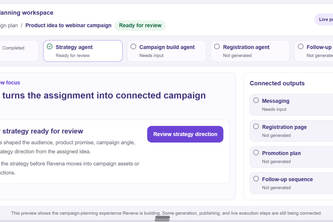
Revena is a self-reported agentic platform designed to help businesses, entrepreneurs, online coaches, and creators plan and execute profitable webinar campaigns from start to finish. It is built using AI agents and tools such as ChatGPT, Codex, Next.js, Supabase, and OpenAI APIs.
What changed
The project emerged from the author’s five years of experience in planning and executing webinar campaigns, combined with a desire to apply AI tools like ChatGPT and Codex to build an automated solution. It was submitted as part of the OpenAI 2026 hackathon.
Single most important open question
Is there evidence that Revena can deliver on its promise of automating the full webinar campaign lifecycle, or is it still in early-stage prototyping?
Note: This analysis is based entirely on the self-reported project description provided by the author. No independent verification or historical data is available.
What The Product Actually Is
The description states that Revena is an “agentic webinar campaign platform” for coaches, consultants, creators, entrepreneurs, and businesses who want to sell an offer through a webinar.
It claims to help users describe what they want to sell and who it’s for, then transforms that idea into a connected webinar campaign by:
- Analysing the offer
- Identifying missing information
- Asking relevant discovery questions
- Developing the webinar strategy
- Calculating the revenue model
- Creating promotional assets
- Preparing registration-page content
- Structuring the webinar delivery
- Creating follow-up sequences
- Requesting approval before important actions
- Updating campaign assets when information changes
The goal is for Revena to do the campaign work, not simply give the user more tasks.
Inference: The product appears to be a SaaS tool that uses AI agents to automate parts of the webinar planning and execution process. It is described as an agentic platform, suggesting it relies on multiple AI components working together.
Positioning & Claim Evolution
The author states that Revena was inspired by over five years of experience in managing large-scale webinars (with up to 10,000 attendees), and that the idea came from a suggestion by ChatGPT during OpenAI Build Week.
It positions itself as an all-in-one solution for webinar growth, aiming to reduce user effort by automating campaign creation and execution.
The author also notes that Revena was built using AI development tools like Codex and GPT-5.6, indicating a focus on leveraging AI in both product design and development.
Claim: Revena is positioned as an agentic platform for webinar planning and execution.
Inference: The positioning evolved from personal experience to a tool built with AI assistance, suggesting it targets users who are already active in the space but want automation.
Target Customer & ICP
The description states that Revena helps:
- Businesses
- Entrepreneurs
- Online coaches
- Creators
These groups are described as those who "want to sell an offer through a webinar."
Claim: The target customer is defined by their use of webinars for selling products or services.
Inference: The ICP likely includes individuals or small teams with some marketing experience and a need for structured support in planning and executing webinars.
Business Model & Pricing Evidence
There is no evidence provided about pricing, monetization strategy, or business model. The author mentions that the next step is to recruit pilot users and convert them into paying customers, but does not describe how this will be done.
Not evidenced: No information on revenue model, pricing tiers, or customer acquisition costs.
Technical & Delivery Signals
The project was built using:
- Next.js
- TypeScript
- Tailwind CSS
- Supabase
- OpenAI APIs (Responses API, Agents SDK)
- Vercel
- Inngest
- Sentry
- PostHog and Vercel Analytics
- Git/GitHub
It also includes a multi-agent development workflow involving:
- Orchestration Agent
- Backend Engineer Agent
- Frontend Engineer Agent
- UI/UX Design Agent
- QA Engineer Agent
- Technical Writer Agent
And four internal runtime agents:
- Revena Orchestrator
- Discovery and Strategy Agent
- Campaign Build Agent
- Webinar Delivery and Follow-Up Agent
Claim: The platform uses AI agents for both development and runtime operations.
Inference: The technical stack suggests a modern SaaS architecture with backend services, frontend UI, and AI integration. However, no evidence of production deployment or scalability is provided.
Traction & Maturity Signals
The author reports:
- A working MVP
- A full product and technical specification created using ChatGPT
- Multi-agent development workflow implemented
- Authentication and database infrastructure built
- Four internal runtime agents developed
- Campaign planning, discovery, strategy, approval, and workspace flows implemented
- Deployment completed
- Interface redesign performed after initial review
However, there is no evidence of:
- Revenue
- Customers
- User engagement metrics
- Product adoption
- Live usage data
Not evidenced: No traction or maturity indicators beyond the author’s own development efforts.
Competitive Context
There is no mention of competitors in the description. The author does not reference existing tools or platforms that help plan or execute webinars, nor does it describe how Revena differentiates from them.
Not evidenced: No competitive landscape or differentiation analysis.
Open Questions & Risks
- Unverified claims: All statements are self-reported and unverified.
- No revenue or traction data: The platform is described as an MVP with no evidence of monetization or customer base.
- Limited maturity: While a working prototype exists, the author notes that workflows still require testing and refinement.
- Dependency on AI tools: Heavy reliance on ChatGPT, Codex, and OpenAI APIs may create scalability or cost risks.
- Single-person team: The project is built by one person (Soji Afotan), which raises questions about long-term sustainability and scaling.
Inference: Revena is in early-stage development with no proven market fit or commercial viability.
Questions the description leaves open
- What specific problems do users face when planning webinars, and how does Revena solve them?
- How many pilot users have you recruited so far, and what feedback have they given?
- Can you provide examples of actual campaign outputs generated by Revena?
- What is your plan for transitioning from a prototype to a scalable product?
- How do you intend to monetize the platform once it reaches market readiness?
- What are the key limitations or blind spots in the current agent-based workflows?
Overall Assessment
At this stage, Revena appears to be an early-stage prototype built by one individual with domain expertise in webinar marketing and AI development tools.
It has not demonstrated any commercial traction, revenue, or customer base. The platform is described as functional but still under development, with several areas needing refinement.
Assessment: Not ready for investment or partnership at this time. It may have potential if it can demonstrate early user feedback, improved workflows, and a clear path to monetization.
User Stories BotA demo video on every pull request
Get a demo video on every new feature
GitHub App that watches your pull requests and records a narrated, captioned demo.
Save time on demo prep and make informed decisions faster with a video walkthrough of every new feature.
Source
Submitted to the OpenAI 2026 hackathon on Devpost. Project home on Devpost. Back to the full gallery on Devpost.
This competitive analysis was produced by top-founders.com (opens in a new tab)
Generated by a language model from this project's public Devpost page — its tagline, the author's own write-up and any built-with tags listed there — as captured in August 2026. Short quotations are the author's words. It is an opinion on the idea as a business, not on the people behind it, and it reflects the description as published then. If the project has moved on, request a correction below. The analysis is not independent research and contains no verified traction, revenue or customer data.
An independent guide by KFG International LLC — not affiliated with, endorsed by, or connected to Devpost or OpenAI.