

Archive position — measured, not model output
0 likes on Devpost
2,263 of the 7,850 archived projects have more likes, and 5,587 share exactly 0 — so this project's #4,439 place in the like-ranked listing is a tie-break inside that group, not a ranking.
Projects (log scale)
Likes on Devpost. ▲ marks this project's group.
Show the figures
| Likes | Projects | Share of archive |
|---|---|---|
| 0 | 5,587 | 71.2% |
| 1 | 1,758 | 22.4% |
| 2 | 284 | 3.6% |
| 3–4 | 132 | 1.7% |
| 5–9 | 75 | 1.0% |
| 10+ | 14 | 0.2% |
 User Stories BotA demo video on every pull request
Get a demo video on every new feature
GitHub App that watches your pull requests and records a narrated, captioned demo.
Save time on demo prep and make informed decisions faster with a video walkthrough of every new feature.
Executive Summary
Company: Hala Impact AI
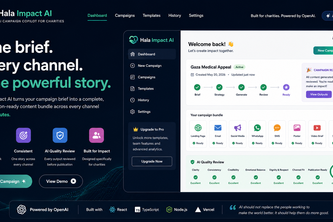
Self-reported purpose: An AI campaign copilot for charities that transforms one fundraising brief into publication-ready, multi-channel content in minutes.
Key claim: The platform helps small charities create consistent, high-quality campaigns using OpenAI tools, without replacing human teams but amplifying their impact.
What changed: The author describes building a structured, multi-stage AI pipeline to generate aligned content across channels and perform an AI-powered readiness review before publication.
Single most important open question: Is there evidence of real-world use or traction from charities?
Note: This analysis is based entirely on the self-reported project description provided by the author. No external verification, revenue data, customer list, or adoption metrics are available. All claims are stated by the author and not independently confirmed.
What The Product Actually Is
The description states that Hala Impact AI is an AI Campaign Copilot designed for charities and nonprofit organizations. It takes a single structured campaign brief and generates a complete bundle of content across multiple communication channels, including:
- Landing page
- Social media posts
- WhatsApp message
- SMS
- Campaign poster brief
- Video content brief
- Internal campaign summary
The system uses OpenAI GPT-4o as its core AI engine and is built with a multi-stage pipeline that includes:
- Analysis of the campaign brief to extract a central "Message Spine"
- Generation of outputs for each channel, aligned with the same message spine
- An AI-powered publication readiness review evaluating clarity, consistency, credibility, emotional balance, safeguarding, and overall quality
Inference: The product is described as more than just text generation—it's a workflow tool aimed at nonprofit communications teams.
Positioning & Claim Evolution
The author positions Hala Impact AI as an AI-powered solution tailored specifically for charities, not a generic AI writing tool. Key positioning elements include:
- It helps small charities reduce repetitive work and improve consistency.
- It does not replace human teams but amplifies their impact.
- It ensures consistent messaging across platforms by using one shared campaign strategy.
The claim evolution shows:
- Initial inspiration from personal experience in nonprofit communications
- A shift toward solving a real problem (time-consuming, inconsistent content creation)
- A focus on responsible AI use—emphasizing human oversight and ethical considerations
Claim: The platform is built to be "human-centered" and "transparent, responsible, and human-centered."
Target Customer & ICP
The description states that Hala Impact AI is designed for charities and nonprofit organizations, particularly those with limited marketing resources.
It targets:
- Small charities lacking dedicated marketing teams
- Communications staff who often rewrite the same campaign multiple times across platforms
- Teams looking to save time while maintaining consistent messaging
Inference: The ICP appears to be small-to-medium-sized nonprofits that operate with minimal internal communications infrastructure.
Business Model & Pricing Evidence
Not evidenced.
The description does not mention any pricing model, monetization strategy, or business model details.
Technical & Delivery Signals
The platform is built using:
- Frontend: React, TypeScript, Vite
- Backend: Node.js, Express
- AI Tools: OpenAI GPT-4o, OpenAI API
- Deployment: Vercel, GitHub
Key technical signals from the description:
- Multi-stage AI pipeline with structured prompting
- AI-powered quality review before publication
- Focus on reliability and error handling (e.g., timeout handling, diagnostic reporting)
- Integration points mentioned: CRM, Mailchimp, Canva, Meta publishing, donor audience intelligence
Inference: The system is designed to be robust and production-ready, with attention to backend diagnostics and fallback behavior.
Traction & Maturity Signals
Not evidenced.
There is no mention of:
- Customers or users
- Revenue or funding
- Adoption metrics
- Product usage data
- Market traction
The project was submitted as part of a hackathon (OpenAI Build Week), indicating it's in an early development stage.
Competitive Context
Not evidenced.
No information is provided about:
- Competitors
- Market size
- Existing solutions in the nonprofit content generation space
- Differentiation from other AI tools or platforms
Inference: The author implies that existing AI writing tools are not tailored for nonprofits, but this is not substantiated.
Open Questions & Risks
- No traction or customer validation – The project is described as a hackathon submission with no evidence of real-world use.
- Unproven business model – No pricing, monetization, or revenue data provided.
- High reliance on OpenAI API – Dependency on a third-party AI service introduces risk if access or pricing changes.
- Ethical and safeguarding concerns – The platform claims to evaluate "safeguarding" and "claim safety," but no details are given about how these are implemented or audited.
- Limited team size – Only one team member is mentioned, raising questions about scalability and execution capability.
Questions the description leaves open
- Have you tested the platform with actual charities? What feedback did they give?
- How do you plan to monetize this product? Is there a pricing model or revenue path?
- What are the specific safeguards in place for content that might be inappropriate or misleading?
- How does the AI quality review process work in practice? Can it be customized or adjusted by users?
- What is your roadmap for scaling beyond the hackathon prototype?
- Are there any legal or compliance issues related to publishing campaign content for nonprofits?
Overall Assessment
Not evidenced.
There is no evidence of:
- Revenue
- Customers
- Product-market fit
- Team traction
- Financials or funding history
Inference: This is an early-stage idea, likely a prototype or proof-of-concept. It may have potential if validated with real users and developed into a scalable product—but currently lacks any commercial due-diligence signals.
User Stories BotA demo video on every pull request
Get a demo video on every new feature
GitHub App that watches your pull requests and records a narrated, captioned demo.
Save time on demo prep and make informed decisions faster with a video walkthrough of every new feature.
Source
Submitted to the OpenAI 2026 hackathon on Devpost. Project home on Devpost. Back to the full gallery on Devpost.
This competitive analysis was produced by top-founders.com (opens in a new tab)
Generated by a language model from this project's public Devpost page — its tagline, the author's own write-up and any built-with tags listed there — as captured in August 2026. Short quotations are the author's words. It is an opinion on the idea as a business, not on the people behind it, and it reflects the description as published then. If the project has moved on, request a correction below. The analysis is not independent research and contains no verified traction, revenue or customer data.
An independent guide by KFG International LLC — not affiliated with, endorsed by, or connected to Devpost or OpenAI.