

Archive position — measured, not model output
0 likes on Devpost
2,263 of the 7,850 archived projects have more likes, and 5,587 share exactly 0 — so this project's #4,440 place in the like-ranked listing is a tie-break inside that group, not a ranking.
Projects (log scale)
Likes on Devpost. ▲ marks this project's group.
Show the figures
| Likes | Projects | Share of archive |
|---|---|---|
| 0 | 5,587 | 71.2% |
| 1 | 1,758 | 22.4% |
| 2 | 284 | 3.6% |
| 3–4 | 132 | 1.7% |
| 5–9 | 75 | 1.0% |
| 10+ | 14 | 0.2% |
 User Stories BotA demo video on every pull request
Get a demo video on every new feature
GitHub App that watches your pull requests and records a narrated, captioned demo.
Save time on demo prep and make informed decisions faster with a video walkthrough of every new feature.
Executive Summary
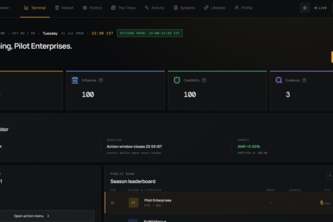
The company appears to be a single-person project (zuhaib shaikh) building a multiplayer political-economic simulation game called Halaldor. The author describes it as a social strategy game driven by markets, politics, and rumors, where players compete through influence, share trading, lobbying, and rumor management rather than traditional combat or resource collection.
The core product is a rule-based deterministic engine that simulates a dynamic economy and political landscape based on player actions. It uses AI only for storytelling elements like headlines and summaries, not gameplay mechanics.
What changed
The project was submitted to the OpenAI 2026 hackathon, indicating it's in an early development or prototype phase, likely built over a short timeframe (as suggested by the single developer and hackathon context).
The single most important open question
Is there any evidence of actual player engagement or retention beyond the author’s own playtesting? The description states no revenue, customers, or traction data are available.
What The Product Actually Is
- The description states that Halaldor is a multiplayer political-economic simulation game.
- Players represent publicly traded companies competing for top position on the Halaldor Index.
- Core gameplay involves:
- Trading shares
- Negotiating alliances and investment deals
- Spreading or verifying rumors
- Submitting complaints and investigations
- Lobbying institutions (Media, Finance, Intelligence)
- Participating in weekly council governance
- Predicting market movements and political outcomes
- The game is built around a deterministic engine, not AI-driven mechanics.
- AI is used only for storytelling enhancements such as generating newspaper headlines and weekly summaries.
- Actions update the Halaldor Index and the political landscape.
This is a self-reported description of a conceptual game engine, not an actual product with users or monetization.
Positioning & Claim Evolution
- The author claims Halaldor is inspired by:
- Stock markets
- Political strategy games
- Social deduction games
- Negotiation-based board games
- It positions itself as different from typical multiplayer strategy games, which reward resource collection or repetitive tasks.
- The game emphasizes that information is more valuable than money, and that every decision changes the political and economic landscape.
- It aims to create a living economy where trust, reputation, and market perception matter just as much as wealth.
These are claims about intent and positioning. No evidence of actual adoption or user feedback exists beyond the author’s own description.
Target Customer & ICP
- The target audience is multiplayer strategy gamers, particularly those interested in:
- Political simulations
- Economic systems
- Social deduction elements
- Negotiation-based gameplay
- Players are described as representing publicly traded companies competing for leadership on the Halaldor Index.
- No specific demographic or industry data is provided.
The description does not indicate whether there is a defined customer segment beyond general gamers. It lacks evidence of actual users or personas.
Business Model & Pricing Evidence
- There is no mention of pricing, monetization, or business model in the self-reported description.
- No revenue streams, subscriptions, or paid features are described.
- The project appears to be a personal hackathon submission, not yet commercialized.
Not evidenced. No indication of how the product would generate value or income.
Technical & Delivery Signals
- Built with:
- Codex
- OpenAI
- React
- Shadedn
- Supabase
- Tailwind
- TypeScript
- The game engine is rule-based and deterministic, not AI-heavy.
- AI is used only for storytelling elements like headlines and summaries.
- Core gameplay mechanics are processed through a lightweight rule engine.
This suggests a low-cost, scalable technical approach. However, no evidence of performance metrics or scalability beyond the single developer's prototype.
Traction & Maturity Signals
- The project was submitted to the OpenAI 2026 hackathon, indicating it’s likely in an early stage.
- It is described as a single-developer effort (zuhaib shaikh).
- No evidence of:
- Users
- Revenue
- Customers
- Product usage data
- Retention metrics
Not evidenced. The project appears to be a prototype or proof-of-concept, not yet mature or tractioned.
Competitive Context
- The author references inspiration from:
- Stock markets
- Political strategy games
- Social deduction games
- Negotiation-based board games
- No mention of direct competitors or market analysis.
- No evidence of competitive positioning or differentiation in the marketplace.
Not evidenced. No indication of existing competition or strategic positioning within a larger market.
Open Questions & Risks
- Single developer: The entire project is attributed to one person (zuhaib shaikh), raising questions about scalability and long-term maintenance.
- No traction or user data: There is no evidence of actual players, engagement, or adoption.
- Hackathon origin: Likely a prototype, not yet commercialized or tested in real-world conditions.
- Unproven monetization model: No business model or revenue path described.
- Unclear long-term vision execution: While the author describes future features, no evidence of progress toward them.
These are inferred risks from the lack of evidence and project context. Not directly stated by the author.
Questions the description leaves open
- What is the actual user engagement or retention rate for this game?
- How do you plan to scale beyond a single developer?
- Have you conducted any playtesting with external users?
- What are your plans for monetization and revenue generation?
- How do you intend to maintain and evolve the game’s economy over time?
- Are there any partnerships or integrations planned with existing platforms or communities?
These questions aim to probe the lack of evidence around traction, scalability, and business viability.
Overall Assessment
- The project is described as a personal hackathon submission by one developer.
- No evidence of:
- Revenue
- Customers
- Traction
- Product-market fit
- Business model or monetization strategy
Not evidenced. This is a conceptual prototype with no commercial validation.
Confidence Level Low — the description provides no verifiable data about product performance, user behavior, or market traction. It is a self-reported idea, not a validated business.
User Stories BotA demo video on every pull request
Get a demo video on every new feature
GitHub App that watches your pull requests and records a narrated, captioned demo.
Save time on demo prep and make informed decisions faster with a video walkthrough of every new feature.
Source
Submitted to the OpenAI 2026 hackathon on Devpost. Project home on Devpost. Back to the full gallery on Devpost.
This competitive analysis was produced by top-founders.com (opens in a new tab)
Generated by a language model from this project's public Devpost page — its tagline, the author's own write-up and any built-with tags listed there — as captured in August 2026. Short quotations are the author's words. It is an opinion on the idea as a business, not on the people behind it, and it reflects the description as published then. If the project has moved on, request a correction below. The analysis is not independent research and contains no verified traction, revenue or customer data.
An independent guide by KFG International LLC — not affiliated with, endorsed by, or connected to Devpost or OpenAI.