

Archive position — measured, not model output
0 likes on Devpost
2,263 of the 7,850 archived projects have more likes, and 5,587 share exactly 0 — so this project's #2,476 place in the like-ranked listing is a tie-break inside that group, not a ranking.
Projects (log scale)
Likes on Devpost. ▲ marks this project's group.
Show the figures
| Likes | Projects | Share of archive |
|---|---|---|
| 0 | 5,587 | 71.2% |
| 1 | 1,758 | 22.4% |
| 2 | 284 | 3.6% |
| 3–4 | 132 | 1.7% |
| 5–9 | 75 | 1.0% |
| 10+ | 14 | 0.2% |
 User Stories BotA demo video on every pull request
Get a demo video on every new feature
GitHub App that watches your pull requests and records a narrated, captioned demo.
Save time on demo prep and make informed decisions faster with a video walkthrough of every new feature.
Executive Summary
What the company appears to be
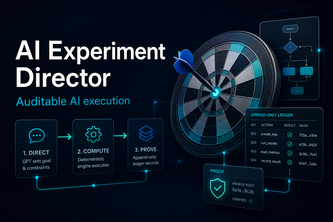
The project described is "AI Experiment Director", a local desktop application built using GPT-5.6 and Codex. The author states that it is an experiment management system where GPT-5.6 selects actions from a set of pre-defined options, while deterministic computation handles results, physics, and data storage. It supports bounded experimentation with replayability, branching, and append-only ledger functionality.
What changed
The project evolved from a simple test using Codex to a full application for an OpenAI hackathon. The author reports that the system was built in one thread using GPT-5.6, with clear separation of concerns between AI-driven decision-making and deterministic execution logic.
Single most important open question — the commercial due-diligence read
Is there evidence of any traction, revenue, or customer adoption beyond the author’s own development efforts? The description contains no data on users, usage, sales, or market response. All claims are self-reported and unverified.
What The Product Actually Is
The description states that AI Experiment Director is a local desktop program written in Python, designed to manage bounded experiments using GPT-5.6 for action selection and deterministic computation for results. It includes:
- A GPT-5.6 Director that chooses one action from a set of options.
- A deterministic engine computing physics, scores, and outcomes.
- An append-only ledger (SQLite) storing every result for exact replay and counterfactual branching.
- A Technical Lab to view history, replay throws, and visualize how small changes affect outcomes.
- Support for single, double, treble, and bull targeting, with fair comparisons under matched conditions.
- No external dependencies beyond Python’s standard library.
The system is described as being built entirely in one main thread using GPT-5.6, with the author handling product decisions and correction rounds.
Evidence
- The project is self-reported as a desktop app built with Python.
- It uses Tkinter for UI, SQLite for storage, and standard-library modules for computation.
- GPT-5.6 is used to pick actions; no AI-generated results or numbers are produced directly by the model.
Inference The system appears to be a proof-of-concept tool for managing deterministic experiments in a controlled environment — likely aimed at developers or researchers working with AI-assisted development and reproducible testing.
Positioning & Claim Evolution
The author claims that the product is:
- A bounded experiment engine, where GPT only chooses actions, not generates outcomes.
- A deterministic system that ensures reproducibility and fairness in comparisons.
- An append-only ledger for preserving all results without modification.
- A tool for replayable, branching experiments with clear separation between AI decision-making and program logic.
The project evolved from a casual experiment into a structured application during the OpenAI hackathon. The author notes that Codex proposed the idea after reviewing initial work, suggesting that the core concept was not entirely original but was shaped by AI feedback.
Evidence
- The system is described as being built using GPT-5.6 and Codex.
- The author states that Codex suggested the project idea and then built it from scratch.
- The system supports replayability, branching, and deterministic outcomes.
Inference The positioning seems to be around AI-assisted experimentation tools, particularly for developers or researchers who want reproducible, rule-bound AI interaction. It is not positioned as a commercial product but rather as a prototype or personal tool.
Target Customer & ICP
The description does not state any specific customer segments or target personas. The author describes the system as being built for personal use and to enter a hackathon, with no mention of external users or customers.
Evidence
- No explicit customer profile is given.
- The project was developed by one person (kimmo Liukkonen) in a short timeframe.
- The system is described as a local desktop app, suggesting it is not intended for mass distribution or SaaS delivery.
Inference The likely ICP includes developers, researchers, or AI enthusiasts who are interested in reproducible AI-assisted development and deterministic experimentation. However, there is no evidence of any actual customer base or market demand.
Business Model & Pricing Evidence
There is no evidence of a business model or pricing strategy in the description. The project is described as a personal hackathon submission with no indication of monetization plans, subscriptions, licensing, or sales.
Evidence
- No mention of revenue streams.
- No pricing information.
- No indication of commercial intent beyond the author’s own use and competition entry.
Inference The system appears to be a personal prototype, not a commercial offering. There is no evidence of any business model at this stage.
Technical & Delivery Signals
The project is built as a local desktop application in Python, using only standard library modules:
- Tkinter for UI and drawing.
- SQLite for append-only storage.
- Standard-library HTTPS for optional OpenAI integration.
- unittest for testing.
- **SHA-256, xorshift64*, Box-Muller** for random number generation.
The system is described as having:
- A clear architecture with defined steps: goal → action → validation → runtime → engine → ledger → UI.
- 85 passing tests.
- No runtime dependencies beyond Python.
- Timestamped commits and notes on Codex involvement.
Evidence
- The system is described as being built in one main thread using GPT-5.6.
- It supports offline functionality.
- The author tested the repo from a fresh folder, confirming installability and launch.
Inference The technical approach suggests a modular, rule-bound system, with strong separation between AI decision-making and deterministic execution. This may appeal to developers or researchers focused on reproducibility and controlled experimentation.
Traction & Maturity Signals
There is no evidence of traction, revenue, or customer adoption beyond the author’s own development efforts. The project was submitted to a hackathon and has no data on usage, growth, or market response.
Evidence
- No mention of users, customers, or sales.
- No data on engagement or retention.
- No indication of any product in production or commercial use.
Inference This is a pre-product prototype, likely at an early stage of development. It has not yet reached a point where traction or maturity can be assessed.
Competitive Context
The description does not provide information about competitors or the broader market landscape. The author does not reference similar tools or platforms in the space of AI-assisted experimentation or deterministic systems.
Evidence
- No mention of competing products.
- No indication of market analysis or competitive positioning.
Inference There is no evidence of a competitive landscape, and it's unclear whether this project addresses an existing gap or creates a new category. The author’s focus appears to be on personal development rather than market disruption.
Open Questions & Risks
- No commercial traction or customer base: The system is described as a hackathon submission with no evidence of real-world use.
- Unverified claims: All descriptions are self-reported and unverified; there is no independent validation of functionality or performance.
- Limited scope: The project is focused on darts, but the author notes that the underlying system could be extended to other domains — however, this has not yet been implemented.
- Single-person development: With only one developer (the author), scalability and long-term maintenance are uncertain.
Evidence
- No revenue or customer data.
- No evidence of product-market fit or adoption.
- The project is described as a personal tool, not a scalable offering.
Questions the description leaves open
- What specific use cases beyond darts are you envisioning for this system?
- How do you plan to scale beyond a single-user, local desktop environment?
- Have you tested the system with others or in real-world scenarios?
- Are there any plans to monetize or commercialize this tool?
- What are the limitations of GPT-5.6 in this context, and how have you mitigated them?
- How do you plan to ensure reproducibility across different machines or environments?
Overall Assessment
Not evidenced.
There is no evidence of any commercial traction, revenue, or customer adoption. The project is described as a personal hackathon submission with no indication of market demand, scalability, or business model.
The system is not yet a product, but rather a prototype that may evolve into one. It lacks the signals typically required for investment or partnership consideration — such as user data, revenue, or market validation.
Confidence Low. This analysis is based entirely on self-reported information and does not include any third-party verification or historical data.
User Stories BotA demo video on every pull request
Get a demo video on every new feature
GitHub App that watches your pull requests and records a narrated, captioned demo.
Save time on demo prep and make informed decisions faster with a video walkthrough of every new feature.
Source
Submitted to the OpenAI 2026 hackathon on Devpost. Project home on Devpost. Back to the full gallery on Devpost.
This competitive analysis was produced by top-founders.com (opens in a new tab)
Generated by a language model from this project's public Devpost page — its tagline, the author's own write-up and any built-with tags listed there — as captured in August 2026. Short quotations are the author's words. It is an opinion on the idea as a business, not on the people behind it, and it reflects the description as published then. If the project has moved on, request a correction below. The analysis is not independent research and contains no verified traction, revenue or customer data.
An independent guide by KFG International LLC — not affiliated with, endorsed by, or connected to Devpost or OpenAI.