

Archive position — measured, not model output
0 likes on Devpost
2,263 of the 7,850 archived projects have more likes, and 5,587 share exactly 0 — so this project's #2,468 place in the like-ranked listing is a tie-break inside that group, not a ranking.
Projects (log scale)
Likes on Devpost. ▲ marks this project's group.
Show the figures
| Likes | Projects | Share of archive |
|---|---|---|
| 0 | 5,587 | 71.2% |
| 1 | 1,758 | 22.4% |
| 2 | 284 | 3.6% |
| 3–4 | 132 | 1.7% |
| 5–9 | 75 | 1.0% |
| 10+ | 14 | 0.2% |
 User Stories BotA demo video on every pull request
Get a demo video on every new feature
GitHub App that watches your pull requests and records a narrated, captioned demo.
Save time on demo prep and make informed decisions faster with a video walkthrough of every new feature.
Executive Summary
What the company appears to be
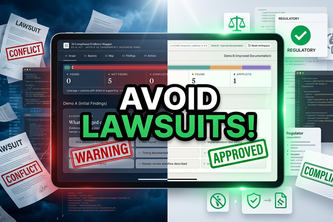
The project described by the caller is an evidence-readiness tool for compliance professionals, legal operations teams, product engineers and internal reviewers. It is designed to map AI compliance obligations—specifically under the EU AI Act’s Article 50 transparency requirements—into traceable evidence, visible gaps, responsible owners and clear next actions.
What changed
The author states that this is a narrow MVP focused on one workflow: mapping organisational materials (e.g., internal documentation, public disclosures) to prepared control sets for EU AI Act Article 50 transparency readiness. It does not issue legal assessments or certifications; instead, it surfaces evidence gaps and suggests next steps.
Single most important open question
Is there sufficient evidence in the project description to support a belief that this tool has traction, revenue, or adoption beyond its own demonstration?
Note: This analysis is based entirely on the self-reported, unverified project description provided by the caller. No third-party verification, archived data, or independent sources are available.
What The Product Actually Is
The description states that AI Compliance Evidence Mapper is an evidence-readiness tool for developers, product teams, compliance professionals, legal operations and internal reviewers. It focuses on mapping organisational materials to a prepared control set related to EU AI Act Article 50 transparency obligations.
It does not issue legal assessments or certifications. Instead, it surfaces:
- Evidence found
- Partial evidence
- Evidence not found in supplied materials
- Conflicting evidence
- Applicability questions
- Human-review requirements
- Exact source excerpts and line numbers
- Evidence strength and limitations
- Suggested responsible owner
- Smallest useful next action
The system is built as a standalone React and TypeScript application with no runtime AI calls, accounts, databases or external services.
Claim: The product is an evidence-mapping tool for compliance workflows.
Evidence: Described in the write-up as mapping documents to controls, identifying gaps, routing to owners and suggesting actions.
Positioning & Claim Evolution
The author positions the tool not as a compliance checker but as a way to make compliance claims inspectable. The central principle is: “Compliance is not a checkbox. It is an evidence trail.”
It distinguishes between:
- Evidence-readiness (what documentation supports a claim)
- Legal compliance (which requires human judgment)
- Applicability questions (which remain open for qualified review)
The tool does not present itself as legal advice or certification, nor does it attempt to replace human legal judgment.
Claim: The tool helps organisations understand what their existing documentation actually demonstrates.
Evidence: Stated in the write-up under “Inspiration” and reiterated throughout.
Target Customer & ICP
The description states that the target users include:
- Developers
- Product teams
- Compliance professionals
- Legal operations
- Internal reviewers
It is explicitly aimed at those who need to assess whether organisational claims are supported by evidence, particularly in the context of AI regulation.
Claim: The tool targets compliance and legal professionals working with AI systems.
Evidence: Explicitly listed in the write-up under “What it does.”
Business Model & Pricing Evidence
Not evidenced. The description does not contain any information about pricing, monetisation strategy, or business model.
Finding: No evidence of business model or pricing structure.
Technical & Delivery Signals
The prototype is built as a standalone React and TypeScript application using:
- Node.js
- Vite
- TypeScript
- React
- Vitest for testing
- No runtime AI calls
- No accounts, databases, API keys or external services
It parses documents into line-addressable evidence, evaluates versioned control sets, deduplicates evidence, preserves exact excerpts and line numbers, classifies evidence strength, detects cross-document conflicts, routes gaps to suggested owners, creates deterministic next actions, and calculates transparent evidence-coverage metrics.
Claim: The tool is a deterministic, local engine with no external dependencies.
Evidence: Described in “How we built it” section.
Traction & Maturity Signals
Not evidenced. There is no mention of revenue, customers, usage data, or product adoption beyond the prototype and demo scenarios.
Finding: No evidence of traction, customers or revenue.
Competitive Context
The description does not reference any competitors or existing tools in this space. It does not describe how this tool compares to others in AI compliance or evidence mapping.
Finding: No competitive context provided.
Open Questions & Risks
- The tool is described as a prototype, not a production-ready product.
- It does not claim to provide legal advice or certification.
- There is no evidence of revenue, customers or adoption.
- The project is self-reported and unverified; no third-party validation exists.
- It focuses on one narrow workflow (EU AI Act Article 50), which may limit its broader appeal.
Inference: Without traction or commercialisation, the risk of failure in a competitive market is high.
Questions the description leaves open
- What are the actual use cases beyond the demo? Is there any feedback from potential users?
- How does this tool integrate with existing compliance or governance platforms?
- Are there plans to expand beyond EU AI Act Article 50?
- Has the team considered how to scale beyond a single-person development effort?
- What is the long-term vision for monetisation and product roadmap?
Note: These questions are based on gaps in the self-reported description.
Overall Assessment
Not evidenced. The project description does not contain any information about funding, valuation, or investment interest.
Finding: No evidence of investment or partnership activity.
User Stories BotA demo video on every pull request
Get a demo video on every new feature
GitHub App that watches your pull requests and records a narrated, captioned demo.
Save time on demo prep and make informed decisions faster with a video walkthrough of every new feature.
Source
Submitted to the OpenAI 2026 hackathon on Devpost. Project home on Devpost. Back to the full gallery on Devpost.
This competitive analysis was produced by top-founders.com (opens in a new tab)
Generated by a language model from this project's public Devpost page — its tagline, the author's own write-up and any built-with tags listed there — as captured in August 2026. Short quotations are the author's words. It is an opinion on the idea as a business, not on the people behind it, and it reflects the description as published then. If the project has moved on, request a correction below. The analysis is not independent research and contains no verified traction, revenue or customer data.
An independent guide by KFG International LLC — not affiliated with, endorsed by, or connected to Devpost or OpenAI.