

Archive position — measured, not model output
0 likes on Devpost
2,263 of the 7,850 archived projects have more likes, and 5,587 share exactly 0 — so this project's #6,305 place in the like-ranked listing is a tie-break inside that group, not a ranking.
Projects (log scale)
Likes on Devpost. ▲ marks this project's group.
Show the figures
| Likes | Projects | Share of archive |
|---|---|---|
| 0 | 5,587 | 71.2% |
| 1 | 1,758 | 22.4% |
| 2 | 284 | 3.6% |
| 3–4 | 132 | 1.7% |
| 5–9 | 75 | 1.0% |
| 10+ | 14 | 0.2% |
 User Stories BotA demo video on every pull request
Get a demo video on every new feature
GitHub App that watches your pull requests and records a narrated, captioned demo.
Save time on demo prep and make informed decisions faster with a video walkthrough of every new feature.
Executive Summary
What the company appears to be
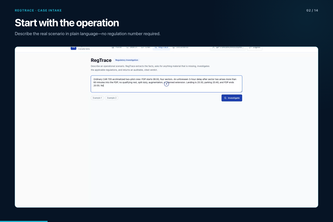
RegTrace is a self-reported tool that uses AI to help Canadian aviation professionals investigate operational scenarios by translating plain-language descriptions into structured regulatory findings. It claims to support citation-gated investigations, with tools to extract facts, ask clarifying questions, and return assessments tied to official regulations.
What changed
The author reports extending an earlier side project, FlightRef, into RegTrace during a Build Week event. The new version introduces multi-phase workflows, structured investigation steps, and AI-powered evidence grounding via OpenAI's GPT-5.6 model and custom tools.
The single most important open question
Is there any evidence of actual use or traction beyond the author’s own demonstrations? The description states no revenue, customers, or adoption data are available — only self-reported claims about functionality and performance.
What The Product Actually Is
The description states that RegTrace is an AI-powered investigation aid for Canadian aviation professionals. It allows users to describe operational problems in plain language and returns a structured regulatory assessment based on a 44-document corpus including the Aeronautics Act, Canadian Aviation Regulations, and Transport Canada manuals.
Key features include:
- Fact extraction from user input
- Clarifying questions when facts are missing
- Investigation planning
- Search across multiple regulatory documents using purpose-built tools
- Distinguishing between binding and advisory material by authority tier
- Returning assessments (supported, conditional, insufficient, or conflicting)
- Deep-linking to exact sections of source documents
- Producing printable RegTrace Case Files
The system is built on a Next.js frontend, Supabase backend, and uses GPT-5.6 via OpenAI Responses API with function calling for evidence retrieval.
Inference The product appears to be a proof-of-concept or prototype built as part of a hackathon submission, not yet deployed in production at scale.
Positioning & Claim Evolution
The author positions RegTrace as an extension of FlightRef, which was previously developed as a side project for searching aviation regulations. During Build Week, the author expanded it into a structured investigative tool rather than just a search engine.
Claims made:
- RegTrace turns operational problems into "structured, citation-gated regulatory investigations."
- It is not a legal determination but an aid to help teams build defensible trails back to official text.
- The system distinguishes between Acts, Regulations, Standards, Advisory material, and Guidance by authority tier.
- Users can correct facts or add details and see updated assessments without restarting the process.
Inference This evolution from a search tool to an investigative assistant suggests intent to move beyond simple information retrieval toward decision support in regulated environments.
Target Customer & ICP
The description states that RegTrace focuses on Canadian airlines and operators, specifically groups such as flight crews, dispatchers, and flight standards teams who regularly reference regulations during operations.
These users are described as needing to:
- Reference regulations while dealing with operational scenarios
- Search by keywords rather than regulation numbers
- Identify missing facts, determine binding sources, reconcile provisions, and preserve defensible trails
Inference The target customer is likely internal staff within regulated aviation organizations — not external clients or consumers. The ICP seems to be mid-to-senior-level professionals in regulatory compliance or operational roles.
Business Model & Pricing Evidence
There is no evidence provided about pricing, monetization, or business model. The description does not mention any revenue streams, subscriptions, licensing fees, or customer acquisition costs.
Not evidenced
Technical & Delivery Signals
The system uses:
- GPT-5.6 via OpenAI Responses API
- Function calling with four bounded tools: regulation search, exact-section reading, related-document lookup, and definition lookup
- PostgreSQL full-text search combined with pgvector search in Supabase
- Next.js 14, TypeScript, React, Tailwind CSS, Vercel
- Zod for input/output validation
- SSE streaming for real-time interface updates
The author reports using Codex extensively during development to implement tasks like orchestration, testing, and QA.
Inference The technical stack indicates a modern web application built with AI integration, likely intended for demonstration or prototyping rather than enterprise deployment. Use of function calling and tool grounding suggests an attempt at controlling output quality.
Traction & Maturity Signals
The description states:
- Live end-to-end investigations completed in 34–53 seconds during QA
- All 35 unique citation links from rehearsals opened the intended source sections
- A clear repository history separating FlightRef foundation from RegTrace work
- The product was submitted to an OpenAI hackathon
However, there is no evidence of:
- Actual users or customer base
- Revenue or monetization
- Product adoption or usage metrics
- Production deployment or scaling efforts
Not evidenced
Competitive Context
The description does not provide any information about competitors or market positioning beyond the author’s own claims. No mention is made of existing tools for regulatory compliance, aviation regulation search engines, or AI-powered legal research platforms.
Not evidenced
Open Questions & Risks
- Unverified claims: All functionality and performance are self-reported without independent validation.
- Prototype nature: The product appears to be a hackathon submission with no evidence of real-world use or scalability.
- AI dependency: Heavy reliance on GPT-5.6 raises concerns about consistency, cost, and control over outputs.
- Limited scope: Focus on Canadian aviation regulations may limit broader applicability unless expanded.
- No commercial traction: No evidence of revenue, customers, or market validation.
Inference Without external verification or data on adoption, the risk of misalignment between stated capabilities and real-world utility is high.
Questions the description leaves open
- What specific regulatory domains outside of Canadian aviation are you planning to support?
- How do you plan to validate that model outputs align with official interpretations of regulations?
- Have you tested RegTrace with actual users from the aviation industry?
- Are there any known limitations or edge cases in how the AI handles ambiguous or conflicting regulations?
- What is your roadmap for moving beyond a prototype into a scalable product?
- How do you intend to monetize this tool, if at all?
- Can you demonstrate how the citation-gating mechanism prevents false references from appearing in results?
Overall Assessment
There is no evidence of commercial traction, revenue, or customer adoption. The description indicates that RegTrace is a self-reported prototype built during a hackathon event, with no indication of production use or market validation.
Confidence: Low
This project lacks any verified commercial signals. It may represent an interesting idea in regulatory AI for aviation, but there is insufficient evidence to assess its viability as a business or investment opportunity. The author’s claims about functionality and performance remain unverified.
User Stories BotA demo video on every pull request
Get a demo video on every new feature
GitHub App that watches your pull requests and records a narrated, captioned demo.
Save time on demo prep and make informed decisions faster with a video walkthrough of every new feature.
Source
Submitted to the OpenAI 2026 hackathon on Devpost. Project home on Devpost. Back to the full gallery on Devpost.
This competitive analysis was produced by top-founders.com (opens in a new tab)
Generated by a language model from this project's public Devpost page — its tagline, the author's own write-up and any built-with tags listed there — as captured in August 2026. Short quotations are the author's words. It is an opinion on the idea as a business, not on the people behind it, and it reflects the description as published then. If the project has moved on, request a correction below. The analysis is not independent research and contains no verified traction, revenue or customer data.
An independent guide by KFG International LLC — not affiliated with, endorsed by, or connected to Devpost or OpenAI.