

Archive position — measured, not model output
2 likes on Devpost
221 of the 7,850 archived projects have more likes, and 284 share exactly 2 — so this project's #418 place in the like-ranked listing is a tie-break inside that group, not a ranking.
Projects (log scale)
Likes on Devpost. ▲ marks this project's group.
Show the figures
| Likes | Projects | Share of archive |
|---|---|---|
| 0 | 5,587 | 71.2% |
| 1 | 1,758 | 22.4% |
| 2 | 284 | 3.6% |
| 3–4 | 132 | 1.7% |
| 5–9 | 75 | 1.0% |
| 10+ | 14 | 0.2% |
 User Stories BotA demo video on every pull request
Get a demo video on every new feature
GitHub App that watches your pull requests and records a narrated, captioned demo.
Save time on demo prep and make informed decisions faster with a video walkthrough of every new feature.
Executive Summary
What the company appears to be: PixelBisect is a developer tool that automates the process of identifying which Git commit introduced a visual regression in a web application. It operates as a local CLI tool and uses native Git bisect, browser automation (Playwright), and pixel comparison (pixelmatch) to isolate problematic commits.
What changed: The author describes building a tool to solve a common pain point for developers: finding the exact commit that caused a subtle visual bug when visual regression tests indicate a problem but don't pinpoint its origin. The solution is presented as an automated, offline-first CLI utility with deterministic behavior and self-contained reporting.
Single most important open question: Is there any evidence of usage beyond the author’s own demo? The description states no revenue, customers, or adoption data — only a self-reported tool built for a hackathon.
What The Product Actually Is
The description states that PixelBisect is a local visual-regression forensics CLI. It takes as input:
- A local Git repository
- A known-good commit
- A known-bad commit
- A page URL
- A CSS selector
It then performs the following actions:
- Creates an isolated Git worktree without modifying the developer's active checkout.
- Verifies visual differences between good and bad endpoints.
- Uses native
git bisect runto search commit history. - Installs dependencies, starts application, captures screenshots at each tested commit.
- Classifies commits as GOOD or BAD using deterministic screenshots and thresholded pixel comparison.
- Identifies the exact first-bad commit.
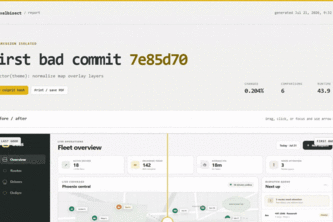
- Produces a self-contained HTML evidence report.
The final output includes:
- Culprit commit hash, author, date, message
- Last-good and first-bad screenshots
- Interactive before/after slider
- Highlighted pixel-difference image
- Changed-pixel statistics
- Changed computed CSS properties
- Every commit tested during the bisect
- The Git patch that introduced the regression
All data is embedded in one offline HTML file. No external services, API keys, or cloud infrastructure are used.
Inference: This is a narrow, focused developer tool for debugging visual regressions in web applications — not a general-purpose testing platform or SaaS product.
Positioning & Claim Evolution
The author positions PixelBisect as a solution to a specific problem in developer workflows: finding the root cause of visual regressions. The tagline “Visual testing catches tomorrow’s regressions. PixelBisect finds yesterday’s.” frames it as a complementary tool to existing visual regression tools.
Key claims:
- It automates manual processes (rebuilding revisions, comparing screenshots).
- It is deterministic and local.
- It does not require an account or upload data.
- It produces a self-contained report for easy sharing and review.
There is no indication of broader positioning beyond solving this niche developer problem. No mention of enterprise adoption, integrations with CI/CD pipelines, or support for multiple platforms or frameworks.
Inference: The tool is positioned as a developer utility, not a commercial product or platform. It appears to be built by one person for personal use and possibly for a hackathon.
Target Customer & ICP
The description states that PixelBisect is intended for developers working on web applications, particularly those who run visual regression tests and need to trace bugs back to specific commits.
It targets users who:
- Work with Git repositories
- Use visual testing tools
- Are debugging subtle UI issues
- Want to avoid manual, time-consuming processes
No explicit segmentation or targeting beyond this general category is described. No mention of enterprise customers, teams, or specific roles (e.g., QA engineers, DevOps).
Inference: The ICP is likely individual developers or small engineering teams working on frontend-heavy applications where visual regressions are a concern.
Business Model & Pricing Evidence
The description does not provide any information about pricing, monetization, or business model. It emphasizes that the tool runs locally and does not require an account or API key — suggesting no subscription or service-based revenue model.
Inference: There is no evidence of a commercial business model beyond the author’s own use case or hackathon submission.
Technical & Delivery Signals
The project is built using:
- TypeScript
- Node.js
- Git (native bisect, worktrees)
- Playwright + Chromium for browser automation
- pixelmatch + pngjs for image comparison
- Vite for demo app
- GitHub Actions for CI verification
It uses:
- Native
git bisect runfor binary search - Detached worktrees to avoid modifying the developer’s active branch
- Deterministic screenshots and thresholded pixel comparison
- Self-contained HTML reports with embedded assets
The tool is described as:
- A CLI utility
- Designed for reproducibility and reliability
- Tested across platforms (Windows, Ubuntu)
- Built with unit, integration, and E2E tests
Inference: The technical stack suggests a well-engineered, low-level developer tool, likely optimized for performance and correctness in local environments.
Traction & Maturity Signals
The description includes:
- A reproducible demo repository with 64 commits
- A real-world example of a subtle visual bug (driver markers disappearing)
- A detailed walkthrough of how the tool identifies the root cause
- Use of Codex/GPT-5.6 for development assistance
However, there is no evidence of external usage, customer feedback, or adoption beyond the author’s own work.
Inference: The project shows maturity in design and implementation but lacks any signal of traction or real-world deployment.
Competitive Context
The description does not mention competitors or existing tools in this space. It implies that current visual regression tools do not provide the same level of forensic capability — i.e., identifying the exact commit responsible for a visual change.
Inference: There is no known competitive landscape described, but the tool fills a gap in debugging workflows where developers must manually trace visual regressions.
Open Questions & Risks
- No external validation or usage: The tool exists only as a self-reported demo and hackathon submission.
- Single-person team: Only one developer is listed (anasm266 Mohamed Riyaz).
- No commercial traction: No revenue, customers, or product-market fit data.
- Limited scope: Designed for local use only; no cloud or enterprise features.
- Unproven adoption: The tool may not be widely used or tested outside of the author’s own environment.
Inference: This is a proof-of-concept or prototype, not a scalable or commercial product. Risk of misalignment between perceived utility and actual market demand.
Questions the description leaves open
- Has anyone else used PixelBisect beyond the demo?
- Are there any plans to expand beyond local usage or add cloud features?
- What is the intended path from prototype to product, if any?
- How does it handle edge cases like dynamic content, animations, or complex rendering?
- Is there a plan for documentation, community support, or open-source release?
- What are the long-term goals for the tool — is it meant to be a standalone utility or part of a larger platform?
Overall Assessment
Not evidenced: There is no evidence of commercial traction, revenue, or customer base. The project appears to be a self-developed hackathon submission, not a product with market validation.
Confidence level: Low — based entirely on self-reported content and no external data.
Assessment: This is a developer utility prototype, likely built for personal use or a hackathon, with no indication of commercial viability or scalability. It does not meet the criteria for investment or partnership at this stage.
User Stories BotA demo video on every pull request
Get a demo video on every new feature
GitHub App that watches your pull requests and records a narrated, captioned demo.
Save time on demo prep and make informed decisions faster with a video walkthrough of every new feature.
Source
Submitted to the OpenAI 2026 hackathon on Devpost. Project home on Devpost. Back to the full gallery on Devpost.
This competitive analysis was produced by top-founders.com (opens in a new tab)
Generated by a language model from this project's public Devpost page — its tagline, the author's own write-up and any built-with tags listed there — as captured in August 2026. Short quotations are the author's words. It is an opinion on the idea as a business, not on the people behind it, and it reflects the description as published then. If the project has moved on, request a correction below. The analysis is not independent research and contains no verified traction, revenue or customer data.
An independent guide by KFG International LLC — not affiliated with, endorsed by, or connected to Devpost or OpenAI.