

Archive position — measured, not model output
2 likes on Devpost
221 of the 7,850 archived projects have more likes, and 284 share exactly 2 — so this project's #420 place in the like-ranked listing is a tie-break inside that group, not a ranking.
Projects (log scale)
Likes on Devpost. ▲ marks this project's group.
Show the figures
| Likes | Projects | Share of archive |
|---|---|---|
| 0 | 5,587 | 71.2% |
| 1 | 1,758 | 22.4% |
| 2 | 284 | 3.6% |
| 3–4 | 132 | 1.7% |
| 5–9 | 75 | 1.0% |
| 10+ | 14 | 0.2% |
 User Stories BotA demo video on every pull request
Get a demo video on every new feature
GitHub App that watches your pull requests and records a narrated, captioned demo.
Save time on demo prep and make informed decisions faster with a video walkthrough of every new feature.
Executive Summary
What the company appears to be
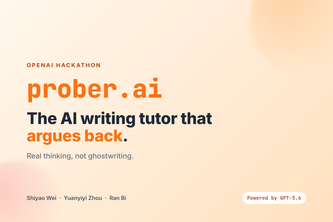
Prober.ai is an AI-powered educational tool designed to support argumentative writing by prompting students with critical questions rather than rewriting their essays. The product is described as a writing tutor that uses persona-based feedback to encourage reflection and reasoning development.
What changed
This project was submitted to the OpenAI 2026 hackathon, indicating it is an early-stage prototype or proof-of-concept. It was built in a short timeframe (a hackathon) and has no evidence of prior traction, revenue, or customer adoption.
Single most important open question
Is there a viable market need for this type of AI writing tutor, and can the product scale beyond a hackathon prototype?
What The Product Actually Is
The description states that Prober.ai is an AI-powered argumentative-writing tutor. It allows students to write essays in a rich-text editor (Quill), choose a feedback persona (e.g., Reviewer #2 or Confused Reader), and receive critical questions about their draft instead of direct edits.
It implements a "reflect-then-unlock" workflow where students must write a defense or reflection before receiving revision suggestions. The system uses Gemini API for generating persona-based questions, with endpoints like /challenge and /unlock.
The frontend is built using HTML, CSS, JavaScript, and Quill editor; the backend runs on Node.js and Express.
Evidence Self-reported by author. No independent verification of functionality or performance.
Positioning & Claim Evolution
The authors claim that Prober.ai turns AI into a "sparring partner" rather than a "copy-paste shortcut." It aims to build critical thinking through interactive question-based feedback, positioning itself as an alternative to traditional AI writing tools that focus on editing or rewriting.
They state their goal is to help students develop stronger arguments by confronting the kinds of questions a critical reader would ask. The product is framed as changing the role of AI in education — not replacing student thought but encouraging explanation and improvement.
Evidence Self-reported claims about intent and positioning, not proof of traction or adoption.
Target Customer & ICP
The description indicates that Prober.ai targets students working on argumentative essays. It is designed for educational use, particularly in contexts where critical thinking and reasoning are emphasized.
There is no explicit mention of specific grade levels, age groups, or institutional types (e.g., K-12, college, university). However, the inclusion of personas like "Reviewer #2" suggests a focus on academic writing at higher education levels.
Evidence Self-reported target audience; no data on actual users or institutions using it.
Business Model & Pricing Evidence
There is no evidence provided about pricing, monetization strategy, or business model. The project was built as part of a hackathon and lacks any indication of revenue streams, subscription models, or paid features.
Evidence Not evidenced.
Technical & Delivery Signals
Prober.ai uses a vanilla HTML/CSS/JS frontend with Quill for rich-text editing. The backend is Node.js + Express, connected to the Gemini API via carefully designed prompts. It includes features such as:
- Responsive web design
- Safe Markdown rendering
- Input validation and request-size limits
- Keyboard-accessible navigation
- Reduced-motion support
- Onboarding guidance
- Session statistics
- Persistent theme toggle
The system implements a two-endpoint architecture: /challenge for generating questions, and /unlock for unlocking revision suggestions after reflection.
Evidence Self-reported technical stack and implementation details; no evidence of production deployment or scalability.
Traction & Maturity Signals
There is no evidence of traction, revenue, customers, or adoption beyond the hackathon submission. The project has a team size of three members (Ran Bi, yiyi11, sw3550), and no prior funding, partnerships, or user base are mentioned.
The authors note they built a complete experience in a hackathon setting, but this does not indicate real-world usage or product-market fit.
Evidence Not evidenced.
Competitive Context
No information is provided about existing competitors or market landscape. The description does not reference other AI writing tools, educational platforms, or tutoring services that might be relevant to the space.
Evidence Not evidenced.
Open Questions & Risks
- Unproven market need: No evidence of demand or user testing beyond a hackathon.
- Prototype-only status: The product is described as a hackathon submission with no indication of further development or commercial viability.
- Limited scope: Currently focused only on argumentative essays and lacks support for other writing genres.
- No monetization strategy: No mention of how the tool would generate revenue or sustain itself.
- Dependency on AI API: Reliance on Gemini API may pose risks if access changes or becomes costly.
Evidence Inferences based on lack of evidence in description.
Questions the description leaves open
- What specific educational institutions or teachers have shown interest in using Prober.ai?
- How do you plan to validate the effectiveness of your approach (e.g., through student outcomes, teacher feedback)?
- Are there any early adopters or pilot programs currently underway?
- What are your plans for expanding beyond argumentative essays and into other writing genres?
- How will you handle scalability and performance as more users engage with the platform?
- Do you have a clear path to monetization or revenue generation?
- What is the timeline for moving from prototype to a production-ready product?
Overall Assessment
At this stage, Prober.ai appears to be an early-stage hackathon project with no demonstrated traction, revenue, or customer base. While the concept of using AI to foster critical thinking in writing shows promise, there is insufficient evidence to assess its commercial viability or market readiness.
The product is described as a polished prototype but lacks any indication of real-world usage or impact. Without further development, user testing, or business model clarity, it cannot be considered a viable investment or partnership opportunity at this time.
Confidence Level Low — based on minimal self-reported evidence and lack of external validation.
User Stories BotA demo video on every pull request
Get a demo video on every new feature
GitHub App that watches your pull requests and records a narrated, captioned demo.
Save time on demo prep and make informed decisions faster with a video walkthrough of every new feature.
Source
Submitted to the OpenAI 2026 hackathon on Devpost. Project home on Devpost. Back to the full gallery on Devpost.
This competitive analysis was produced by top-founders.com (opens in a new tab)
Generated by a language model from this project's public Devpost page — its tagline, the author's own write-up and any built-with tags listed there — as captured in August 2026. Short quotations are the author's words. It is an opinion on the idea as a business, not on the people behind it, and it reflects the description as published then. If the project has moved on, request a correction below. The analysis is not independent research and contains no verified traction, revenue or customer data.
An independent guide by KFG International LLC — not affiliated with, endorsed by, or connected to Devpost or OpenAI.