

Archive position — measured, not model output
0 likes on Devpost
2,263 of the 7,850 archived projects have more likes, and 5,587 share exactly 0 — so this project's #4,346 place in the like-ranked listing is a tie-break inside that group, not a ranking.
Projects (log scale)
Likes on Devpost. ▲ marks this project's group.
Show the figures
| Likes | Projects | Share of archive |
|---|---|---|
| 0 | 5,587 | 71.2% |
| 1 | 1,758 | 22.4% |
| 2 | 284 | 3.6% |
| 3–4 | 132 | 1.7% |
| 5–9 | 75 | 1.0% |
| 10+ | 14 | 0.2% |
 User Stories BotA demo video on every pull request
Get a demo video on every new feature
GitHub App that watches your pull requests and records a narrated, captioned demo.
Save time on demo prep and make informed decisions faster with a video walkthrough of every new feature.
Executive Summary
What the company appears to be
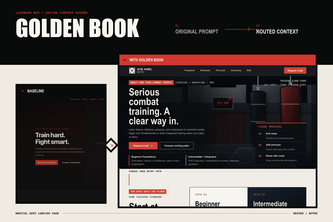
The description states that Golden Book MCP is a project submitted to the OpenAI 2026 hackathon. It claims to route source-backed design context for websites, apps, games, and tools, helping coding agents build distinctive interfaces without copying identities or inventing claims.
What changed
There is no evidence of prior versions or changes; this is a single submission to a hackathon.
The single most important open question
Is there any evidence of traction, revenue, customer adoption, or product-market fit beyond the self-reported tagline and hackathon submission?
What The Product Actually Is
The description states that Golden Book MCP "routes source-backed design context for websites, apps, games, and tools". It is described as helping coding agents build distinctive interfaces without copying identities or inventing claims.
Inference It appears to be a tool or framework aimed at AI coding agents, possibly in the context of interface design or development workflows. The term “MCP” (Model Context Protocol) suggests it may relate to how AI agents interact with or process contextual data.
Not evidenced There is no evidence of actual functionality, architecture, or product deliverables beyond the tagline and hackathon submission.
Positioning & Claim Evolution
The description states that Golden Book MCP helps “coding agents build distinctive interfaces without copying identities or inventing claims.”
Claim
It positions itself as a tool to help AI coding agents avoid plagiarism or over-reliance on existing design patterns, by providing source-backed context.
Inference This suggests a focus on ethical or original AI-generated UI/UX development, possibly in response to concerns about AI tools replicating existing designs.
Not evidenced There is no evidence of prior positioning, evolution of claims, or market feedback. The description does not indicate whether this is a new idea or an iteration of something previously proposed.
Target Customer & ICP
The description states that Golden Book MCP helps “coding agents” build interfaces.
Claim
It targets AI coding agents as its primary users.
Inference If the tool is for AI agents, it may be aimed at developers or teams using AI tools to generate UIs or code. The ICP could include developers working with AI-assisted design or development platforms.
Not evidenced There is no evidence of specific customer segments, personas, or use cases beyond the general claim that it helps coding agents.
Business Model & Pricing Evidence
The description does not state anything about pricing, monetization, or business model.
Not evidenced No information on how the product would be sold, whether it’s free, subscription-based, or otherwise.
Technical & Delivery Signals
The author states that the project was built with: “context, mimo, model, v2.5”.
Claim
It uses technologies or frameworks related to context handling, models, and possibly AI agents or LLMs.
Inference This may suggest a technical stack involving AI or machine learning components, but no details are provided about architecture, scalability, or delivery mechanisms.
Not evidenced There is no evidence of technical implementation, performance metrics, or delivery methods.
Traction & Maturity Signals
The description states that the project was submitted to the OpenAI 2026 hackathon.
Claim
It is a hackathon submission.
Inference This indicates early-stage development and lack of commercial traction. It does not suggest any product-market fit, customer adoption, or revenue generation.
Not evidenced There is no evidence of user feedback, pilot programs, or product usage beyond the hackathon entry.
Competitive Context
The description does not mention any competitors or competitive landscape.
Not evidenced No information on existing tools or platforms that may address similar problems in AI-assisted design or development.
Open Questions & Risks
- Thin evidence base: The only evidence is a hackathon submission and tagline. No product, traction, or market validation.
- Unproven claims: The description makes strong claims about helping AI agents avoid copying identities, but no proof of effectiveness or adoption.
- No team or funding: Only one member listed (Alex Burkhart), with no indication of funding or team structure.
- Lack of clarity on product scope: It is unclear what exactly the tool does or how it works beyond a high-level claim.
Questions the description leaves open
- What specific problem are you solving, and how does this tool address it?
- How does Golden Book MCP differ from existing tools in AI-assisted design or development?
- Have you tested the tool with real users or AI agents? If so, what were the results?
- What is your roadmap for product development beyond the hackathon?
- Are there any early adopters or partners interested in using this tool?
- How do you plan to monetize this product?
Overall Assessment
Not evidenced There is no evidence of commercial viability, traction, or market demand.
Inference Given that this is a hackathon submission with no additional information, it appears to be in an exploratory or early-stage phase. It lacks the signals typically required for investment or partnership consideration.
Confidence level Very low — based on self-reported evidence only, with no product, customers, or revenue data.
User Stories BotA demo video on every pull request
Get a demo video on every new feature
GitHub App that watches your pull requests and records a narrated, captioned demo.
Save time on demo prep and make informed decisions faster with a video walkthrough of every new feature.
Source
Submitted to the OpenAI 2026 hackathon on Devpost. Project home on Devpost. Back to the full gallery on Devpost.
This competitive analysis was produced by top-founders.com (opens in a new tab)
Generated by a language model from this project's public Devpost page — its tagline and any built-with tags listed there, since the author published no write-up — as captured in August 2026. Short quotations are the author's words. It is an opinion on the idea as a business, not on the people behind it, and it reflects the description as published then. If the project has moved on, request a correction below. The analysis is not independent research and contains no verified traction, revenue or customer data.
An independent guide by KFG International LLC — not affiliated with, endorsed by, or connected to Devpost or OpenAI.