

Archive position — measured, not model output
0 likes on Devpost
2,263 of the 7,850 archived projects have more likes, and 5,587 share exactly 0 — so this project's #4,348 place in the like-ranked listing is a tie-break inside that group, not a ranking.
Projects (log scale)
Likes on Devpost. ▲ marks this project's group.
Show the figures
| Likes | Projects | Share of archive |
|---|---|---|
| 0 | 5,587 | 71.2% |
| 1 | 1,758 | 22.4% |
| 2 | 284 | 3.6% |
| 3–4 | 132 | 1.7% |
| 5–9 | 75 | 1.0% |
| 10+ | 14 | 0.2% |
 User Stories BotA demo video on every pull request
Get a demo video on every new feature
GitHub App that watches your pull requests and records a narrated, captioned demo.
Save time on demo prep and make informed decisions faster with a video walkthrough of every new feature.
Executive Summary
What the company appears to be
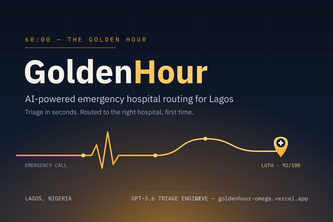
GoldenHour is a self-reported AI-powered emergency hospital routing system for Lagos, Nigeria, designed to help dispatchers quickly identify the most appropriate hospital for a patient based on real-time capacity and specialist availability. The system uses GPT-5.6 for triage and decision-making, with a model-generated scoring function per case.
What changed
The project was built as part of an OpenAI hackathon submission. It is described as live and end-to-end on real infrastructure, though no external validation or user feedback is provided.
Single most important open question
Is there any evidence of actual hospital or emergency dispatcher adoption, or integration into existing systems? The description states the system is live but does not confirm whether it has been used in real emergencies or by actual healthcare professionals.
What The Product Actually Is
The description states that GoldenHour uses AI triage to route emergencies to the right hospital. It leverages GPT-5.6 for emergency classification and decision-making, and generates a scoring function per case based on live data from 12 Lagos hospitals. This includes ICU beds, specialists on duty, generator status, blood bank availability, and traffic-adjusted ETA.
The system is described as producing ranked hospital recommendations with explanations of its reasoning, including transparency about trade-offs (e.g., routing a stroke patient to a non-neurologist hospital if all neuro-capable facilities are too far).
It includes a FastAPI backend on Railway, SQLite for the hospital registry, and a React/Vite frontend hosted on Vercel.
Evidence
- The author states that GPT-5.6 handles triage and explanation.
- The system scores hospitals based on live capacity data.
- It generates a model-driven scoring function per emergency.
- The product is described as end-to-end and deployed in production.
- The frontend and backend are built with specific technologies (FastAPI, React/Vite, SQLite, Railway, Vercel).
Inference The system is an AI-assisted decision support tool for emergency dispatchers in Lagos.
Positioning & Claim Evolution
The author positions GoldenHour as a solution to the “golden hour” problem in Lagos traffic. The core claim is that in traffic-congested environments, time-sensitive medical emergencies are often misrouted due to lack of real-time hospital capacity data.
It is described as answering one question quickly: given an emergency, which hospital should the patient go to?
The system is framed not as a black box but as a tool that makes trade-offs visible to human judgment. It explicitly avoids hiding risks or biases in favor of transparency.
Evidence
- The tagline: “In Lagos traffic, the golden hour is all you have.”
- The author states that the system is designed to route emergencies based on real-time hospital data.
- The system explains its reasoning and flags trade-offs.
- It is described as a tool for human judgment, not automation.
Inference The positioning emphasizes urgency, transparency, and local relevance (Lagos-specific).
Target Customer & ICP
The description states that GoldenHour is intended for dispatchers who are managing emergency calls in Lagos. These users are likely part of the emergency response system, such as ambulance services or hospital dispatch centers.
It is implied that these dispatchers are trying to make fast decisions under pressure, where time and accurate information are critical.
Evidence
- The author describes the user as a dispatcher who receives emergency calls.
- The system is built for use in real-time emergency situations.
- It is designed to help route patients to hospitals with available capacity.
Inference The primary customer is an emergency response dispatcher or hospital coordinator in Lagos, likely working within public or private healthcare systems.
Business Model & Pricing Evidence
There is no evidence in the description of a business model or pricing structure. The project is described as a hackathon submission and deployed on real infrastructure, but there is no mention of monetization, licensing, or customer acquisition.
Evidence
- No mention of revenue streams.
- No indication of pricing or subscription models.
- No information about partnerships or commercial use.
Inference The business model remains unknown. The project may be a prototype or proof-of-concept with no commercialization plan at this stage.
Technical & Delivery Signals
The system is built using FastAPI, React/Vite, SQLite, and hosted on Railway and Vercel. It uses GPT-5.6 for triage and explanation, and generates scoring functions per case.
The author reports challenges in deployment, including schema mismatches, model parameter issues, and silent API failures. These were resolved through explicit prompt engineering and testing.
Evidence
- Built with FastAPI, React/Vite, SQLite, Railway, Vercel.
- Uses GPT-5.6 for triage and explanation.
- Model-generated scoring functions per case.
- Deployment challenges included schema mismatches and API failures.
Inference The system is technically functional but was built under tight constraints (e.g., overnight hackathon session). The author notes that it was deployed in production, though no further technical validation or scalability data is provided.
Traction & Maturity Signals
The description states that the system is live and end-to-end on real infrastructure. It was built during a hackathon and is described as functional, but there is no evidence of user adoption, customer feedback, or performance metrics.
Evidence
- The system is described as live and deployed.
- The author reports that it was tested with real cases (e.g., stroke in Lekki).
- No mention of users, feedback, or usage data.
Inference The product has been built and deployed but lacks evidence of traction or adoption by end-users.
Competitive Context
There is no mention of competitors or similar systems in the description. The author does not reference existing tools for emergency routing or hospital capacity management.
Evidence
- No competitor analysis.
- No references to similar products or platforms.
Inference The competitive landscape is unknown, and there is no indication that GoldenHour is part of a broader ecosystem of healthcare tech solutions in Nigeria or globally.
Open Questions & Risks
- No real-world validation: The system is described as live but not tested in actual emergency scenarios.
- Limited data sources: Only 12 hospitals are included; no evidence of hospital partnerships or data integration.
- Model dependency risks: Reliance on GPT-5.6 and frontier models introduces risk of API failures, parameter changes, or model drift.
- No commercialization plan: No indication of how the product will scale or monetize.
- Single-founder project: The team size is listed as one person, which may limit development and deployment capacity.
Evidence
- No evidence of real-world use or feedback.
- No mention of hospital partnerships or data sources beyond 12 hospitals.
- Model dependency noted in challenges.
- No commercialization strategy mentioned.
Inference The project has a strong technical foundation but lacks validation, scalability, and commercial viability indicators.
Questions the description leaves open
- Have you tested the system with actual emergency dispatchers or hospital staff?
- How is the real-time data for hospitals (e.g., ICU beds, generator status) collected and updated?
- What is the plan for expanding beyond Lagos?
- Are there any partnerships with hospitals or emergency services already in place?
- How do you plan to monetize or scale this solution?
- What are the risks of model drift or API failures in a production environment?
Overall Assessment
Not evidenced.
The description does not provide sufficient evidence to assess whether GoldenHour is ready for investment or partnership. It is described as a functional prototype built during a hackathon, but there is no indication of traction, commercialization, or adoption by end-users.
Confidence Low. The project is self-reported and unverified, with no third-party validation or data on performance, users, or market fit.
Inference This is a proof-of-concept tool with potential for impact in Lagos' emergency healthcare system, but it lacks the evidence to support investment or partnership decisions at this stage.
User Stories BotA demo video on every pull request
Get a demo video on every new feature
GitHub App that watches your pull requests and records a narrated, captioned demo.
Save time on demo prep and make informed decisions faster with a video walkthrough of every new feature.
Source
Submitted to the OpenAI 2026 hackathon on Devpost. Project home on Devpost. Back to the full gallery on Devpost.
This competitive analysis was produced by top-founders.com (opens in a new tab)
Generated by a language model from this project's public Devpost page — its tagline, the author's own write-up and any built-with tags listed there — as captured in August 2026. Short quotations are the author's words. It is an opinion on the idea as a business, not on the people behind it, and it reflects the description as published then. If the project has moved on, request a correction below. The analysis is not independent research and contains no verified traction, revenue or customer data.
An independent guide by KFG International LLC — not affiliated with, endorsed by, or connected to Devpost or OpenAI.