

Archive position — measured, not model output
2 likes on Devpost
221 of the 7,850 archived projects have more likes, and 284 share exactly 2 — so this project's #422 place in the like-ranked listing is a tie-break inside that group, not a ranking.
Projects (log scale)
Likes on Devpost. ▲ marks this project's group.
Show the figures
| Likes | Projects | Share of archive |
|---|---|---|
| 0 | 5,587 | 71.2% |
| 1 | 1,758 | 22.4% |
| 2 | 284 | 3.6% |
| 3–4 | 132 | 1.7% |
| 5–9 | 75 | 1.0% |
| 10+ | 14 | 0.2% |
 User Stories BotA demo video on every pull request
Get a demo video on every new feature
GitHub App that watches your pull requests and records a narrated, captioned demo.
Save time on demo prep and make informed decisions faster with a video walkthrough of every new feature.
Executive Summary
What the company appears to be
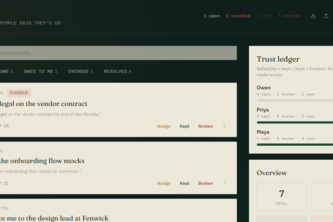
Promised is a self-reported commitment-tracking tool built as a hackathon project. The author states it extracts promises from text (e.g., emails, Slack threads) and displays them in a browser-based ledger with KEPT/BROKEN tracking and reliability scores.
What changed
The project was submitted to the OpenAI 2026 hackathon. It is described as a proof-of-concept tool built using AI assistance (Codex), React, TypeScript, and Tailwind CSS, with no backend or signup required.
Single most important open question
Is there any evidence of traction, revenue, or customer adoption beyond the self-reported project description?
What The Product Actually Is
The description states that Promised is a commitment tracker. It allows users to paste raw text (e.g., email threads, Slack exports) and extracts who promised what, to whom, and by when. Users can mark commitments as KEPT or BROKEN in a filterable ledger. A trust ledger shows reliability scores for individuals based on their track record. The tool also supports drafting follow-up messages for overdue items.
It is described as fully browser-based with no backend or signup required. It works offline using an offline regex-based parser and integrates with GPT-5.6 for natural language extraction.
Evidence
- “You paste in raw text — an email thread, a Slack export, meeting notes — and it extracts who promised what, to whom, and by when.”
- “Everything lives in your browser — no backend, no signup.”
- “I used Codex extensively throughout the build... The hardest part was the natural language extraction.”
Inference The tool is built for personal or small team use, based on its browser-only architecture and lack of cloud infrastructure.
Positioning & Claim Evolution
The author claims that Promised treats sentences like commitments — specifically, those made in meetings, emails, or Slack threads. It positions itself as a solution to the problem of untracked promises in workplace communication.
Evidence
- “We've all been in that meeting where someone says 'I'll get that to you by Friday' and everyone nods, and then Friday comes and goes and nobody remembers.”
- “Promised is a commitment tracker.”
Inference The tool does not appear to have evolved beyond a hackathon prototype. The author describes it as a “simple” CRUD app with UX depth, suggesting it’s not yet a mature product.
Target Customer & ICP
The description states that the tool is for individuals or teams who make and receive commitments in email or Slack threads. It targets users who want to track accountability and reliability in workplace communication.
Evidence
- “I wanted a tool that treats those sentences like the commitments they actually are.”
- “Everything lives in your browser — no backend, no signup.”
Inference The target is likely early-stage professionals or small teams with informal communication workflows. No specific ICP is defined beyond this general use case.
Business Model & Pricing Evidence
There is no evidence of a business model or pricing structure in the description. The tool is described as fully browser-based and offline, with no mention of monetization or paid features.
Evidence
- “Everything lives in your browser — no backend, no signup.”
- No mention of subscriptions, usage fees, or premium tiers.
Inference The project appears to be a prototype with no commercial model defined. It is not evident whether the team intends to monetize it.
Technical & Delivery Signals
Promised was built using React, TypeScript, Vite, and Tailwind CSS. The author used Codex extensively for scaffolding and prompt engineering. It includes an offline regex-based parser as a fallback, and integrates GPT-5.6 for natural language extraction. The UI uses SVG turbulence filters to simulate hand-stamped badges.
Evidence
- “Built with (author-declared): openai-gpt-5.6, react, tailwind-css, typescript, vite”
- “I used Codex extensively... The hardest part was the natural language extraction...”
- “The offline parser works surprisingly well for a regex-based approach.”
Inference The tool is built with modern frontend stack and AI-assisted development. It is not evident whether it has been scaled or optimized beyond the prototype stage.
Traction & Maturity Signals
There is no evidence of traction, revenue, customers, or adoption beyond the project description. The tool is described as a hackathon submission with no mention of user feedback, usage metrics, or product-market fit.
Evidence
- “This project was submitted to the OpenAI 2026 hackathon on Devpost.”
- “Everything lives in your browser — no backend, no signup.”
Inference The tool is at a very early stage and not yet proven in the market. No data on usage or retention exists.
Competitive Context
There is no evidence of direct competitors mentioned in the description. The author does not reference existing tools for tracking commitments or accountability in workplace communication.
Evidence
- No mention of competing products or market analysis.
Inference It is unclear whether similar tools exist, and if so, how Promised would differentiate itself.
Open Questions & Risks
- No traction or revenue: The tool is described as a hackathon project with no evidence of adoption.
- Unproven extraction accuracy: The author notes challenges in natural language extraction and date parsing.
- Limited scalability: The browser-only, offline approach may not scale for enterprise use cases.
- No monetization strategy: No indication of how the product would be monetized or whether it is intended to become a commercial offering.
Evidence
- “The biggest challenge was extraction accuracy.”
- “Everything lives in your browser — no backend, no signup.”
Questions the description leaves open
- What is the current level of promise extraction accuracy? How does it perform on real-world data?
- Are there any plans to move beyond the browser-only prototype into a scalable product?
- Has the team considered how this would work in enterprise or team settings?
- Is there any user feedback or internal testing beyond the hackathon?
- What is the long-term vision for monetization, if any?
Overall Assessment
The project is described as a hackathon submission with no evidence of traction, revenue, or commercial viability. It is not evident whether it has evolved into a product that could be monetized or scaled.
Evidence
- “This project was submitted to the OpenAI 2026 hackathon.”
- No mention of customers, revenue, or product-market fit.
Inference At this stage, there is no commercial due-diligence case for investment or partnership. The tool appears to be an early prototype with unproven utility and no clear path to monetization.
User Stories BotA demo video on every pull request
Get a demo video on every new feature
GitHub App that watches your pull requests and records a narrated, captioned demo.
Save time on demo prep and make informed decisions faster with a video walkthrough of every new feature.
Source
Submitted to the OpenAI 2026 hackathon on Devpost. Project home on Devpost. Back to the full gallery on Devpost.
This competitive analysis was produced by top-founders.com (opens in a new tab)
Generated by a language model from this project's public Devpost page — its tagline, the author's own write-up and any built-with tags listed there — as captured in August 2026. Short quotations are the author's words. It is an opinion on the idea as a business, not on the people behind it, and it reflects the description as published then. If the project has moved on, request a correction below. The analysis is not independent research and contains no verified traction, revenue or customer data.
An independent guide by KFG International LLC — not affiliated with, endorsed by, or connected to Devpost or OpenAI.