

Archive position — measured, not model output
0 likes on Devpost
2,263 of the 7,850 archived projects have more likes, and 5,587 share exactly 0 — so this project's #6,309 place in the like-ranked listing is a tie-break inside that group, not a ranking.
Projects (log scale)
Likes on Devpost. ▲ marks this project's group.
Show the figures
| Likes | Projects | Share of archive |
|---|---|---|
| 0 | 5,587 | 71.2% |
| 1 | 1,758 | 22.4% |
| 2 | 284 | 3.6% |
| 3–4 | 132 | 1.7% |
| 5–9 | 75 | 1.0% |
| 10+ | 14 | 0.2% |
 User Stories BotA demo video on every pull request
Get a demo video on every new feature
GitHub App that watches your pull requests and records a narrated, captioned demo.
Save time on demo prep and make informed decisions faster with a video walkthrough of every new feature.
Executive Summary
What the company appears to be
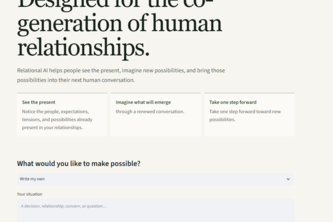
Relational AI is a self-reported project that describes itself as an experimental conversational AI system designed to help users explore relational qualities in their lives through finite, structured conversations. It is built by one person (明彦 森田) and submitted to the OpenAI 2026 hackathon.
What changed
The author states this project explores a design direction for conversational AI that intentionally ends conversations rather than maximizing engagement or retention. It introduces concepts like “Participation Maps,” “Participation Reviews,” and “Participation Cards” as tools for reflection and transition beyond the AI interaction.
Single most important open question — the commercial due-diligence read
Is there evidence of a viable business model, customer demand, or product-market fit beyond this single-person prototype? The description does not indicate any revenue, customers, or traction. It is unclear whether the idea has evolved into something scalable or if it remains an experimental concept.
What The Product Actually Is
The description states that Relational AI is a finite conversational experience designed to help users bring unresolved relational situations into structured dialogue. During the conversation:
- A Participation Map is built, highlighting people, communities, responsibilities, contexts, and next steps.
- After sufficient movement, it generates a Participation Review and an editable Participation Card, grounded in the user’s own language.
- The system intentionally ends the conversation rather than prolonging engagement.
It is described as a Streamlit-based MVP using OpenAI APIs for optional structured responses, with deterministic fallback behavior to preserve interaction flow without API access.
Inference This product appears to be an experimental prototype focused on ethical design in conversational AI, not a commercial offering. It does not appear to have any revenue-generating features or customer-facing elements beyond its MVP form.
Positioning & Claim Evolution
The author claims that Relational AI is an alternative to traditional conversational AI systems that optimize for engagement and retention. Instead, it aims to:
- Help users notice relational qualities.
- Encourage transition into life beyond AI.
- Promote agency and participation, not dependency.
It builds on the idea of relational architecture, human agency, and participation over engagement.
The project is positioned as a design experiment rather than a product or service. It is described as a “finite” conversational experience, which contrasts with typical AI systems that aim to keep users engaged for longer.
Inference This is a conceptual, ethical, and design-driven project. There is no evidence of a commercial positioning beyond its hackathon submission.
Target Customer & ICP
The description does not state who the target customer or ideal customer profile (ICP) is. It only says that users bring “one unresolved relationship or relational situation” into the conversation.
Inference It is unclear whether this system targets individuals, therapists, coaches, or a specific demographic. The project is described as an experimental tool for personal reflection, not a scalable product for a defined market segment.
Business Model & Pricing Evidence
There is no evidence of any business model, pricing strategy, monetization approach, or revenue streams in the description.
The project is presented as a single-person hackathon submission, with no indication of commercial viability or customer acquisition.
Inference No business model or pricing is evident. It is not clear whether this will ever become a paid product or service.
Technical & Delivery Signals
- Built with: Streamlit, OpenAI API, Python
- Includes: structured prompting, response validation, participation-state tracking, deterministic readiness rules, and fallback behavior
- Has: unit tests covering conversation flow, participation readiness, response structure, fallback behavior, and safeguards
- Supports: optional OpenAI-powered responses and deterministic fallback mode
Inference The technical implementation is minimal but functional for a prototype. It suggests a clear understanding of conversational AI design principles and system architecture.
Traction & Maturity Signals
There is no evidence of traction, customers, revenue, or adoption beyond the MVP submitted to a hackathon.
The project is described as an MVP, not a product in use. The author states it was built for a hackathon, and there is no indication of further development or user feedback.
Inference No traction or maturity signals are evident. This remains a prototype with no commercial deployment or usage data.
Competitive Context
The description does not mention any competitors or existing solutions in the space of conversational AI or relational design.
It is positioned as an alternative approach to traditional AI systems that optimize for engagement, but there is no evidence of how it compares to other tools or platforms in this domain.
Inference No competitive context is provided. It is unclear whether similar concepts exist or how this project would fit into the broader market.
Open Questions & Risks
- Single-person team: The entire project was built by one individual, which raises concerns about scalability and long-term maintenance.
- No commercial traction or revenue: There is no evidence of customers, adoption, or monetization.
- Unproven business model: No indication of how this would be monetized or scaled.
- Highly experimental design: The focus on “finite” conversations and ethical AI may not align with mainstream market demand.
- Limited scope: The project is described as a prototype for a hackathon, not a product.
Inference The project is experimental and lacks commercial viability. It is unclear whether it will evolve into something more substantial or remain a one-off design experiment.
Questions the description leaves open
- What is the intended path from this MVP to a scalable product or service?
- Are there any users or early adopters who have engaged with this system beyond the prototype?
- How do you plan to monetize or commercialize this concept?
- What are the key assumptions about user behavior and demand for this type of AI interaction?
- Do you see a clear pathway to building a team or product that can support long-term development?
Overall Assessment
Not evidenced.
There is no evidence of revenue, customers, traction, or commercial viability beyond the single-person hackathon submission.
This project appears to be an experimental design concept, not a product or business ready for investment or partnership.
It is unclear whether this idea will evolve into something scalable or commercially viable. The description does not indicate any intention to move beyond the prototype stage.
Confidence: Low.
The author states that the MVP is “the beginning of exploring a different future for conversational AI,” but there is no evidence of progress toward that future beyond the prototype.
User Stories BotA demo video on every pull request
Get a demo video on every new feature
GitHub App that watches your pull requests and records a narrated, captioned demo.
Save time on demo prep and make informed decisions faster with a video walkthrough of every new feature.
Source
Submitted to the OpenAI 2026 hackathon on Devpost. Project home on Devpost. Back to the full gallery on Devpost.
This competitive analysis was produced by top-founders.com (opens in a new tab)
Generated by a language model from this project's public Devpost page — its tagline, the author's own write-up and any built-with tags listed there — as captured in August 2026. Short quotations are the author's words. It is an opinion on the idea as a business, not on the people behind it, and it reflects the description as published then. If the project has moved on, request a correction below. The analysis is not independent research and contains no verified traction, revenue or customer data.
An independent guide by KFG International LLC — not affiliated with, endorsed by, or connected to Devpost or OpenAI.