

Archive position — measured, not model output
0 likes on Devpost
2,263 of the 7,850 archived projects have more likes, and 5,587 share exactly 0 — so this project's #2,381 place in the like-ranked listing is a tie-break inside that group, not a ranking.
Projects (log scale)
Likes on Devpost. ▲ marks this project's group.
Show the figures
| Likes | Projects | Share of archive |
|---|---|---|
| 0 | 5,587 | 71.2% |
| 1 | 1,758 | 22.4% |
| 2 | 284 | 3.6% |
| 3–4 | 132 | 1.7% |
| 5–9 | 75 | 1.0% |
| 10+ | 14 | 0.2% |
 User Stories BotA demo video on every pull request
Get a demo video on every new feature
GitHub App that watches your pull requests and records a narrated, captioned demo.
Save time on demo prep and make informed decisions faster with a video walkthrough of every new feature.
Executive Summary
What the company appears to be
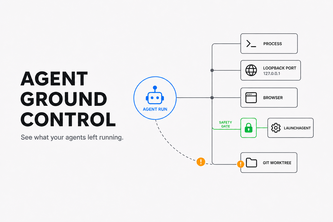
Agent Ground Control is a native macOS menu-bar app and CLI tool designed to help developers monitor and clean up processes, ports, browser helpers, services, and worktrees that are left running by coding agents. It reconstructs ownership from local evidence and provides conservative cleanup actions with previews and receipts.
What changed
The project was submitted as part of the OpenAI 2026 hackathon. It is a self-contained, deterministic tool built in Swift for macOS, using no LLM runtime dependencies or cloud services. The author describes it as an engineering solution to a personal problem—managing agent-side processes on a Mac without manual tools like Activity Monitor or ps.
Single most important open question
Is there any evidence of traction, revenue, or customer adoption beyond the author's own use case and demo lab?
What The Product Actually Is
The description states that Agent Ground Control is:
- A native macOS menu-bar app and CLI
- Built using Swift 6, SwiftUI, AppKit, and Swift Package Manager
- Uses Unix domain sockets for communication between UI and daemon
- Stores data in SQLite
- Does not use Electron, kernel extensions, system extensions, cloud backends, or analytics services
- Operates without any LLM runtime dependencies or model keys
- Includes a Demo Lab that creates local fixtures for testing detection, refusal, preview, cleanup, and receipts
It collects evidence from:
- Process ancestry
- Loopback port ownership
- LaunchAgent state
- Browser helpers
- Worktree state
- Narrowly scoped agent identity signals
The tool is conservative in its actions:
- Every eligible action starts with a preview and a 30-second single-use token
- Cleanup uses SIGTERM, never SIGKILL or file deletion
- Stores immutable receipts after cleanup
- If evidence is incomplete, it returns Unknown instead of guessing
Inference: The product is a local system-level utility for managing agent-side resources on macOS.
Positioning & Claim Evolution
The author states:
- This tool was built to solve a personal problem: “I kept hitting a gap their UIs were not designed to answer”
- It aims to provide a machine-level view that shows evidence and is conservative enough to control what it found
- The tool does not require an agent account, API key, or internet connection
- It is presented as a deterministic, inspectable, and safe way to manage local resources
Inference: The positioning is that of a developer-focused system utility for managing the side effects of coding agents on macOS. It positions itself not as an agent platform but as a cleanup companion.
Target Customer & ICP
The description states:
- The tool is built for developers using coding agents
- It targets users who run multiple agent sessions on one Mac
- It addresses the need to understand which processes, ports, or worktrees are still active after an agent task ends
Inference: The primary customer is likely MacOS developers working with AI coding agents, particularly those who use tools like Codex or GPT-based agents and want better control over their local environment.
Not evidenced:
- No explicit mention of enterprise customers
- No evidence of specific personas or buyer roles beyond "developer"
Business Model & Pricing Evidence
The description states:
- The tool is free to try via a DMG download
- It includes a Demo Lab for evaluation without needing an agent account or API key
- No pricing information, subscriptions, or monetization model is mentioned
Inference: The business model appears to be free-to-use with no direct revenue mechanism at this stage. It may evolve into a paid product or service later, but there is no evidence of that yet.
Technical & Delivery Signals
The description states:
- Built in Swift 6 for macOS 14+ on Apple Silicon
- Uses AppKit, SwiftUI, Swift Package Manager
- No Electron, web dashboard, root helper, kernel extension, system extension, cloud backend, or analytics service
- Daemon runs unprivileged per-user and collects read-only evidence
- SQLite used to store privacy-reduced summaries and receipts
- Uses Unix domain sockets for secure communication between app and daemon
- Codex and GPT-5.6 were used during development but are not runtime dependencies
Inference: The technical stack is consistent with a native macOS application, and the architecture emphasizes security, privacy, and determinism.
Traction & Maturity Signals
The description states:
- Includes a Demo Lab for testing
- Passed 397 XCTest cases and 67 Swift Testing cases
- A five-minute qualification run showed:
- Average CPU usage: 0.327%
- Peak RSS: 95,895,552 bytes
- DMG size: 3.72 MB
- The tool is presented as a submitted hackathon project, not a production release
- No mention of users, customers, or adoption beyond the author
Inference: There is no evidence of traction, revenue, or customer base. It is a proof-of-concept or early-stage prototype.
Competitive Context
The description states:
- The tool was built to address gaps in existing agent UIs
- It does not rely on LLMs or cloud services
- It focuses on local resource management, not agent orchestration or platform features
Inference: The competitive space includes:
- Other developer tools for managing local environments
- Agent UI platforms that may lack granular process control
- Tools like Activity Monitor,
ps,lsof, andlaunchctl(which the tool aims to simplify)
Not evidenced:
- No mention of competitors or market positioning against them
Open Questions & Risks
The description states:
- The tool is a hackathon submission, not a production release
- It uses ad-hoc signing and is not Developer ID-signed or Apple-notarized
- It has no runtime dependencies on LLMs or cloud services, but this may limit future expansion
- No evidence of monetization, traction, or customer feedback
Inference:
- Risk: The tool is not production-ready, lacks formal distribution, and may not scale beyond the author’s use case.
- Open question: There is no evidence of commercial viability or long-term roadmap.
Questions the description leaves open
- What is the intended path to production release?
- Are there any plans for monetization or customer acquisition beyond the demo lab?
- How does this tool integrate with existing agent platforms (e.g., Codex, GitHub Copilot)?
- Has the author considered broader platform support beyond macOS 14+ on Apple Silicon?
- What are the long-term goals for evidence collection and adapter integration?
Overall Assessment
The description states:
- This is a self-submitted hackathon project
- No revenue, customers, or traction data are available
- The tool is built with no runtime dependencies on LLMs or cloud services
- It is not yet a commercial product or platform
Inference: At this stage, there is no evidence of a viable business, and the project appears to be an early-stage prototype. It may have potential as a developer utility but lacks any commercial due-diligence signals.
Assessment Not ready for investment or partnership consideration without further development, traction, or product-market fit evidence.
User Stories BotA demo video on every pull request
Get a demo video on every new feature
GitHub App that watches your pull requests and records a narrated, captioned demo.
Save time on demo prep and make informed decisions faster with a video walkthrough of every new feature.
Source
Submitted to the OpenAI 2026 hackathon on Devpost. Project home on Devpost. Back to the full gallery on Devpost.
This competitive analysis was produced by top-founders.com (opens in a new tab)
Generated by a language model from this project's public Devpost page — its tagline, the author's own write-up and any built-with tags listed there — as captured in August 2026. Short quotations are the author's words. It is an opinion on the idea as a business, not on the people behind it, and it reflects the description as published then. If the project has moved on, request a correction below. The analysis is not independent research and contains no verified traction, revenue or customer data.
An independent guide by KFG International LLC — not affiliated with, endorsed by, or connected to Devpost or OpenAI.