

Archive position — measured, not model output
0 likes on Devpost
2,263 of the 7,850 archived projects have more likes, and 5,587 share exactly 0 — so this project's #2,382 place in the like-ranked listing is a tie-break inside that group, not a ranking.
Projects (log scale)
Likes on Devpost. ▲ marks this project's group.
Show the figures
| Likes | Projects | Share of archive |
|---|---|---|
| 0 | 5,587 | 71.2% |
| 1 | 1,758 | 22.4% |
| 2 | 284 | 3.6% |
| 3–4 | 132 | 1.7% |
| 5–9 | 75 | 1.0% |
| 10+ | 14 | 0.2% |
 User Stories BotA demo video on every pull request
Get a demo video on every new feature
GitHub App that watches your pull requests and records a narrated, captioned demo.
Save time on demo prep and make informed decisions faster with a video walkthrough of every new feature.
Executive Summary
What the company appears to be
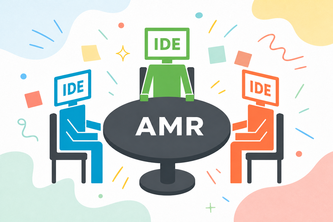
Agent IDE Meeting Room (AMR) is a self-reported system designed to enable collaboration between independently built Agent IDEs — specifically, vendor-built AI coding environments like Codex — within a shared coordination space. The author states that AMR allows these agents to work together without reducing them to interchangeable API bots.
What changed
The project was submitted as part of the OpenAI 2026 hackathon. It represents an early-stage prototype built by one individual (Nont Loxpude), using a specification-first, test-driven development approach with Python and FastAPI. The author describes AMR as a "deterministic secretary" that enforces meeting phases, roles, and state tracking while preserving each agent's native identity.
Single most important open question
Is there evidence of real-world usage or adoption of AMR by developers or teams using Codex or other Agent IDEs? The description does not indicate any such traction, nor does it describe how the system would be deployed beyond a single developer’s environment.
What The Product Actually Is
The description states that AMR is:
- A Python MCP server with a FastAPI Director dashboard
- A deterministic secretary, enforcing meeting phases, role permissions, approval gates, and anomaly detection
- A system that provides a shared protocol, memory, and coordination space between Agent IDEs
- A mailbox and delivery layer connecting the shared room to each IDE, including GUI-only agents
- Built using YAML for meeting rules, atomic JSON writes for state, and append-only JSONL logs for transcripts
It is described as not recreating or replacing agents but instead enabling them to collaborate while preserving their native identities.
Inference AMR appears to be a coordination layer for multi-agent AI environments, built around the idea that each Agent IDE has its own unique configuration and behavior — which AMR aims to preserve during collaboration.
Positioning & Claim Evolution
The author makes several claims:
- “The Agent IDE is the agent.”
- “Vendor tuning, tools, context management, permissions, memory, interface, and continuous product updates” shape an AI coding agent’s real behavior.
- “Today, using Codex together with other Agent IDEs requires a human to repeatedly switch windows, copy messages, explain context, and coordinate decisions manually.”
- AMR allows agents to collaborate without being reduced to interchangeable API bots.
These claims suggest a positioning around preserving agent identity while enabling structured collaboration, rather than building generic multi-agent orchestration tools.
Inference The positioning is not about replacing or standardizing AI agents but about enabling them to work together in a shared, accountable space — possibly with implications for enterprise use cases where vendor lock-in is a concern.
Target Customer & ICP
The description does not clearly define a target customer or ideal customer profile (ICP). It implies that AMR is intended for:
- Users who are already using or developing Agent IDEs like Codex
- Developers or teams working with multiple AI agents in coding contexts
- A "human Director" role who coordinates meetings and assigns roles
It does not state whether the system targets individual developers, enterprises, or specific industries.
Inference The likely ICP is technical users or teams building or operating AI coding agents, possibly in research or development settings. However, no evidence of actual customers or user personas exists.
Business Model & Pricing Evidence
There is no evidence in the description of a business model or pricing structure. The project is presented as a hackathon submission and does not mention monetization, licensing, or any commercial offering.
Inference No business model or pricing data is evidenced; this remains unknown.
Technical & Delivery Signals
The author states:
- AMR is built using Python, FastAPI, YAML, JSONL, Windows UI Automation, and other technologies
- It uses a deterministic secretary to enforce rules
- It supports both headless and GUI-based agents
- A mailbox and delivery layer handles communication with agents
- The system includes file locking, stale-lock recovery, and atomic JSON writes
- It was developed using TDD, specification-first development, and 260 automated tests
Inference The technical architecture is detailed, modular, and designed for safety and coordination. However, it is unclear whether this has been tested in production or scaled beyond a single developer's environment.
Traction & Maturity Signals
There is no evidence of traction or adoption. The project is described as:
- A single-developer hackathon submission
- Built by one person (Nont Loxpude)
- Not yet packaged for general use
- Not integrated with any commercial product or platform
Inference No measurable traction, revenue, or user base is evidenced. The system appears to be in an early prototype phase.
Competitive Context
The description does not mention competitors or a competitive landscape. It focuses on the concept of Agent IDEs and how AMR enables them to collaborate.
Inference There is no evidence of existing products or platforms that directly compete with AMR, nor is there any indication of market awareness or positioning relative to others in the space.
Open Questions & Risks
- No traction or adoption: The system has not been tested in real-world environments or used by teams.
- Single developer: The project was built by one person, raising questions about scalability and long-term maintenance.
- Limited deployment scope: It is unclear how AMR would be deployed beyond a single developer’s machine.
- GUI dependency: The system uses Windows UI Automation to interact with GUI-only agents — this may limit portability or reliability.
- No commercial viability: No evidence of monetization, pricing, or business model.
Inference The project is experimental and lacks any demonstration of real-world utility or scalability. It may not yet be ready for enterprise or commercial use.
Questions the description leaves open
- Has AMR been tested with more than one developer or team?
- What are the limitations of the current GUI-based delivery layer, and how might they affect broader adoption?
- How does AMR handle failures in agent communication or activation?
- Are there plans to support other operating systems beyond Windows?
- What is the intended path from prototype to a commercial product or platform?
- Have you considered integrating with existing AI agent platforms or frameworks?
- What are the key assumptions about how Agent IDEs will evolve, and how does AMR adapt to that?
Overall Assessment
The description indicates that this is an early-stage prototype built by a single developer as part of a hackathon. There is no evidence of traction, revenue, or commercial viability.
Assessment Not evidenced as a viable investment or partnership opportunity at this time. The project shows technical sophistication and a clear conceptual framework but lacks real-world usage, scalability, or business model evidence.
User Stories BotA demo video on every pull request
Get a demo video on every new feature
GitHub App that watches your pull requests and records a narrated, captioned demo.
Save time on demo prep and make informed decisions faster with a video walkthrough of every new feature.
Source
Submitted to the OpenAI 2026 hackathon on Devpost. Project home on Devpost. Back to the full gallery on Devpost.
This competitive analysis was produced by top-founders.com (opens in a new tab)
Generated by a language model from this project's public Devpost page — its tagline, the author's own write-up and any built-with tags listed there — as captured in August 2026. Short quotations are the author's words. It is an opinion on the idea as a business, not on the people behind it, and it reflects the description as published then. If the project has moved on, request a correction below. The analysis is not independent research and contains no verified traction, revenue or customer data.
An independent guide by KFG International LLC — not affiliated with, endorsed by, or connected to Devpost or OpenAI.