

Archive position — measured, not model output
0 likes on Devpost
2,263 of the 7,850 archived projects have more likes, and 5,587 share exactly 0 — so this project's #6,307 place in the like-ranked listing is a tie-break inside that group, not a ranking.
Projects (log scale)
Likes on Devpost. ▲ marks this project's group.
Show the figures
| Likes | Projects | Share of archive |
|---|---|---|
| 0 | 5,587 | 71.2% |
| 1 | 1,758 | 22.4% |
| 2 | 284 | 3.6% |
| 3–4 | 132 | 1.7% |
| 5–9 | 75 | 1.0% |
| 10+ | 14 | 0.2% |
 User Stories BotA demo video on every pull request
Get a demo video on every new feature
GitHub App that watches your pull requests and records a narrated, captioned demo.
Save time on demo prep and make informed decisions faster with a video walkthrough of every new feature.
Executive Summary
What the company appears to be
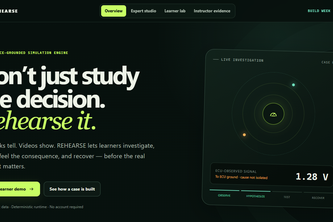
REHEARSE is an educational simulation engine that transforms expert source material into interactive, evidence-grounded learning scenarios. The author states it is built for vocational training, particularly in automotive diagnostics, where learners must make consequential decisions based on incomplete evidence.
What changed
The project description indicates a shift from general AI tooling toward a focused, deterministic simulation product with structured outputs and validation layers. It uses GPT-5.6 as a compiler for scenario candidates but not for decision-making or authorization.
Single most important open question
Is there sufficient evidence of traction, customer feedback or adoption to suggest the product has moved beyond concept-stage into real-world use?
What The Product Actually Is
The description states that REHEARSE is an interactive, evidence-grounded simulation engine, not a quiz generator or generic chatbot. It compiles knowledge into a causal scenario graph and allows learners to make decisions with consequences.
It includes:
- A learner workflow: work order, symptom confirmation, inspection, hypothesis formation, verification.
- An instructor analytics layer: decision path, observations, evidence used, diagnosed misconception, confidence levels.
- A deterministic engine: no AI controls scenario state or scoring; model output is a candidate only.
The author describes one deep automotive case as the initial demonstration. The system uses synthetic data (vehicle specs, prices, times) to simulate real-world diagnostic scenarios without using proprietary manufacturer data.
It is built with:
- Next.js, React, TypeScript, Zod
- OpenAI Responses API with Structured Outputs
- Playwright for browser checks
- Cloudflare Workers
Not evidenced: No mention of revenue, customers, pricing, or actual deployment beyond the author’s own testing and demo video pipeline.
Positioning & Claim Evolution
The author states:
"Textbooks tell. Videos show. REHEARSE lets you practice."
This positions REHEARSE as a practice-based learning tool, distinct from traditional instructional formats. It emphasizes evidence-grounded reasoning and diagnostic decision-making in vocational contexts.
Claims include:
- The system diagnoses misconceptions behind reasoning
- Learners can recover from wrong decisions with consequences
- Instructors get visibility into how learners thought
The author also states that the product is a reusable education engine, not limited to automotive diagnostics, although the first case is automotive.
Inference: The positioning suggests REHEARSE targets vocational instructors and onboarding teams looking for safe, repeatable practice environments. However, no evidence of market traction or adoption exists.
Target Customer & ICP
The author identifies:
- Primary audience: Vocational instructors and workshop onboarding teams
- Use case: Practicing rare, costly, or unsafe-to-recreate decisions before real-world application
They also state:
"A pilot should measure whether learners choose more discriminating tests, reduce unnecessary simulated cost and time, recover from misconceptions, and need less instructor intervention on repeated cases."
This implies a target customer persona focused on training outcomes and efficiency gains.
Not evidenced: No mention of actual customers, partnerships, or feedback loops. The description does not name specific institutions or users.
Business Model & Pricing Evidence
The author states:
"The public judge experience is intentionally keyless and deterministic so it remains fast and reliable."
This suggests a free-to-use public demo with no explicit pricing model described.
There is no mention of:
- Subscription tiers
- Licensing models
- Enterprise or institutional use cases
- Revenue streams
Not evidenced: No business model, pricing structure, or monetization strategy is provided.
Technical & Delivery Signals
The system is built using:
- Next.js, React, TypeScript, Zod
- OpenAI Responses API with Structured Outputs
- Playwright for browser checks
- Cloudflare Workers
Key technical features include:
- 45 deterministic unit and integration tests
- 12 desktop/mobile development browser checks
- 6 optimized-production browser checks
- Input/output validation, origin protection, rate limits, kill switch
- Prompt-injection defenses
- Dependency, license, accessibility, secret-leak audits
The author notes that:
"Codex accelerated the build" and helped move from concept to working vertical slice.
They also state:
"Approved scenarios are cached, and model calls are reserved for generation and adaptive wording rather than ordinary learner transitions."
Inference: The system is built with a strong emphasis on determinism, security, and validation, suggesting an engineering approach that prioritizes reliability over generative AI control.
Traction & Maturity Signals
The author describes:
- A single, deep automotive case
- A demo video pipeline
- A private repository with immutable submission tag and integrity manifest
They also note:
"I ran a sanitized owner proof against the exact gpt-5.6-sol model."
However, there is no mention of:
- Customer adoption
- User feedback or usage metrics
- Product iteration history
- Real-world deployment
Not evidenced: No evidence of traction, user base, or product maturity beyond the author’s own development and testing.
Competitive Context
The description does not reference:
- Direct competitors
- Similar tools in the education or simulation space
- Market positioning relative to other vocational training platforms
Not evidenced: No competitive analysis or market context provided.
Open Questions & Risks
- No revenue, customer or adoption data: The product is described as a prototype or demo with no evidence of real-world use.
- Unproven learning outcomes: While the author describes intended pilot metrics, no actual results are shared.
- Single-person team: The project is built by one individual, raising questions about scalability and long-term maintenance.
- Limited scope: The system is demonstrated only in automotive diagnostics; its broader applicability is untested.
- AI dependency with strict boundaries: While the author says AI is used only for compilation and adaptive wording, this may limit innovation or adaptability.
Inference: Without evidence of traction or feedback, REHEARSE remains a concept-stage product. The lack of external validation raises risk that it may not meet real-world needs.
Questions the description leaves open
- What is the current status of the pilot testing? Are there any early results?
- How do you plan to scale beyond one domain (automotive)?
- What are your plans for monetization or commercialization?
- Have you received feedback from vocational instructors or training teams?
- How do you intend to validate that learners actually improve their decision-making through use?
- What is the long-term vision for the product beyond this hackathon submission?
Overall Assessment
Not evidenced: No data on valuation, funding rounds, or investment interest.
The author states:
"Everything above is the authors' own account. It is not independently verified, and no revenue, customer or traction data is available beyond what they state."
This project appears to be a concept-stage prototype, built by one individual for a hackathon submission. There is no evidence of commercial traction, user adoption, or product-market fit.
Confidence level: Low. The description is self-reported and unverified. It lacks any signals of real-world use or impact.
User Stories BotA demo video on every pull request
Get a demo video on every new feature
GitHub App that watches your pull requests and records a narrated, captioned demo.
Save time on demo prep and make informed decisions faster with a video walkthrough of every new feature.
Source
Submitted to the OpenAI 2026 hackathon on Devpost. Project home on Devpost. Back to the full gallery on Devpost.
This competitive analysis was produced by top-founders.com (opens in a new tab)
Generated by a language model from this project's public Devpost page — its tagline, the author's own write-up and any built-with tags listed there — as captured in August 2026. Short quotations are the author's words. It is an opinion on the idea as a business, not on the people behind it, and it reflects the description as published then. If the project has moved on, request a correction below. The analysis is not independent research and contains no verified traction, revenue or customer data.
An independent guide by KFG International LLC — not affiliated with, endorsed by, or connected to Devpost or OpenAI.