

Archive position — measured, not model output
0 likes on Devpost
2,263 of the 7,850 archived projects have more likes, and 5,587 share exactly 0 — so this project's #6,306 place in the like-ranked listing is a tie-break inside that group, not a ranking.
Projects (log scale)
Likes on Devpost. ▲ marks this project's group.
Show the figures
| Likes | Projects | Share of archive |
|---|---|---|
| 0 | 5,587 | 71.2% |
| 1 | 1,758 | 22.4% |
| 2 | 284 | 3.6% |
| 3–4 | 132 | 1.7% |
| 5–9 | 75 | 1.0% |
| 10+ | 14 | 0.2% |
 User Stories BotA demo video on every pull request
Get a demo video on every new feature
GitHub App that watches your pull requests and records a narrated, captioned demo.
Save time on demo prep and make informed decisions faster with a video walkthrough of every new feature.
Executive Summary
What the company appears to be: Rehearsal is a self-reported proof-of-concept tool for AI agent interaction, built as a single-user demonstration for one trusted Git repository scenario. It allows users to simulate an AI agent's actions in an isolated environment and correct unwanted outcomes using natural language before approving changes.
What changed: The project was submitted as part of the OpenAI 2026 hackathon. It represents an experimental approach to AI agent safety and interaction design, focusing on simulated futures and outcome contracts.
The single most important open question: Is there any evidence that Rehearsal has moved beyond a one-person hackathon prototype into a product with traction or commercial viability?
What The Product Actually Is
- The description states that Rehearsal runs AI agent tasks in an isolated Git worktree.
- It shows deleted and changed files, disk delta, broken references, test results, and Outcome Contract violations.
- Users can correct unwanted futures in plain English.
- GPT-5.6 compiles corrections into a bounded, monotonic Outcome Contract.
- Rehearsal simulates again and allows approval only for the exact preview ID and patch digest.
- It applies the exact binary patch, re-measures hashes, tests, and contract proof.
- A downloadable execution receipt with offline SHA-256 integrity verification is emitted.
- The UI is built with HTML/CSS/JavaScript and runs locally.
Evidence strength: Self-reported. No independent verification or demonstration of actual use beyond the author's own account.
Positioning & Claim Evolution
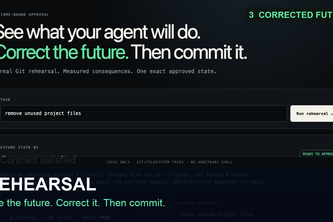
- The tagline states: “See what your AI agent will do. Correct the future. Then commit it.”
- The description claims Rehearsal explores a new interaction primitive: approving the simulated future, not opaque action sequences.
- It positions itself as a tool for AI agent safety and correctness by allowing users to preview consequences before committing changes.
- The authors state that this is a single-user loopback demonstration for one trusted seeded Git/filesystem scenario.
- There is no evidence of prior positioning or evolution in the description — it appears to be a one-time submission.
Evidence strength: Self-reported. No external validation or historical context provided.
Target Customer & ICP
- The description does not name specific customers or personas.
- It implies a user who interacts with AI agents and needs to understand consequences before approving actions.
- The project is described as a single-user demonstration, not intended for broader adoption.
- There is no evidence of target customer segmentation or ideal customer profile (ICP).
Evidence strength: Not evidenced.
Business Model & Pricing Evidence
- No business model or pricing information is provided in the description.
- The project is presented as a hackathon submission with no indication of monetization strategy.
- There is no mention of revenue, customers, or commercial use cases.
Evidence strength: Not evidenced.
Technical & Delivery Signals
- Built using Python standard library only.
- Uses native Git detached worktrees and binary patches.
- Employs SHA-256 state snapshots.
- GPT-5.6 API for semantic contract compilation and consequence explanation.
- Deterministic mechanics for diff, tests, hashes, approval, and rollback.
- Local responsive HTML/CSS/JavaScript UI.
- 60 automated behavior, security, recovery, receipt-integrity, and HTTP/UI tests.
- No third-party dependencies.
- The project is described as a single-user demonstration with no production sandboxing.
Evidence strength: Self-reported. Technical details are provided but not independently verified.
Traction & Maturity Signals
- The project is described as a hackathon submission (OpenAI 2026).
- It includes 60 passing tests and a verification script.
- No evidence of revenue, customers, or adoption beyond the authors' own account.
- The authors explicitly state that Rehearsal is not a production sandbox for arbitrary repositories.
- There is no evidence of product-market fit, user feedback, or growth metrics.
Evidence strength: Not evidenced.
Competitive Context
- No competitive landscape or market analysis is provided in the description.
- The project does not reference existing tools or platforms addressing similar AI agent safety or interaction issues.
- No mention of competitors or substitutes.
Evidence strength: Not evidenced.
Open Questions & Risks
- The project is a single-user demonstration with no evidence of scalability or production readiness.
- It is explicitly stated to be a hackathon submission, not a commercial product.
- The authors acknowledge that it does not support arbitrary repositories and lacks sandboxing for untrusted code.
- No revenue, customers, or traction data exists beyond the self-reported description.
- The tool is described as a proof-of-concept with no indication of further development or commercialization.
Evidence strength: Inferred from self-reporting. Not independently verified.
Questions the description leaves open
- What are the actual use cases for Rehearsal beyond this hackathon prototype?
- Has there been any user feedback or testing outside of the authors' own environment?
- Is there a plan to move beyond the single-user, trusted repository scenario?
- How does Rehearsal intend to scale beyond its current technical limitations (e.g., sandboxing, containerization)?
- Are there any plans for monetization or commercial deployment?
Evidence strength: Inferences based on self-reported description.
Overall Assessment
- The project is described as a single-user hackathon submission with no evidence of traction, revenue, or customer adoption.
- It is not positioned as a product but as an experimental interaction primitive.
- There is no indication of commercial viability or scalability beyond the authors' own use case.
- No funding, headcount, or business model information is provided.
Assessment: Not evidenced. The project appears to be a proof-of-concept with no demonstrated path to commercialization or product-market fit. It does not meet minimum criteria for due-diligence consideration as a potential investment or partnership target.
Confidence level: Low — based entirely on self-reported, unverified information.
User Stories BotA demo video on every pull request
Get a demo video on every new feature
GitHub App that watches your pull requests and records a narrated, captioned demo.
Save time on demo prep and make informed decisions faster with a video walkthrough of every new feature.
Source
Submitted to the OpenAI 2026 hackathon on Devpost. Project home on Devpost. Back to the full gallery on Devpost.
This competitive analysis was produced by top-founders.com (opens in a new tab)
Generated by a language model from this project's public Devpost page — its tagline, the author's own write-up and any built-with tags listed there — as captured in August 2026. Short quotations are the author's words. It is an opinion on the idea as a business, not on the people behind it, and it reflects the description as published then. If the project has moved on, request a correction below. The analysis is not independent research and contains no verified traction, revenue or customer data.
An independent guide by KFG International LLC — not affiliated with, endorsed by, or connected to Devpost or OpenAI.