

Archive position — measured, not model output
0 likes on Devpost
2,263 of the 7,850 archived projects have more likes, and 5,587 share exactly 0 — so this project's #6,277 place in the like-ranked listing is a tie-break inside that group, not a ranking.
Projects (log scale)
Likes on Devpost. ▲ marks this project's group.
Show the figures
| Likes | Projects | Share of archive |
|---|---|---|
| 0 | 5,587 | 71.2% |
| 1 | 1,758 | 22.4% |
| 2 | 284 | 3.6% |
| 3–4 | 132 | 1.7% |
| 5–9 | 75 | 1.0% |
| 10+ | 14 | 0.2% |
 User Stories BotA demo video on every pull request
Get a demo video on every new feature
GitHub App that watches your pull requests and records a narrated, captioned demo.
Save time on demo prep and make informed decisions faster with a video walkthrough of every new feature.
Executive Summary
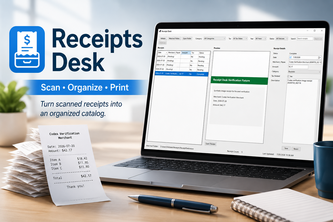
The company appears to be a solo project (1 person) named ReceiptDesk, submitted as part of an OpenAI hackathon. The author states it is a Windows desktop application built using GPT-5.6 and Codex AI systems, designed to automate receipt cataloging for tax season.
What changed: The description indicates the author used AI tools to build a functional standalone application in a short timeframe (a few days), with human oversight. It represents an experiment in AI-assisted development rather than a commercial product.
The single most important open question: Is there any evidence of traction, revenue, or customer adoption beyond the author's own use case? The description is entirely self-reported and unverified — no data on users, sales, or market demand exists.
What The Product Actually Is
- The description states ReceiptDesk is a standalone Windows desktop application.
- It watches a folder for new receipt images or PDFs.
- It imports, hashes, stores, and displays receipts locally using SQLite.
- Users can edit metadata (date, merchant, amount, category, tax status, description).
- It supports filtering, sorting, searching, CSV export, and print preview.
- There is no cloud dependency, OCR service, web server, or external API required.
Inference: The product is a desktop tool for personal use, not a SaaS or enterprise offering.
Evidence: From the author’s own write-up.
Positioning & Claim Evolution
- The author claims ReceiptDesk was built to solve a real household problem — automating receipt cataloging for tax season.
- It is positioned as a human-led AI collaboration tool, where GPT-5.6 and Codex work together under human direction.
- The project is framed as both a solution to a real-world need and a demonstration of AI-assisted engineering.
- The author emphasizes that the result is not a mock-up but a functional, tested application usable by their wife.
Inference: This is an experimental product with a focus on AI-human collaboration, not a commercial offering.
Evidence: From the author’s own write-up.
Target Customer & ICP
- The description states the primary user is the author's wife, Michele.
- The problem described is specific to tax season receipt management for individuals or households.
- There is no indication of a broader target market beyond personal use or small-scale household workflows.
Inference: The target customer is likely a single individual or small household managing their own receipts.
Evidence: From the author’s own write-up.
Business Model & Pricing Evidence
- No pricing, subscription model, or monetization strategy is mentioned.
- The application is described as standalone and local, with no cloud services or external dependencies.
- There is no evidence of any revenue streams, licensing, or commercial use cases beyond personal utility.
Inference: No business model or pricing structure is evident.
Evidence: Not evidenced.
Technical & Delivery Signals
- Built using .NET 8, C#, Windows Forms, SQLite, PowerShell, and AI tools (ChatGPT-5.6, Codex).
- Uses a custom relay system called Spider + Fly to coordinate AI agents.
- The application supports local file watching, duplicate detection via SHA-256, and embedded previews.
- Includes automated tests and Git-based version control.
- No external APIs or cloud services are used.
Inference: The technical stack is standard for Windows desktop development with AI integration.
Evidence: From the author’s own write-up.
Traction & Maturity Signals
- The project was submitted to a hackathon (OpenAI 2026).
- It is described as a working prototype, not a commercial product.
- There is no evidence of user adoption, customer base, or revenue.
- No mention of product releases, updates, or growth metrics.
Inference: The project is in early development and lacks traction.
Evidence: Not evidenced.
Competitive Context
- No competitors are named or described.
- The problem addressed (receipt management for tax season) is not unique to this solution.
- There are existing tools for receipt scanning, categorization, and tax preparation, but none are mentioned in the description.
Inference: The competitive landscape is unknown; no direct comparison is made.
Evidence: Not evidenced.
Open Questions & Risks
- The project is self-reported and unverified — no third-party validation or data.
- It is a single-person effort, which raises questions about scalability, support, and long-term maintenance.
- The use of AI tools (GPT-5.6, Codex) in development introduces uncertainty around reproducibility and reliability.
- There is no evidence of product-market fit or customer demand beyond the author’s personal use case.
Inference: Risk of limited commercial viability due to lack of traction and unproven market need.
Evidence: Not evidenced.
Questions the description leaves open
- What is the actual user base for ReceiptDesk beyond the author?
- Has the application been tested in real-world conditions outside of the author’s household?
- Are there plans to expand beyond personal use or add features like OCR, cloud sync, or integrations?
- How does the author plan to monetize or scale this product if at all?
- What are the limitations of the current AI-assisted development approach in terms of reproducibility and maintainability?
Overall Assessment
- The project is a personal experiment with AI-assisted software development, not a commercial venture.
- There is no evidence of revenue, customers, or traction.
- It is unclear whether the author intends to pursue this as a business or product.
- The project does not demonstrate a scalable or market-ready offering.
Inference: Not suitable for investment or partnership at this stage.
Evidence: Not evidenced.
User Stories BotA demo video on every pull request
Get a demo video on every new feature
GitHub App that watches your pull requests and records a narrated, captioned demo.
Save time on demo prep and make informed decisions faster with a video walkthrough of every new feature.
Source
Submitted to the OpenAI 2026 hackathon on Devpost. Project home on Devpost. Back to the full gallery on Devpost.
This competitive analysis was produced by top-founders.com (opens in a new tab)
Generated by a language model from this project's public Devpost page — its tagline, the author's own write-up and any built-with tags listed there — as captured in August 2026. Short quotations are the author's words. It is an opinion on the idea as a business, not on the people behind it, and it reflects the description as published then. If the project has moved on, request a correction below. The analysis is not independent research and contains no verified traction, revenue or customer data.
An independent guide by KFG International LLC — not affiliated with, endorsed by, or connected to Devpost or OpenAI.