

Archive position — measured, not model output
0 likes on Devpost
2,263 of the 7,850 archived projects have more likes, and 5,587 share exactly 0 — so this project's #2,353 place in the like-ranked listing is a tie-break inside that group, not a ranking.
Projects (log scale)
Likes on Devpost. ▲ marks this project's group.
Show the figures
| Likes | Projects | Share of archive |
|---|---|---|
| 0 | 5,587 | 71.2% |
| 1 | 1,758 | 22.4% |
| 2 | 284 | 3.6% |
| 3–4 | 132 | 1.7% |
| 5–9 | 75 | 1.0% |
| 10+ | 14 | 0.2% |
 User Stories BotA demo video on every pull request
Get a demo video on every new feature
GitHub App that watches your pull requests and records a narrated, captioned demo.
Save time on demo prep and make informed decisions faster with a video walkthrough of every new feature.
Executive Summary
Project: AeroSentinel
Self-reported basis: The entire analysis is based on the author’s own description of the project as submitted to the OpenAI 2026 hackathon on Devpost. No independent verification or external data is available.
Commercial due-diligence read: The project appears to be a prototype for a ground control decision support system that monitors flight telemetry and detects faults using simulation-based tools. It has no demonstrated traction, revenue, or customer base. The single most important open question is whether the author can demonstrate a viable path from prototype to product in a real-world aviation environment.
What The Product Actually Is
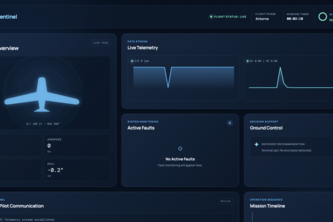
The description states that AeroSentinel is a Ground Control Decision Support System that monitors live flight telemetry and detects faults (Side Stick, Throttle, Engine). It integrates with the FlightGear flight simulator and uses Kalman Filtering and CUSUM-based analysis to process telemetry data. When a fault is detected, it provides recovery guidance and visualizes the system’s status through a real-time dashboard.
- Evidenced: The system monitors live telemetry from FlightGear.
- Inferred: It may be used in simulation environments for training or safety monitoring.
- Not evidenced: Whether it has been deployed in real-world aviation, or whether it supports actual aircraft operations.
Positioning & Claim Evolution
The author positions AeroSentinel as a system that improves operational safety by transforming raw telemetry into actionable insights. It is described as a decision support tool for ground control teams during flight simulations.
- Evidenced: The system aims to improve situational awareness and fault detection.
- Inferred: It may be positioned as a training or simulation aid, not a production-grade safety system.
- Not evidenced: No claims about market fit, scalability, or real-world deployment in aviation.
Target Customer & ICP
The description does not name specific customers or target segments. However, it implies the system is intended for ground control teams and flight simulation environments, particularly those using FlightGear.
- Evidenced: The system targets ground control operators in simulated flight environments.
- Inferred: It may be aimed at training institutions, simulation labs, or aviation safety researchers.
- Not evidenced: No evidence of specific customer personas, use cases, or market segmentation.
Business Model & Pricing Evidence
There is no evidence of a business model or pricing structure in the description. The project is presented as a prototype for a hackathon.
- Evidenced: No pricing, monetization, or business model details.
- Inferred: If commercialized, it may be sold to simulation labs or training institutions.
- Not evidenced: No indication of revenue streams, licensing, or customer acquisition plans.
Technical & Delivery Signals
The system is built using Python, Flask, HTML/CSS/JS, and integrates with FlightGear. It uses Kalman Filtering and CUSUM for fault detection and OpenAI Codex for development assistance. The frontend is a real-time dashboard powered by WebSockets.
- Evidenced: Use of Python, Flask, telemetry collection, filtering, and visualization.
- Inferred: Modular architecture and real-time processing capabilities.
- Not evidenced: No evidence of scalability, production-grade infrastructure, or deployment in live environments.
Traction & Maturity Signals
The project is described as a hackathon prototype. There is no evidence of traction, customers, revenue, or adoption beyond the author’s own development efforts.
- Evidenced: It was built for a hackathon and is a proof-of-concept.
- Inferred: It may have limited real-world application or scalability.
- Not evidenced: No data on usage, performance, or user feedback.
Competitive Context
The description does not mention any competitors. However, the concept of flight telemetry monitoring and fault detection in aviation environments is a known domain with existing solutions in military and commercial aviation.
- Evidenced: No competitive analysis provided.
- Inferred: The system may compete with or complement existing flight safety systems.
- Not evidenced: No evidence of market presence, competitor products, or differentiation.
Open Questions & Risks
- Prototype only: The project is a hackathon prototype with no demonstrated real-world use.
- Simulation-only focus: It is built for FlightGear and not yet proven in actual aviation environments.
- No commercialization path: No evidence of a business model, customer base, or monetization strategy.
- Unverified claims: All features are self-reported without independent validation.
Questions the description leaves open
- What is the intended real-world application of this system beyond simulation?
- Has the system been tested in any actual flight environments or with real operators?
- How does it plan to scale from a single simulator to multiple aircraft or live operations?
- Are there any partnerships or pilot programs with aviation organizations?
- What are the key assumptions about fault detection and recovery guidance that have not yet been validated?
Overall Assessment
Not evidenced: No evidence of traction, revenue, or customer adoption. The system is a prototype built for a hackathon.
- Confidence level: Low.
- Assessment: Not ready for investment or partnership at this stage. It may be a promising idea with significant potential if it can demonstrate real-world applicability and scalability, but no evidence of that exists in the description.
User Stories BotA demo video on every pull request
Get a demo video on every new feature
GitHub App that watches your pull requests and records a narrated, captioned demo.
Save time on demo prep and make informed decisions faster with a video walkthrough of every new feature.
Source
Submitted to the OpenAI 2026 hackathon on Devpost. Project home on Devpost. Back to the full gallery on Devpost.
This competitive analysis was produced by top-founders.com (opens in a new tab)
Generated by a language model from this project's public Devpost page — its tagline, the author's own write-up and any built-with tags listed there — as captured in August 2026. Short quotations are the author's words. It is an opinion on the idea as a business, not on the people behind it, and it reflects the description as published then. If the project has moved on, request a correction below. The analysis is not independent research and contains no verified traction, revenue or customer data.
An independent guide by KFG International LLC — not affiliated with, endorsed by, or connected to Devpost or OpenAI.