

Archive position — measured, not model output
0 likes on Devpost
2,263 of the 7,850 archived projects have more likes, and 5,587 share exactly 0 — so this project's #4,316 place in the like-ranked listing is a tie-break inside that group, not a ranking.
Projects (log scale)
Likes on Devpost. ▲ marks this project's group.
Show the figures
| Likes | Projects | Share of archive |
|---|---|---|
| 0 | 5,587 | 71.2% |
| 1 | 1,758 | 22.4% |
| 2 | 284 | 3.6% |
| 3–4 | 132 | 1.7% |
| 5–9 | 75 | 1.0% |
| 10+ | 14 | 0.2% |
 User Stories BotA demo video on every pull request
Get a demo video on every new feature
GitHub App that watches your pull requests and records a narrated, captioned demo.
Save time on demo prep and make informed decisions faster with a video walkthrough of every new feature.
Executive Summary
What the company appears to be
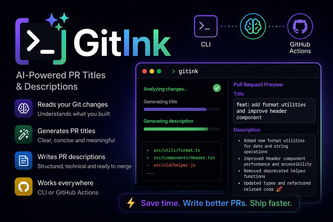
GitInk is a self-reported open-source CLI tool built by one developer (Talha Shiekh) that reads local Git changes and generates PR titles and descriptions using AI, with offline support and custom project instruction capabilities.
What changed
The project was submitted as part of an OpenAI 2026 hackathon on Devpost. It represents a developer tool built in a short timeframe, likely for personal use or hackathon experimentation.
The single most important open question
Is there evidence of actual usage beyond the author's own development and testing? The description states no revenue, customers, or adoption data are available.
Analysis basis
This report is based entirely on the self-reported project description provided by the author. It contains no independent verification, archived history, or third-party corroboration. All claims are treated as stated by the author and not proven facts.
What The Product Actually Is
- The description states GitInk is a CLI tool built with Node.js and TypeScript.
- It reads local Git changes (Git diff).
- It generates PR titles and descriptions using AI.
- It works offline.
- It supports custom project instructions via configuration.
- It is published as an npm package.
- It uses GitHub Actions for automation and YAML workflows for PR automation.
- It was built as an open-source tool.
Inference The tool appears to be a developer utility, not a commercial product or SaaS offering. It is self-reported as a CLI that integrates with Git and GitHub workflows.
Positioning & Claim Evolution
- The description states the author's inspiration was to reduce time spent writing PR titles and descriptions.
- The positioning is that it automates this repetitive task for developers.
- The claim evolution shows a progression from personal problem-solving to building an open-source tool that others can use.
- It claims to help teams keep pull requests consistent.
- It supports custom project instructions, suggesting flexibility in usage.
Inference The positioning is that of a developer productivity tool, not a commercial product. The evolution shows intent to solve a common workflow issue, but no evidence of market traction or adoption.
Target Customer & ICP
- The description states GitInk is for developers.
- It supports custom project instructions, implying it targets teams with specific workflows.
- It works with Git and GitHub, suggesting use in software development environments.
- No explicit customer segments beyond "developers" are mentioned.
Not evidenced No specific ICP, target personas, or customer types are defined. The tool is described as a CLI for developers but no market segmentation or targeting data is provided.
Business Model & Pricing Evidence
- The description states GitInk is an open-source tool.
- It was published as an npm package.
- No pricing information, licensing model, or monetization strategy is mentioned.
- No evidence of revenue streams or business model is provided.
Not evidenced There is no indication of a commercial business model. The tool appears to be open-source and free to use.
Technical & Delivery Signals
- Built as an open-source CLI tool using Node.js, TypeScript.
- Uses AI (specifically mentioned as Google Gemini) for PR generation.
- Works offline.
- Supports custom project instructions via configuration.
- Uses GitHub Actions and YAML workflows for automation.
- Published on npm.
- The author mentions building a CLI tool, working with Git internals, and setting up CI/CD pipelines.
Inference Technical delivery is self-reported as functional, but no evidence of production use or scalability is provided. It’s a developer-built tool with limited public-facing signals.
Traction & Maturity Signals
- The project was submitted to the OpenAI 2026 hackathon, indicating early-stage development.
- The author states they built their first open-source package.
- It was built in a short timeframe (hackathon context).
- No evidence of user adoption, downloads, or usage metrics is provided.
- No mention of community engagement, stars, forks, or other maturity indicators.
Not evidenced There are no signs of traction, adoption, or market validation. The tool appears to be an experimental or personal project with no public usage data.
Competitive Context
- The description does not mention any competitors.
- It is a developer productivity tool that automates PR generation.
- Tools in this space may include GitHub Copilot, GitLab’s AI features, or other Git-based automation tools.
- No competitive analysis or differentiation strategy is provided.
Not evidenced No information on existing tools or competitive positioning is available. The author does not reference similar products or market dynamics.
Open Questions & Risks
- The tool is self-reported as a hackathon project, suggesting it may be experimental.
- It’s built by a single developer, which raises concerns about long-term maintenance and scalability.
- No evidence of community adoption or usage beyond the author.
- No commercial viability or monetization strategy is evident.
- The tool is open-source, which may limit revenue potential.
- The AI integration is mentioned but not detailed, raising questions about quality or consistency.
Inference Risks include lack of traction, limited support, and no clear path to commercialization. It’s a personal or experimental tool with no evidence of market demand.
Questions the description leaves open
- What is the actual usage of GitInk beyond your own development?
- How does it handle different types of code changes (bug fixes, feature additions, refactors)?
- Are there any plans to monetize or commercialize this tool?
- How do you plan to maintain and evolve the tool over time?
- What are the limitations of the AI-generated PR content?
- Have you received feedback from other developers using it?
- Is there a roadmap for expanding beyond CLI or GitHub?
Overall Assessment
- The project is self-reported as an open-source CLI tool built by one developer.
- It has no evidence of traction, revenue, or adoption.
- It was submitted to a hackathon and appears to be experimental.
- No commercial model or business strategy is evident.
- It is not demonstrated to have any market demand or scalability.
Assessment Not suitable for investment or partnership at this stage. The tool is an early-stage developer utility with no evidence of product-market fit or commercial viability.
User Stories BotA demo video on every pull request
Get a demo video on every new feature
GitHub App that watches your pull requests and records a narrated, captioned demo.
Save time on demo prep and make informed decisions faster with a video walkthrough of every new feature.
Source
Submitted to the OpenAI 2026 hackathon on Devpost. Project home on Devpost. Back to the full gallery on Devpost.
This competitive analysis was produced by top-founders.com (opens in a new tab)
Generated by a language model from this project's public Devpost page — its tagline, the author's own write-up and any built-with tags listed there — as captured in August 2026. Short quotations are the author's words. It is an opinion on the idea as a business, not on the people behind it, and it reflects the description as published then. If the project has moved on, request a correction below. The analysis is not independent research and contains no verified traction, revenue or customer data.
An independent guide by KFG International LLC — not affiliated with, endorsed by, or connected to Devpost or OpenAI.