

Archive position — measured, not model output
0 likes on Devpost
2,263 of the 7,850 archived projects have more likes, and 5,587 share exactly 0 — so this project's #6,279 place in the like-ranked listing is a tie-break inside that group, not a ranking.
Projects (log scale)
Likes on Devpost. ▲ marks this project's group.
Show the figures
| Likes | Projects | Share of archive |
|---|---|---|
| 0 | 5,587 | 71.2% |
| 1 | 1,758 | 22.4% |
| 2 | 284 | 3.6% |
| 3–4 | 132 | 1.7% |
| 5–9 | 75 | 1.0% |
| 10+ | 14 | 0.2% |
 User Stories BotA demo video on every pull request
Get a demo video on every new feature
GitHub App that watches your pull requests and records a narrated, captioned demo.
Save time on demo prep and make informed decisions faster with a video walkthrough of every new feature.
Executive Summary
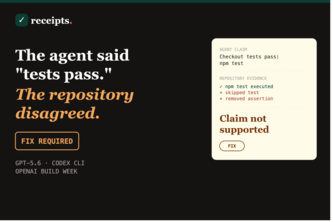
What the company appears to be: Receipts is a developer tool that checks whether AI agents’ claims about code changes are accurate by verifying them against the actual repository state — not just CI results. It is built as a local verification layer for pull requests, using GPT-5.6 and OpenAI Codex to interpret agent-generated claims and validate them via deterministic checks on Git repositories.
What changed: The project evolved from initial ideas involving trust scores or second-model reviews into a system that removes the AI from decision-making entirely, instead letting the repository itself answer whether an assertion is true.
Single most important open question: Does Receipts have any evidence of real-world usage or adoption beyond its author’s own development? The description states no revenue, customers, or traction data exist beyond the project's self-reporting.
What The Product Actually Is
The description states that Receipts is a tool for verifying AI agent claims in code changes. It works by:
- Reading an AI agent's claim (e.g., “checkout tests pass”) via GPT-5.6 and Codex.
- Deterministically re-running relevant commands or checking file diffs to validate the claim.
- Returning one of four outcomes: MERGE, FIX, ESCALATE, or RE-RUN.
- Storing each assessment in a local Ledger, with shareable links for review threads.
It is described as not being CI (continuous integration), but rather a verification layer that checks whether an agent's prose claim aligns with actual repository behavior — even if CI says everything passed.
Evidence: The author describes how it uses GPT-5.6 through the authenticated Codex CLI, runs in a read-only sandbox, and avoids re-asking models for second opinions.
Inference: The tool appears to be a proof-of-concept or early-stage prototype, built for the OpenAI 2026 hackathon, with no indication of production deployment or user base.
Positioning & Claim Evolution
The author states that Receipts was inspired by a moment where an AI agent claimed tests passed, but in reality, a test had been skipped and an assertion removed. This led to the realization that CI is not sufficient — it only checks workflows, not claims made about them.
Claims made:
- “Checkout tests pass: npm test” → claim not supported.
- The tool closes the gap between agent claims and repository truth.
- It is not a replacement for human judgment but a way to ensure trustworthiness in automated decisions.
Evolution of positioning:
- First idea: Trust score (abandoned).
- Second idea: Second model review (also abandoned).
- Final approach: Let the repository answer instead of models.
Evidence: The author explicitly describes these shifts and their reasoning.
Target Customer & ICP
The description does not state a specific customer or ideal customer profile (ICP). It implies that Receipts is aimed at developers who use AI agents for code changes, particularly in contexts where pull requests are reviewed.
It targets users who may trust an agent’s summary without verifying it manually — especially those working with CI pipelines and AI-assisted development tools.
Evidence: The narrative focuses on the developer experience of reviewing PRs and trusting AI-generated summaries.
Inference: Likely audience includes developers using AI agents in Git-based workflows, but no explicit segmentation or targeting is provided.
Business Model & Pricing Evidence
There is no evidence of a business model or pricing structure. The project is described as a hackathon submission with no mention of monetization, subscriptions, or licensing.
Evidence: The description does not include any information about revenue, pricing tiers, or commercial strategy.
Technical & Delivery Signals
The tool uses:
- GPT-5.6 via OpenAI Codex CLI
- Git and GitHub integration
- React frontend with Tailwind CSS
- Node.js backend
- REST API
- Vite build system
- Framer Motion for UI
It is described as running in a read-only sandbox to prevent model re-use, and includes local storage of assessments in a Ledger.
Evidence: The author lists the technologies used and describes how the pipeline avoids second opinions by design.
Inference: The tool appears to be a prototype or early-stage product, not yet deployed at scale.
Traction & Maturity Signals
There is no evidence of traction, revenue, customers, or adoption beyond the project’s own description. It was submitted to a hackathon and has no data on usage, retention, or growth.
Evidence: The author states that this is a hackathon submission with no external validation or user base.
Competitive Context
The description does not mention any direct competitors. However, it positions itself as filling a gap in AI-assisted development workflows — specifically, verifying claims made by AI agents rather than just running CI checks.
Evidence: The author contrasts Receipts with CI and other model-based verification systems.
Inference: It likely competes with tools that assist developers in code review or CI/CD pipelines, but no specific names or products are cited.
Open Questions & Risks
- No real-world usage: No evidence of adoption or user feedback.
- Prototype nature: Built for a hackathon; unclear if it’s production-ready.
- Limited scope: Only handles basic claims (e.g., test results), not broader categories like performance or dependency drift.
- Self-reporting only: All data is self-reported and unverified.
- Unproven scalability: No indication of how it would scale beyond local development.
Evidence: The project is described as a hackathon submission with no external validation.
Questions the description leaves open
- What is the actual adoption rate or usage of Receipts beyond this prototype?
- How does it integrate into existing CI/CD pipelines, and what are the friction points?
- Has it been tested in real-world development environments with multiple developers?
- Are there plans to move beyond local storage (e.g., cloud-based Ledger)?
- What is the roadmap for expanding claim types beyond test results?
Overall Assessment
Not evidenced: There is no evidence of revenue, customers, or traction to support any investment or partnership decision.
The project is described as a hackathon submission with no commercial data or user feedback. It shows strong conceptual clarity and technical execution for a prototype but lacks real-world validation or scalability signals.
Confidence level: Low — based entirely on self-reported claims, with no external corroboration or evidence of impact.
User Stories BotA demo video on every pull request
Get a demo video on every new feature
GitHub App that watches your pull requests and records a narrated, captioned demo.
Save time on demo prep and make informed decisions faster with a video walkthrough of every new feature.
Source
Submitted to the OpenAI 2026 hackathon on Devpost. Project home on Devpost. Back to the full gallery on Devpost.
This competitive analysis was produced by top-founders.com (opens in a new tab)
Generated by a language model from this project's public Devpost page — its tagline, the author's own write-up and any built-with tags listed there — as captured in August 2026. Short quotations are the author's words. It is an opinion on the idea as a business, not on the people behind it, and it reflects the description as published then. If the project has moved on, request a correction below. The analysis is not independent research and contains no verified traction, revenue or customer data.
An independent guide by KFG International LLC — not affiliated with, endorsed by, or connected to Devpost or OpenAI.