

Archive position — measured, not model output
0 likes on Devpost
2,263 of the 7,850 archived projects have more likes, and 5,587 share exactly 0 — so this project's #6,159 place in the like-ranked listing is a tie-break inside that group, not a ranking.
Projects (log scale)
Likes on Devpost. ▲ marks this project's group.
Show the figures
| Likes | Projects | Share of archive |
|---|---|---|
| 0 | 5,587 | 71.2% |
| 1 | 1,758 | 22.4% |
| 2 | 284 | 3.6% |
| 3–4 | 132 | 1.7% |
| 5–9 | 75 | 1.0% |
| 10+ | 14 | 0.2% |
 User Stories BotA demo video on every pull request
Get a demo video on every new feature
GitHub App that watches your pull requests and records a narrated, captioned demo.
Save time on demo prep and make informed decisions faster with a video walkthrough of every new feature.
Executive Summary
What the company appears to be
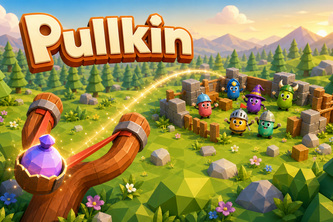
Pullkin is a self-reported physics-based puzzle game built by one developer (Antti P) using AI tools including ChatGPT, Codex, and OpenAI models. It is described as a slingshot-style game with procedural level generation, deterministic physics, and a comic narrative element. The project was submitted to the OpenAI 2026 hackathon.
What changed
The author reports that the original version was a single HTML file, which was later rebuilt into a modular architecture with golden-master tests for physics determinism and procedural level generation. AI tools were used extensively in concept, code generation, and asset creation.
Single most important open question
Is there any evidence of traction, revenue, or user engagement beyond the hackathon submission? The description does not indicate whether the game has been released publicly, monetized, or adopted by users.
What The Product Actually Is
The description states that Pullkin is a physics puzzle game where players launch creatures into levels filled with fragile structures, invisible forces, and predators. Players use projectiles to manipulate the environment and free trapped creatures. It includes:
- A slingshot-style interface
- Procedurally generated levels
- Deterministic physics simulation, modeled using Hooke’s law ($F = -kx$)
- A card draft system that introduces new tools per level
- A silent, hundred-level comic to guide storytelling
The game is described as being built with AI tools like ChatGPT and Codex, and the codebase was initially a 4,400-line HTML file before being modularized.
Claim: The product is a puzzle game combining physics and logic.
Evidence: Author’s own write-up.
Positioning & Claim Evolution
The author states that the goal was to create a game that is:
- Simple to understand but deep enough to engage adults
- Family-friendly, with no menus or explanations needed
- A blend of immediate fun and replayability
They also report two key lessons from development:
- Making physics predictable and trustworthy was more difficult than adding complexity.
- AI tools helped accelerate code development, but human direction remained essential for art.
Claim: The positioning is family-friendly, logic-based puzzle with physics mechanics.
Evidence: Author’s own write-up.
Target Customer & ICP
The description states that the game was designed to be enjoyed by the whole family, with a focus on:
- Simplicity for children
- Depth for adults
- No written instructions or menus
It is implied that the target audience includes families and casual gamers interested in puzzle games.
Claim: The ICP is family-oriented, casual puzzle gamers.
Evidence: Author’s own write-up.
Business Model & Pricing Evidence
There is no evidence of a business model or pricing strategy. The description does not mention monetization, subscriptions, in-app purchases, or any commercial structure.
Claim: No business model or pricing data provided.
Evidence: Not evidenced.
Technical & Delivery Signals
The project was built using:
- AI tools: ChatGPT, Codex, GPT-5.6
- Frontend tech stack: HTML5, CSS, JavaScript, TypeScript, Three.js, WebGL, Web Workers, Web Audio API
- Backend tech stack: Node.js, Firebase
- Development process:
- Original version: single 4,400-line HTML file
- Rebuilt into modular architecture
- Golden-master tests for physics determinism
- Procedural level generation with verification via headless simulation and lightweight solver
Claim: The game uses AI-assisted development and deterministic physics.
Evidence: Author’s own write-up.
Traction & Maturity Signals
There is no evidence of traction, revenue, or user adoption. The project was submitted to a hackathon and has not been publicly released beyond that context.
Claim: No traction or maturity data provided.
Evidence: Not evidenced.
Competitive Context
The description does not mention any competitors or market positioning relative to other puzzle games or physics-based games.
Claim: No competitive analysis provided.
Evidence: Not evidenced.
Open Questions & Risks
- The project is self-reported and unverified; no third-party validation of claims.
- No evidence of commercial viability, monetization, or user engagement.
- The game was built by a single developer (1 person team), which may signal scalability concerns.
- Heavy reliance on AI tools for development raises questions about long-term maintainability and intellectual property.
- The lack of revenue or customer data makes it difficult to assess product-market fit.
Inference: Lack of traction and commercial structure suggests early-stage, non-commercial project.
Evidence: Author’s own write-up.
Questions the description leaves open
- Has the game been released publicly beyond the hackathon?
- Are there any plans for monetization or user engagement metrics?
- What is the long-term vision for the product and team expansion?
- How does the deterministic physics model scale to more complex gameplay?
- What are the risks of relying on AI tools for development, especially in terms of maintainability and control?
Overall Assessment
There is no evidence of revenue, traction, or commercial viability beyond a hackathon submission. The project appears to be an experimental prototype built by one person using AI tools.
Inference: Not suitable for investment or partnership at this stage.
Evidence: Author’s own write-up.
User Stories BotA demo video on every pull request
Get a demo video on every new feature
GitHub App that watches your pull requests and records a narrated, captioned demo.
Save time on demo prep and make informed decisions faster with a video walkthrough of every new feature.
Source
Submitted to the OpenAI 2026 hackathon on Devpost. Project home on Devpost. Back to the full gallery on Devpost.
This competitive analysis was produced by top-founders.com (opens in a new tab)
Generated by a language model from this project's public Devpost page — its tagline, the author's own write-up and any built-with tags listed there — as captured in August 2026. Short quotations are the author's words. It is an opinion on the idea as a business, not on the people behind it, and it reflects the description as published then. If the project has moved on, request a correction below. The analysis is not independent research and contains no verified traction, revenue or customer data.
An independent guide by KFG International LLC — not affiliated with, endorsed by, or connected to Devpost or OpenAI.