

Archive position — measured, not model output
0 likes on Devpost
2,263 of the 7,850 archived projects have more likes, and 5,587 share exactly 0 — so this project's #6,161 place in the like-ranked listing is a tie-break inside that group, not a ranking.
Projects (log scale)
Likes on Devpost. ▲ marks this project's group.
Show the figures
| Likes | Projects | Share of archive |
|---|---|---|
| 0 | 5,587 | 71.2% |
| 1 | 1,758 | 22.4% |
| 2 | 284 | 3.6% |
| 3–4 | 132 | 1.7% |
| 5–9 | 75 | 1.0% |
| 10+ | 14 | 0.2% |
 User Stories BotA demo video on every pull request
Get a demo video on every new feature
GitHub App that watches your pull requests and records a narrated, captioned demo.
Save time on demo prep and make informed decisions faster with a video walkthrough of every new feature.
Executive Summary
What the company appears to be
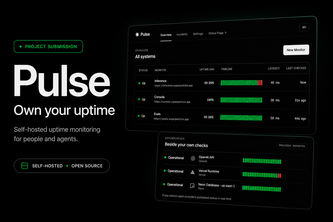
Pulse Uptime is a self-hosted uptime monitoring tool built by a single developer (Stephen Walker) for developers and hobbyist teams who want to monitor their own services and dependencies without paying for infrastructure. It integrates with 20+ provider status feeds, offers a CLI (pulsectl), and supports deployment on Vercel with minimal cost.
What changed
The project was built as part of the OpenAI 2026 hackathon, using AI tools like ChatGPT and Codex to shape its architecture and code. It is described as a minimal, secure, and performant uptime monitoring solution that runs entirely on free-tier infrastructure.
Single most important open question
Is there evidence of any real-world usage or feedback from users beyond the author’s own development experience?
Note
This analysis is based solely on the self-reported project description provided by the author. No independent verification, traction data, revenue figures, customer names, or third-party sources are available.
What The Product Actually Is
The description states that Pulse Uptime:
- Checks endpoints and confirms failures.
- Opens incidents when outages occur.
- Sends one clear alert per outage.
- Mirrors the published status of 20+ providers (e.g., OpenAI, Stripe, Vercel).
- Provides a public status page for each deployment based on live monitor state.
- Offers a typed API and CLI (
pulsectl) for automation and control. - Can be deployed in minutes using Vercel-native infrastructure.
- Uses Postgres-backed storage (Neon), Edge Config for reads, and Resend for alerts.
Inference: The product is described as a lightweight, developer-focused uptime monitoring tool that integrates provider status feeds into its own checks. It is built with minimal infrastructure overhead and designed to run on free tiers.
Claim
Pulse Uptime is an uptime monitoring system that combines self-checks with external provider status feeds.
Evidence Described in the “What it does” section of the author’s write-up.
Positioning & Claim Evolution
The author positions Pulse Uptime as:
- A tool for developers who want to monitor their own services and dependencies without paying for infrastructure.
- A self-hosted, easy-to-use, and visually pleasant uptime monitoring solution.
- A CLI-first tool that supports automation via agents (e.g., Codex).
- A hobbyist-friendly system that works on free tiers.
Inference: The positioning evolved from a personal need (downtime discovery) to a broader developer utility that includes dependency monitoring and agent integration.
Claim
Pulse Uptime is built for developers who want minimal-cost, self-hosted uptime monitoring.
Evidence Stated in the “Inspiration” and “What it does” sections of the write-up.
Target Customer & ICP
The description states:
- The tool is aimed at developers or teams who host their own services.
- It targets hobbyist developers who don’t want to pay for infrastructure.
- It supports deployment via Vercel, suggesting a developer audience familiar with modern cloud platforms.
- It includes a CLI and API, indicating use by automation scripts or agents.
Inference: The ICP is likely small-scale developers or DevOps engineers working in environments where cost-efficiency and self-hosting are priorities.
Claim
Pulse Uptime targets developers who want to monitor their own services and dependencies without paying for infrastructure.
Evidence Stated in the “Inspiration” and “How I built it” sections of the write-up.
Business Model & Pricing Evidence
The description states:
- The tool is designed to run on free tiers (e.g., Vercel Cron, Neon).
- It is built for hobbyist developers who do not want to pay for infrastructure.
- No pricing or monetization model is mentioned in the description.
Inference: There is no evidence of a business model or pricing structure. The tool is described as self-hosted and free-tier compatible.
Claim
Pulse Uptime is designed to run on free tiers, with no explicit pricing model.
Evidence Stated in “How I built it” and “Inspiration” sections.
Technical & Delivery Signals
The description states:
- Built with Go, Next.js, TypeScript, CSS, HTML.
- Uses Vercel-native infrastructure (Cron, Edge Config).
- Postgres-backed storage (Neon), with zero-database reads via Edge Config.
- Resend for alerts.
- No queues or workers; no servers to babysit.
- Storage stays within a configured budget by compacting routine checks into rollups.
- Checker validates DNS answers, pins sockets, refuses private ranges, caps provider feeds at 512 KB.
Inference: The tool is built with modern cloud-native practices and prioritizes performance, security, and minimal resource usage.
Claim
Pulse Uptime uses Vercel-native infrastructure and minimizes resource consumption.
Evidence Stated in “How I built it” section.
Traction & Maturity Signals
The description states:
- The project was submitted to the OpenAI 2026 hackathon.
- It was completed over a short time (4 days).
- No mention of users, customers, or real-world usage beyond the author’s own experience.
- The author intends to open it up to public feedback.
Inference: There is no evidence of traction or adoption. The project is in early development and has not yet been tested in production environments.
Claim
Pulse Uptime is a hackathon project with no demonstrated traction or user base.
Evidence Stated in the “Challenges I ran into” and “What's next” sections.
Competitive Context
The description does not mention any competitors. However, it implies that Pulse Uptime fills a gap for developers who want to monitor both their own services and dependencies without paying for infrastructure.
Inference: The product competes in the niche of lightweight, self-hosted uptime monitoring with dependency integration. It is not directly compared to existing tools like UptimeRobot or StatusCake.
Claim
Pulse Uptime is positioned as a lightweight, developer-focused uptime monitoring tool.
Evidence Stated in “What it does” and “Inspiration” sections.
Open Questions & Risks
- The project is described as a hackathon effort with no prior traction or user feedback.
- It is built by a single developer (Stephen Walker), raising questions about scalability, support, and long-term maintenance.
- No evidence of revenue, customers, or monetization strategy.
- The tool is designed to run on free tiers, which may limit its ability to scale or offer advanced features.
- The use of AI tools like Codex and ChatGPT for development raises concerns about code quality and maintainability.
Claim
Pulse Uptime lacks traction, scalability, and a clear path to monetization.
Evidence Inferred from the project’s early-stage nature and lack of user data or revenue information.
Questions the description leaves open
- What is the current status of public feedback or early adopters?
- Are there any plans for monetization or paid features beyond free-tier usage?
- How does Pulse Uptime handle edge cases like false positives or network-level issues?
- Has the tool been tested in production environments, and what are the results?
- What is the long-term roadmap for maintenance and feature development?
- Are there any plans to expand beyond Vercel-native deployment?
Note
These questions are based on the lack of evidence around traction, scalability, and monetization.
Overall Assessment
The description indicates that Pulse Uptime is a hackathon project built by one developer with no demonstrated traction or revenue. It is positioned as a lightweight tool for developers who want to monitor their services and dependencies without paying for infrastructure.
Inference: The project is in an early stage, lacks commercial evidence, and has not yet proven its value in the market. It may be suitable for early-stage investment if there is a plan to build a user base or monetize it, but currently, it does not meet criteria for a mature product or business.
Claim
Pulse Uptime is an early-stage project with no commercial traction or evidence of adoption.
Evidence Stated in “Traction & Maturity Signals” and “What's next” sections.
User Stories BotA demo video on every pull request
Get a demo video on every new feature
GitHub App that watches your pull requests and records a narrated, captioned demo.
Save time on demo prep and make informed decisions faster with a video walkthrough of every new feature.
Source
Submitted to the OpenAI 2026 hackathon on Devpost. Project home on Devpost. Back to the full gallery on Devpost.
This competitive analysis was produced by top-founders.com (opens in a new tab)
Generated by a language model from this project's public Devpost page — its tagline, the author's own write-up and any built-with tags listed there — as captured in August 2026. Short quotations are the author's words. It is an opinion on the idea as a business, not on the people behind it, and it reflects the description as published then. If the project has moved on, request a correction below. The analysis is not independent research and contains no verified traction, revenue or customer data.
An independent guide by KFG International LLC — not affiliated with, endorsed by, or connected to Devpost or OpenAI.