

Archive position — measured, not model output
0 likes on Devpost
2,263 of the 7,850 archived projects have more likes, and 5,587 share exactly 0 — so this project's #6,160 place in the like-ranked listing is a tie-break inside that group, not a ranking.
Projects (log scale)
Likes on Devpost. ▲ marks this project's group.
Show the figures
| Likes | Projects | Share of archive |
|---|---|---|
| 0 | 5,587 | 71.2% |
| 1 | 1,758 | 22.4% |
| 2 | 284 | 3.6% |
| 3–4 | 132 | 1.7% |
| 5–9 | 75 | 1.0% |
| 10+ | 14 | 0.2% |
 User Stories BotA demo video on every pull request
Get a demo video on every new feature
GitHub App that watches your pull requests and records a narrated, captioned demo.
Save time on demo prep and make informed decisions faster with a video walkthrough of every new feature.
Executive Summary
The company appears to be a single-person project (Mohamed Mostafa) building an AI-powered clinical assistant for cardiac arrest teams. The author states this is a hackathon submission for the OpenAI 2026 hackathon, built with Codex and various AI tools including GPT-5.5 and GPT-5.6. It is described as a deterministic system that listens during cardiac arrest and maintains clinical state without using LLMs in the clinical loop.
What changed
The project description shows an evolution from a raw idea (a cardiologist's frustration with cognitive load during resuscitation) to a technical implementation involving speech recognition, state machines, and multilingual processing. It is not evidenced that this has moved beyond a hackathon prototype or gained any traction.
The single most important open question
Is there evidence of clinical validation or real-world deployment? The description states the author is a cardiologist but does not show any clinical testing, regulatory approval, or adoption by medical institutions.
What The Product Actually Is
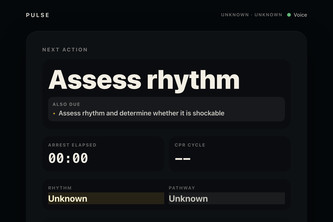
- The description states Pulse is an AI teammate that listens during cardiac arrest
- It maintains clinical state by processing spoken phrases from the resus room
- Spoken evidence becomes clinical events that advance a deterministic state machine
- The system shows team leaders what's true right now and what's due next
- It handles real-world speech including code-switched Egyptian Arabic
- The system is described as having no LLM in the clinical loop, with LLMs only used for speech recognition
- It includes features like CPR clock, rhythm tracking, shock count, medication timeline, and audit trail
- Built with FastAPI + Pydantic backend, Next.js + TypeScript frontend, pluggable speech recognition
Positioning & Claim Evolution
- The description states the author is a cardiologist who was inspired by the cognitive load during cardiac arrest
- The product is positioned as solving the problem of team leaders tracking multiple variables simultaneously
- It claims to be deterministic rather than probabilistic, with no LLM in the clinical loop
- The evolution shows from a general idea (team leader gets tired and loses count) to a specific technical solution (deterministic state machine)
- The author states they wrote a "constitution" for the agent that fixes boundaries it cannot cross
- The positioning is described as solving a real clinical problem rather than being a generic AI tool
Target Customer & ICP
- The description states the target customer is cardiac arrest teams in hospitals
- It specifically mentions the "Cairo resus room" and Egyptian Arabic speech patterns
- The author identifies as a cardiologist, suggesting they are targeting fellow medical professionals
- No evidence of specific hospital partnerships or institutional adoption
- Not evidenced: whether this targets emergency medical services, training institutions, or other healthcare settings
Business Model & Pricing Evidence
- Not evidenced: any business model, pricing structure, or monetization strategy
- The description states this is a hackathon submission with no revenue or customer data
- No evidence of subscription models, licensing fees, or institutional pricing
- No evidence of B2B or healthcare market positioning beyond the clinical use case
Technical & Delivery Signals
- Built with Codex across GPT-5.5 and GPT-5.6 sessions
- Backend: FastAPI + Pydantic, frontend: Next.js + TypeScript
- Uses pluggable speech recognition with offline capability
- Includes deterministic state machines, evidence fusion layer, multilingual normalization
- Has confirmation policy and audio pipeline components
- Features include: CPR clock, rhythm tracking, shock count, medication timeline, audit trail
- The system is described as runnable offline with deterministic fake ASR
- The architecture decision states there's no language model in the clinical loop
- Includes testing with replays of real recorded clinician speech
- Addresses challenges like silence hallucination and echo duplication
Traction & Maturity Signals
- Not evidenced: any traction, revenue, customers, or adoption metrics
- This is described as a hackathon submission (OpenAI 2026)
- No evidence of product-market fit, user feedback, or iterative development beyond the single prototype
- No evidence of clinical validation, regulatory approval, or deployment in real hospitals
- No evidence of team growth, funding rounds, or market expansion plans
Competitive Context
- Not evidenced: any competitive landscape or existing solutions in this space
- The description states that current tools record what happened but don't understand what's happening
- No evidence of competitors, market size, or differentiation from existing medical technology
- No evidence of regulatory environment or compliance requirements for similar products
- The author mentions the "code-switched Egyptian Arabic" as a unique challenge, suggesting this may be a niche application
Open Questions & Risks
- Single-person development: Only one team member (Mohamed Mostafa) is mentioned
- No clinical validation: No evidence of testing with actual medical professionals or institutions
- Hackathon prototype: This is described as a hackathon submission, not a developed product
- Unverified claims: The description states it's self-reported and unverified
- Regulatory risk: Medical applications require extensive validation that's not evidenced here
- Technical challenges: The system addresses issues like silence hallucination and echo duplication, suggesting complexity in real-world speech processing
- Market risk: No evidence of market demand or institutional adoption beyond the author's personal experience
Questions the description leaves open
- What clinical validation has been performed with actual medical professionals?
- How does this system handle edge cases not covered in the current implementation?
- What is the regulatory pathway for medical device deployment?
- Are there any partnerships or pilot programs with hospitals or medical institutions?
- How does the system handle different accents, dialects, and speaking patterns beyond Egyptian Arabic?
- What are the specific technical challenges that remain unresolved?
- How would this system be integrated into existing hospital workflows?
- What is the timeline for moving from prototype to clinical deployment?
Overall Assessment
Not evidenced Any investment or partnership opportunity.
The description states this is a hackathon submission with no revenue, customers, or traction data. The author is a single person (Mohamed Mostafa) and there's no evidence of team growth, funding, or market validation. The product appears to be a technical prototype addressing a specific clinical problem rather than a commercial product. No evidence suggests this has moved beyond the idea stage or gained any institutional adoption. The description itself states it is unverified and self-reported, with no third-party corroboration.
User Stories BotA demo video on every pull request
Get a demo video on every new feature
GitHub App that watches your pull requests and records a narrated, captioned demo.
Save time on demo prep and make informed decisions faster with a video walkthrough of every new feature.
Source
Submitted to the OpenAI 2026 hackathon on Devpost. Project home on Devpost. Back to the full gallery on Devpost.
This competitive analysis was produced by top-founders.com (opens in a new tab)
Generated by a language model from this project's public Devpost page — its tagline, the author's own write-up and any built-with tags listed there — as captured in August 2026. Short quotations are the author's words. It is an opinion on the idea as a business, not on the people behind it, and it reflects the description as published then. If the project has moved on, request a correction below. The analysis is not independent research and contains no verified traction, revenue or customer data.
An independent guide by KFG International LLC — not affiliated with, endorsed by, or connected to Devpost or OpenAI.